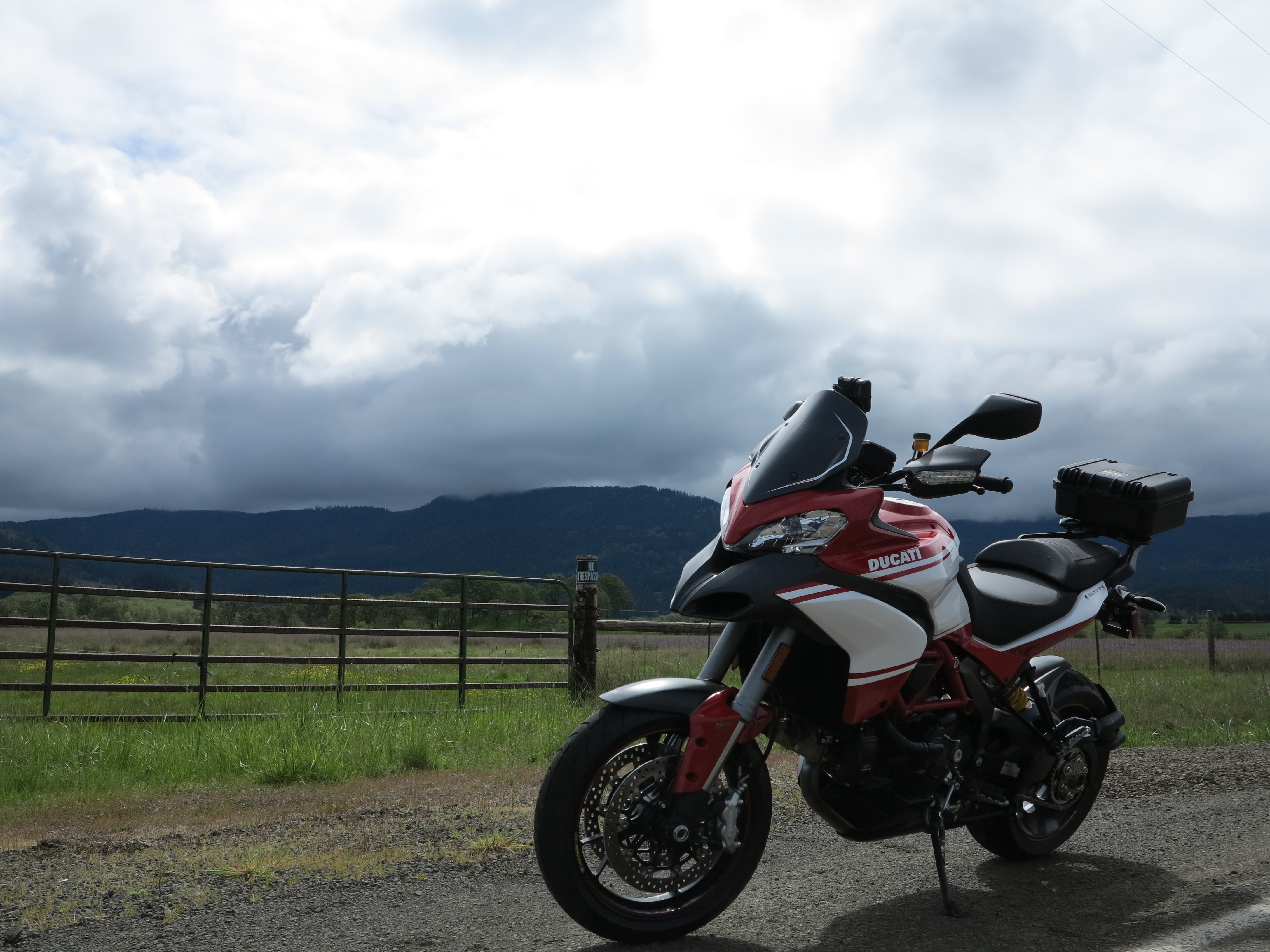
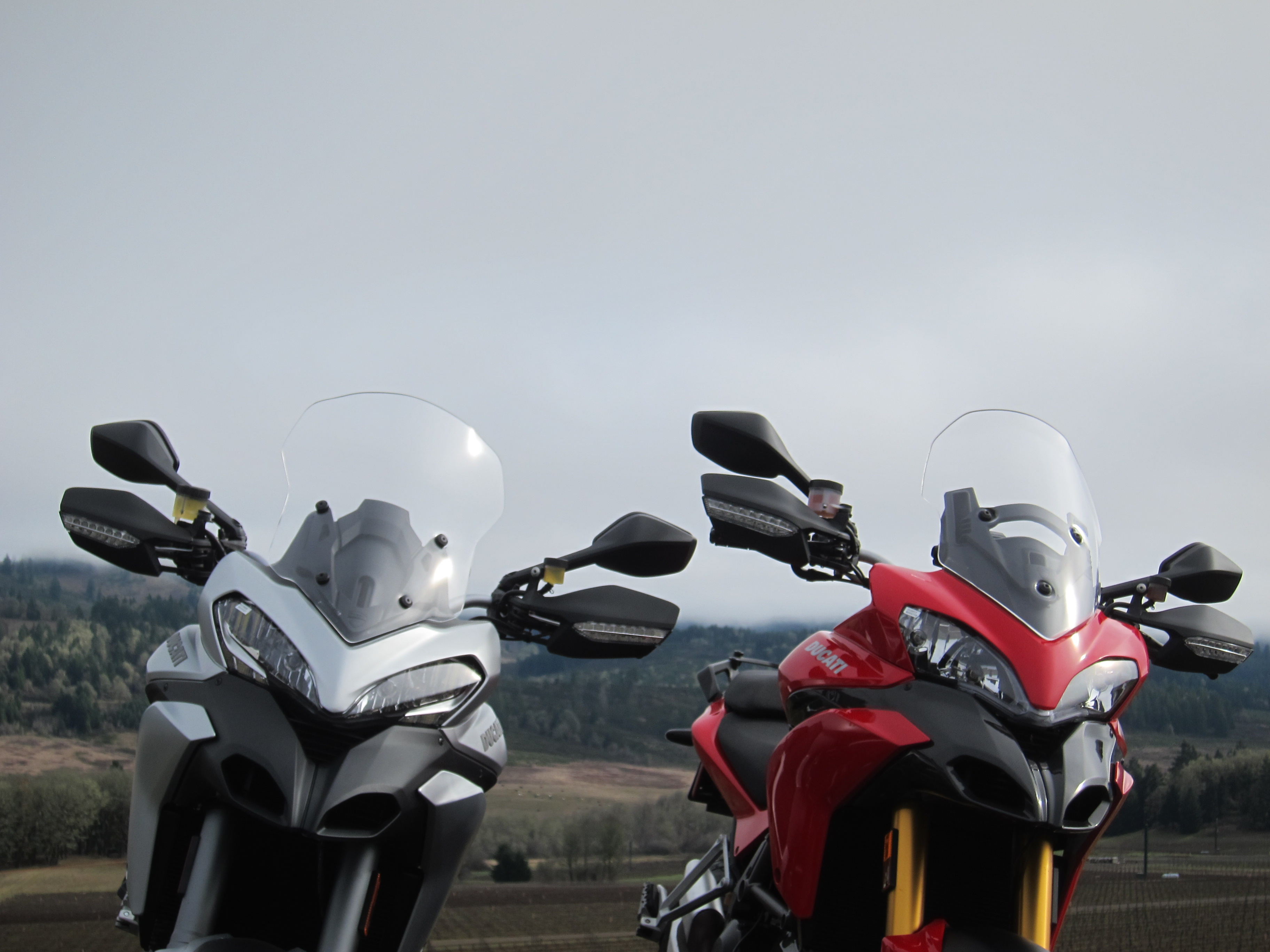
Checking the Spruce Goose in McMinnville

I always liked airplanes. I loved when my parents took me to the local airport in Porto Alegre when I was growing up.  The photo below is from the Aeroporto Internacional Salgado Filho (Salgado Filho International Airport) in Porto Alegre.  Although the photo is from before my time, and the airport had a few changes done to it by the time I frequented it, the main structure remained intact. In fact, Porto Alegre has a new airport, but this old airport, with some expansions and the typically unfortunate remodeling done to it, remains as a terminal to the new airport.

Aeroporto Internacional Salgado Filho, Porto Alegre. Photo from 1955

Aeroporto Internacional Salgado Filho, Porto Alegre. Photo from 1955

The airport had a café and observation deck on its second floor, the top floor on the wing to the left of the air traffic control tower as seen on the photo above. That was my favorite part of the airport. From there I would stand at the edge of the rail and would watch  planes landing and taking off.  I also enjoyed looking at the patio, watching with attention the planes arriving at the gate and all the action that took place to get the plane ready for passengers to deplane, and then getting the planes ready for boarding for a next flight. I was always wondering where the people came from, where they were going. I always wanted to be on a flight, going somewhere, the location was not important, being in a plane was.  Another focus of my attention while at the airport was a large mural on one wall of the terminal, depicting aviation themes, titled the “Conquest of Space.” I used to spend time observing that mural, painted by internationally known local artist Aldo Locatelli.

Aldo Locatelli's Mural, in Porto Alegre's old airport.

Aldo Locatelli’s Mural, in Porto Alegre’s old airport (photo borrowed from the internet).

Aviation lost the glamour it had in the 60’s when it jump started my travel dreams.  Today it is mostly an efficient conveyor belt of passengers and cargo to everywhere in the world. However, I still like airplanes and traveling by plane as much as did in my first flight when I was 12, on a Boeing 737 on a short flight between Montevideo, Uruguay and Buenos Aires, Argentina.  My job of the last 15 years takes me to many places in the United States and to pacific islands, allowing me to enjoy the flying experience often.

Just yesterday I had dinner with my friend Doug and he was talking about taking flying lessons, checking my interest in joining him on flying lessons. At one point when I was in high school I wanted to be a commercial airline pilot. On a student job fair at my high school I managed to get the local airline, VARIG, among other materials and brochures, to lend me a cutout of an actual airplane turbine that was placed as part of my exhibit of what were the steps to start an airline pilot career (VARIG was known to have a top-tier pilot training program in Porto Alegre). They even delivered and installed it.

I did not become a pilot but eventually I did fly a plane for a short while here at the Columbia Gorge, with a friend who was building hours to get her instructor’s license. Based on that experience I told Doug I like better the motorcycle riding experience, the flying close to the ground feeling I get when riding. The reactions to commands are faster and precise, I get a better feel for the speed, it seems I’m going faster in the motorcycle than I was in the plane. The motor sounds and the vibration experience are better in the motorcycle. It is interesting that I like flying, but if I have the chose between flying or riding, riding wins by a great margin. But it was connecting these two passions, airplanes and riding, that leads me to this post of my trip to visit the Evergreen Aviation Museum in McMinnville, Oregon, on May 5th, 2013.  The main goal was to check the Spruce Goose, a remarkable airplane, one of the milestones in the history of aviation despite being flown only once and for only a short mile, barely off the ground (water, actually) at a 70ft maximum altitude. The bike of choice for this excursion was the Multistrada.

Getting the Multistrada Ready for Another Adventure. May 5th, 2013

Getting the Multistrada Ready for Another Adventure. May 5th, 2013

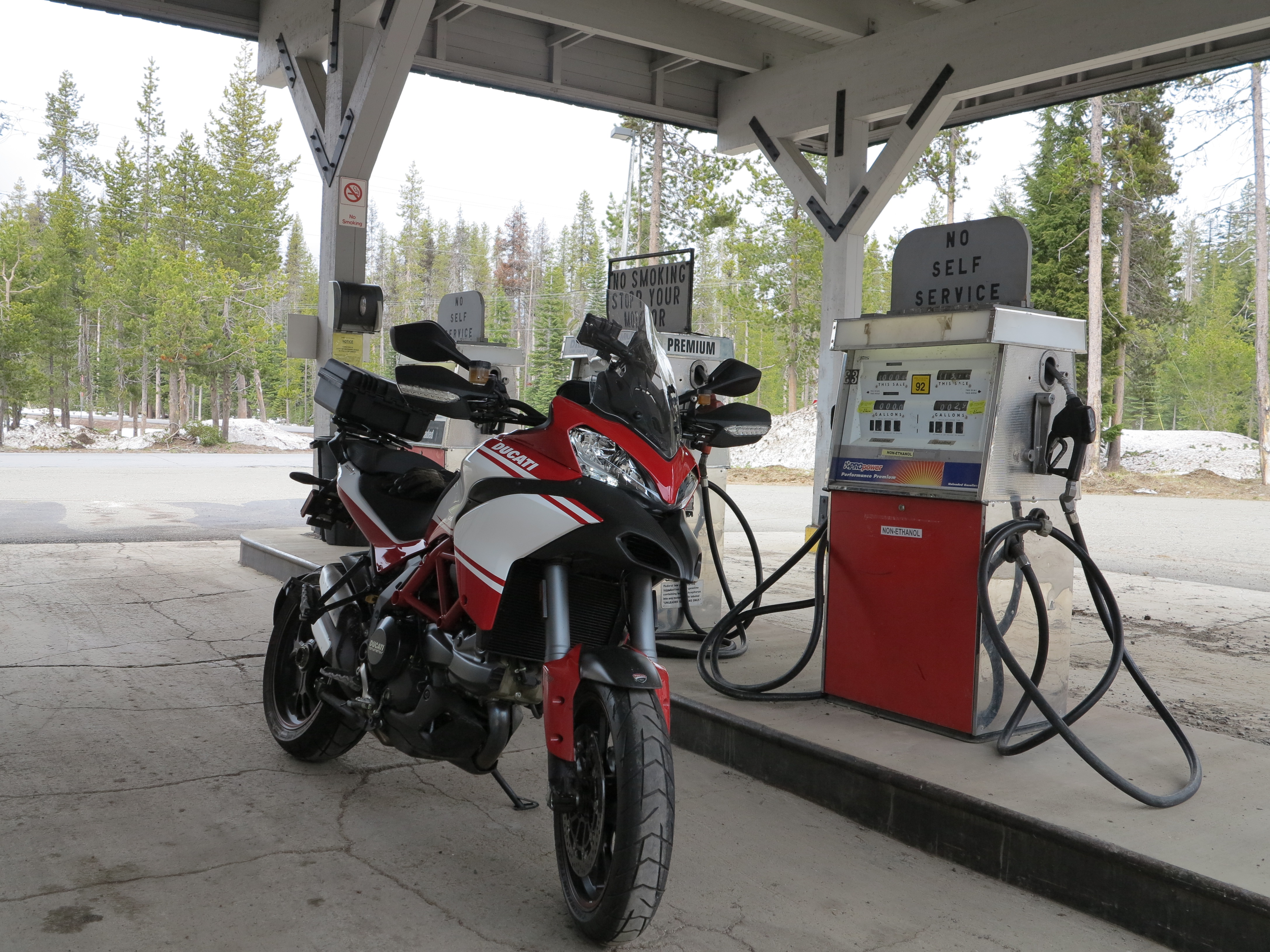
It was going to be a warm day. It was as if we went from Winter to Summer in one week. I knew it was going to be a long day, so the plan was to start as early as possible, let’s say leave by 8:00 am, I deliberated with myself.  And as it is usual with my motorcycle trips, It took me a while longer to leave the house. It was after 9:00 am when my trip started. I took the back roads north until I connected to the Valley of the Kings Road, after my pit stop for non-ethanol gas in Philomath.  Then a short stop in Dallas, Oregon.

The man and his machine. Dallas, Oregon. May 5th, 2013

The man and his machine. Dallas, Oregon. May 5th, 2013

I had been to McMinnville before, but had forgotten how this old town remains up-to-date but mostly intact with its old format. It seems it remains viable today, with a nice downtown area with tree-lined streets, with stores and restaurants and what it seemed like a critical mass of cars and people. I am not sure but it seems to me that it remains viable for its local population, with benefits from tourism, mostly because of its proximity to Portland, and from keeping the downtown area mostly unchanged.

McMinnville, OR. May 5th, 2013

McMinnville, OR. May 5th, 2013

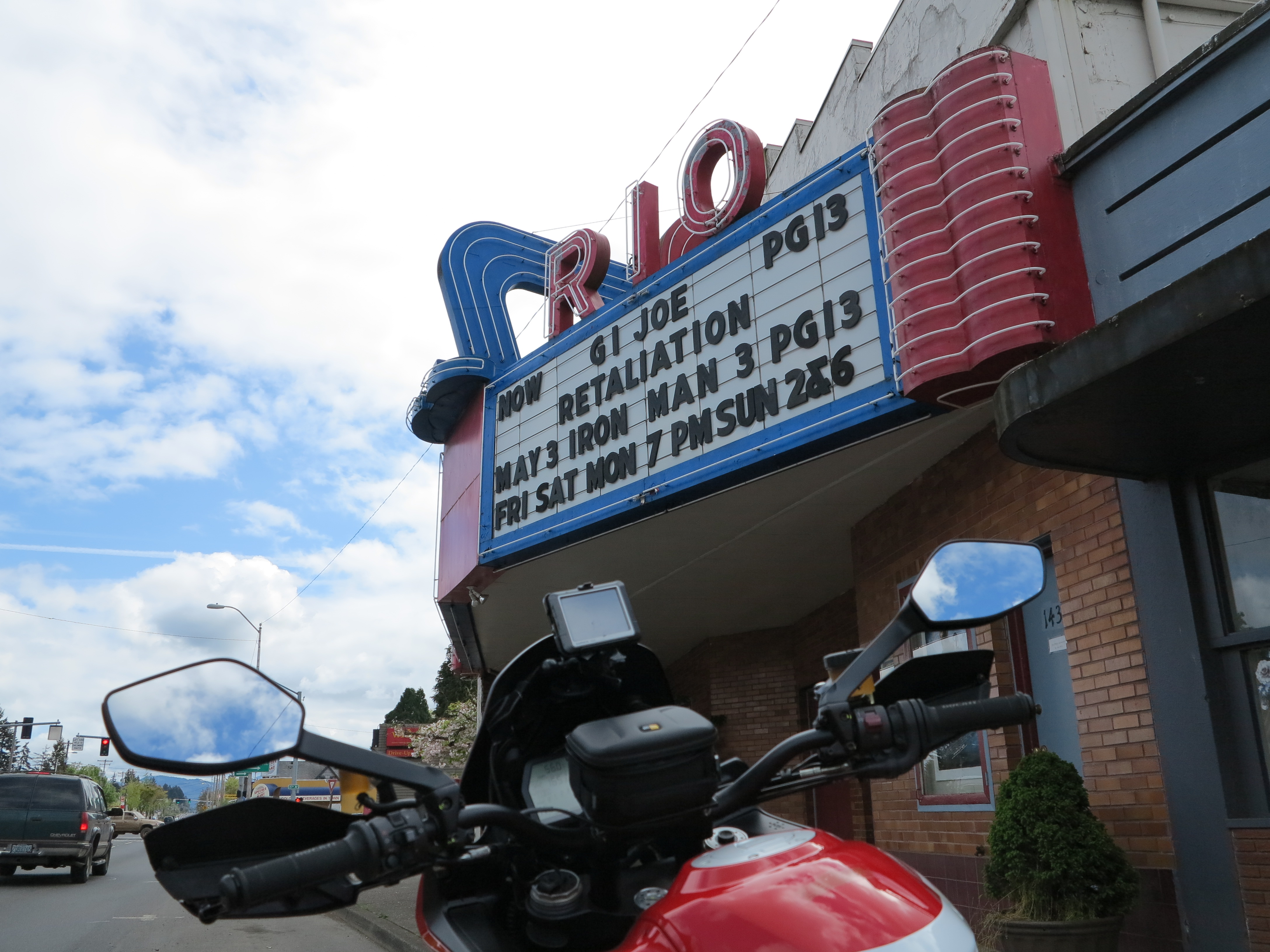
They also have their art deco movie theater.  It seems the Mack Theater still works as a movie theater. Perhaps it benefited from the Save American Cinemas movement, like the Rio theater in the town of Sweet Home, as I described on my post of a few weeks back.

Movie Theater, McMinnville, May 5th, 2013

Movie Theater, McMinnville, May 5th, 2013

The Evergreen Aviation Museum is not too far from downtown McMinnville. And it is difficult to miss it since one of the three main buildings has a 747 parked on top of it, posing in what seems like a take off position.

Boeing 747 on top of building, Evergreen Aviation Museum. McMinnville, OR. May 5th, 2013

Boeing 747 on top of building, Evergreen Aviation Museum. McMinnville, OR. May 5th, 2013

As I walked towards the building housing the Spruce Goose, where you will also find other pre-1960’s airplanes, I saw this Douglas C-47 parked just outside the building.  These planes played an important role carrying soldiers and cargo in the WWII. And its passenger version, the famous DC-3, played a significant role in commercial aviation. But this airplane reminded me of something else,which distracted me from the Spruce Goose.
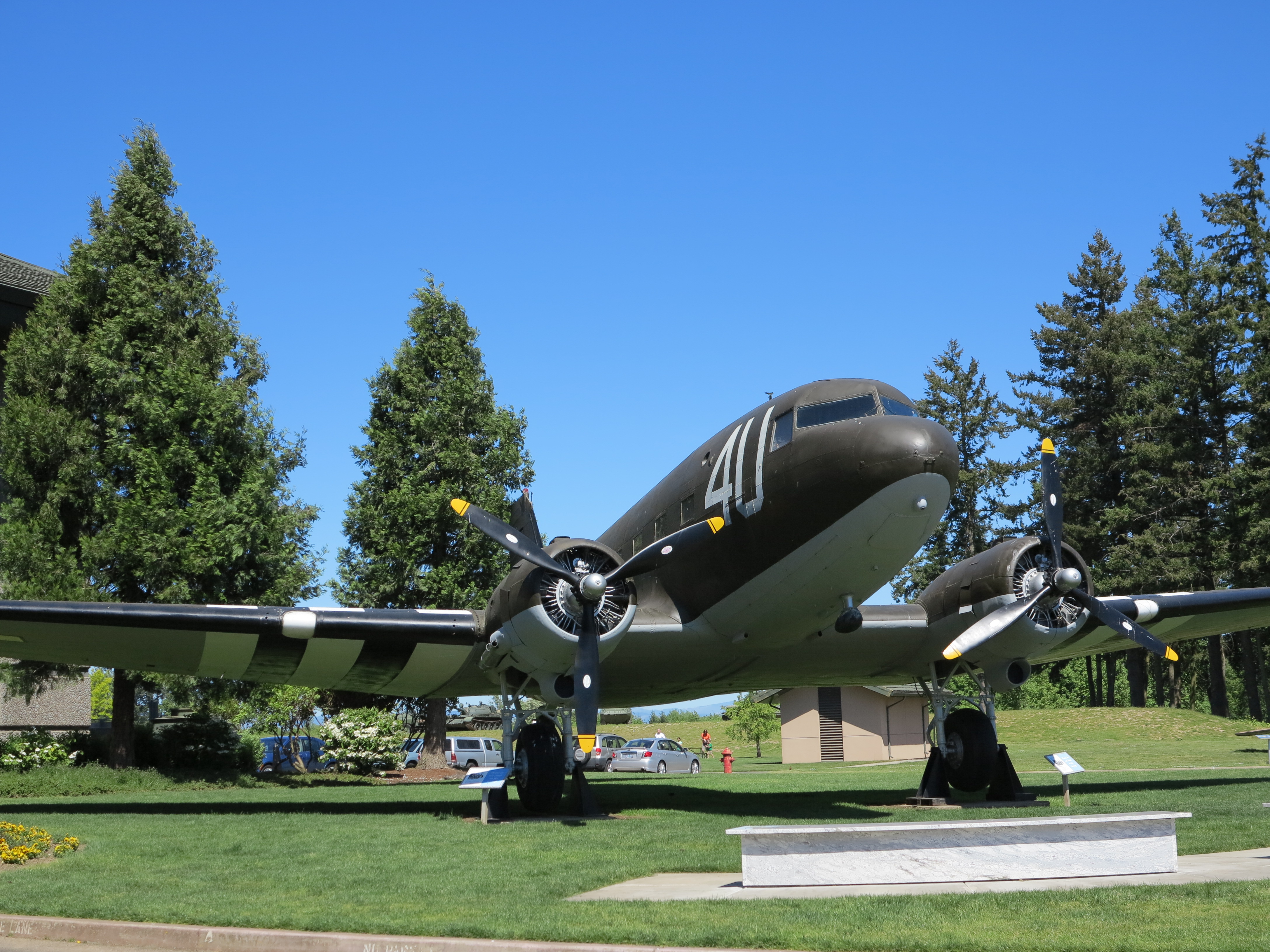
C-47 at the Evergreen Aviation Museum. McMinnville, OR, May 5th, 2013

C-47 at the Evergreen Aviation Museum. McMinnville, OR, May 5th, 2013

My mother had two older sisters, I never met the older one. In 1957 my mother’s older sister, Therezinha de Leão Lemiszek, who already had three children at that time, flew from Porto Alegre to Bagé, which is 380 km (236 miles) south of Porto Alegre, at the border between Brazil and Uruguay. Both towns are in the state of Rio Grande do Sul, in the pampas, the only gaucho area in Brazil.  She went to Bagé to visit her younger sister, my Aunt Gisela, who had just had a baby. On the way back from Bagé to Porto Alegre, the plane she was traveling, a VARIG airlines Curtiss C-46, crashed near the Bagé airport, killing all 40 passengers and crew on board.

ACCIDENT DETAILS

Date:

April 07, 1957

Time:

?

Location:

Bage, Brazil

Operator:

Varig

Flight #:

?

Route:

Bagé – Porto Alegre

AC Type:

Curtiss C-46A-45-CU

Registration:

PP-VCF

cn / ln:

30283

Aboard:

40   (passengers:35  crew:5)

Fatalities:

40   (passengers:35  crew:5)

Ground:

0

Summary:

Shortly after takeoff, a fire developed in the left main landing gear well. The pilot thought the fire had started in the engine, feathered the No.1 engine and returned for an emergency landing. When he couldn’t get the gear down, he performed a go-around after which the left wing separated from the plane. The plane crashed and burned. Fracture of the fuel line in the landing gear housing due to wear against the ribs.

My uncle, Gisela’s husband, had taken my aunt Therezinha to the airport in Bagé. He waited until the plane took off and saw the incident. Either that or he heard about it on the radio and turned around, rushing back to the airport. What I have heard from family stories is that he drove his 4 x 4, which I believe was a Land Rover at that time, all the way to the crash site.  In fact, if my memory of the account is correct, he was the first at the crash site and located my aunt who was already dead at that time.

VARIG Curtiss C-46

VARIG Curtiss C-46

Meanwhile, my other uncle, the husband of Aunt Therezinha, heard the news about the crash when he got to the Porto Alegre airport to pick her up. At that moment VARIG was getting a plane ready to go to the crash site to manage the situation and investigate the accident. My uncle was an Engineer and somehow made his way into that plane. People on the plane thought he was a VARIG engineer, and only found out he was a relative of one of the victims during the flight to Bagé.

VARIG Curtiss C-46 Commando

VARIG Curtiss C-46 Commando

I may have some of the story points mixed up, information is missing, but I know the two facts about my two uncles, husbands of my mother’s older sisters: one was at the crash site, the other flew to Bagé with the group of VARIG’s staff that went to manage the crash site and investigate the crash.  By the way, VARIG stands for Viação Aérea RioGrandense, or Rio Grande do Sul Airlines.  This airline started in my state and became the largest commercial airline in Brazil until its demise, about 10-15 years ago. I flew a VARIG Boeing 747 on my first trip to the United States in 1987, landing at JFK on my way to start my studies at the Ohio State University.

The museum didn’t have a Curtiss C-46 on the exhibit.  But of similar vintage and purpose, besides the C-47 parked outside, they had a DC-3 inside.

DC-3 at the Evergreen Museum, McMinnville, OR. May 5th, 2013

DC-3 at the Evergreen Museum, McMinnville, OR. May 5th, 2013

That was an interesting diversion from my original goal for this trip.  I’m glad it took me to research more about that accident, including its registry. Back to my original intent for this trip, what about that Spruce Goose? I could not miss it, this thing is really a gigantic beast.  My camera did not have  a lens wide enough to capture the entire plane in one shot from within the confines of the building.
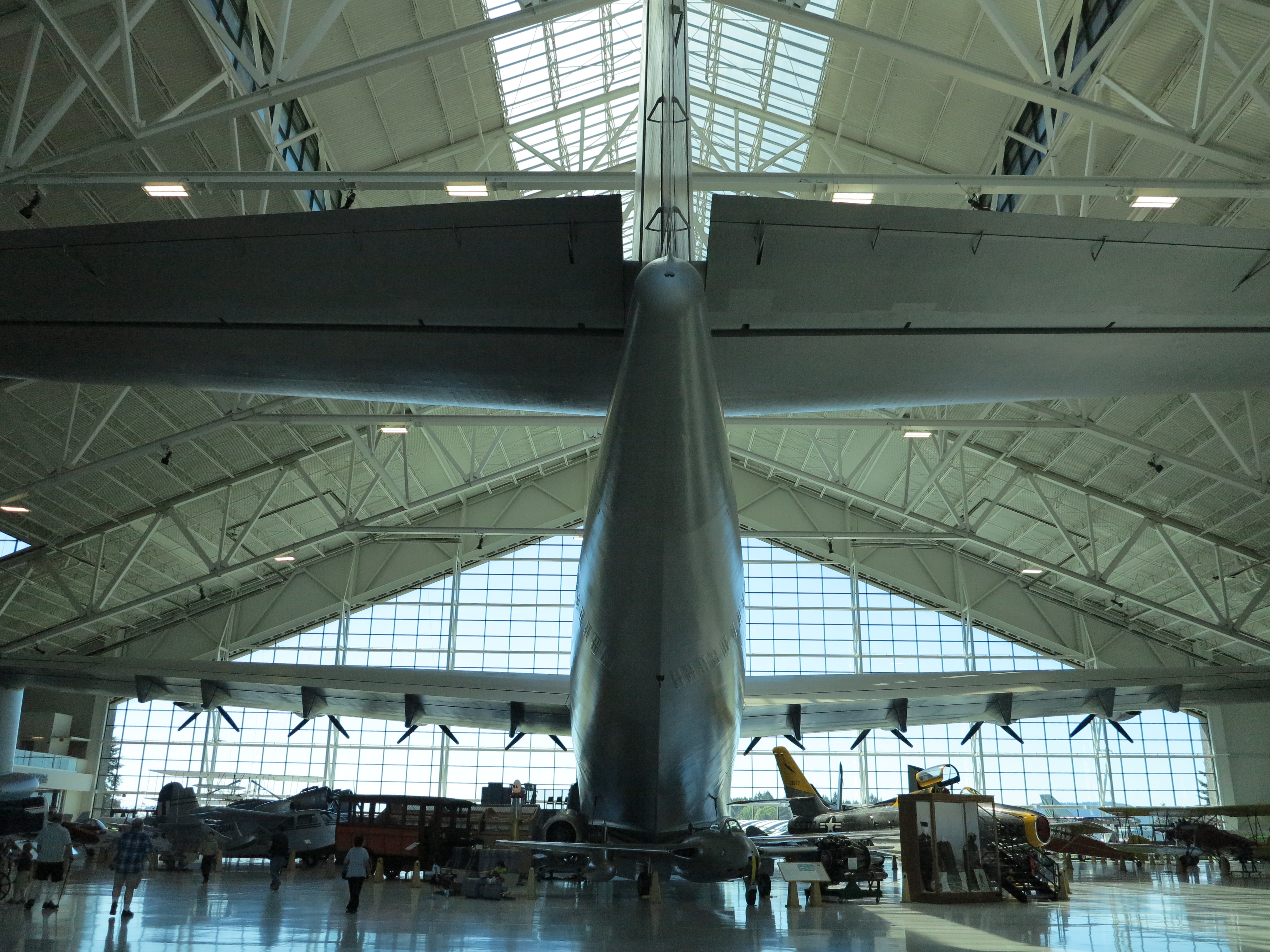
The Spruce Goose at the Evergreen Aviation Museum

The Spruce Goose at the Evergreen Aviation Museum

This entire building of the museum is a hanger for the beast. Many of the smaller aircraft in the exhibit are parked under its wings.

The Spruce Goose at the Evergreen Aviation Museum

The Spruce Goose at the Evergreen Aviation Museum

Below is a photo taken inside the beast, looking at the tail end of the plane, with a human figure to give an idea of scale.

The tail of the Spruce Goose, with a human figure to give an idea of the dimensions of this beast.

The tail of the Spruce Goose, with a human figure to give an idea of the scale and the dimensions of this beast.

This airplane was a result of a commission by the U.S. government to the Hughes Aircraft Company to build a large flying boat capable of carrying men and materials over long distances, after the US entered the WWII, in 1941.  Check here for an account of the story of this plane, and of the only time it flew from the LA Times.  It remains a tribute or maybe a reminder, to the fine line between audacity and stubbornness, or between perhaps courage and eccentricity. Howard Hughes, the designer and owner of Hughes Aircraft Company could be placed either on the audacity or eccentricity sides of this spectrum.
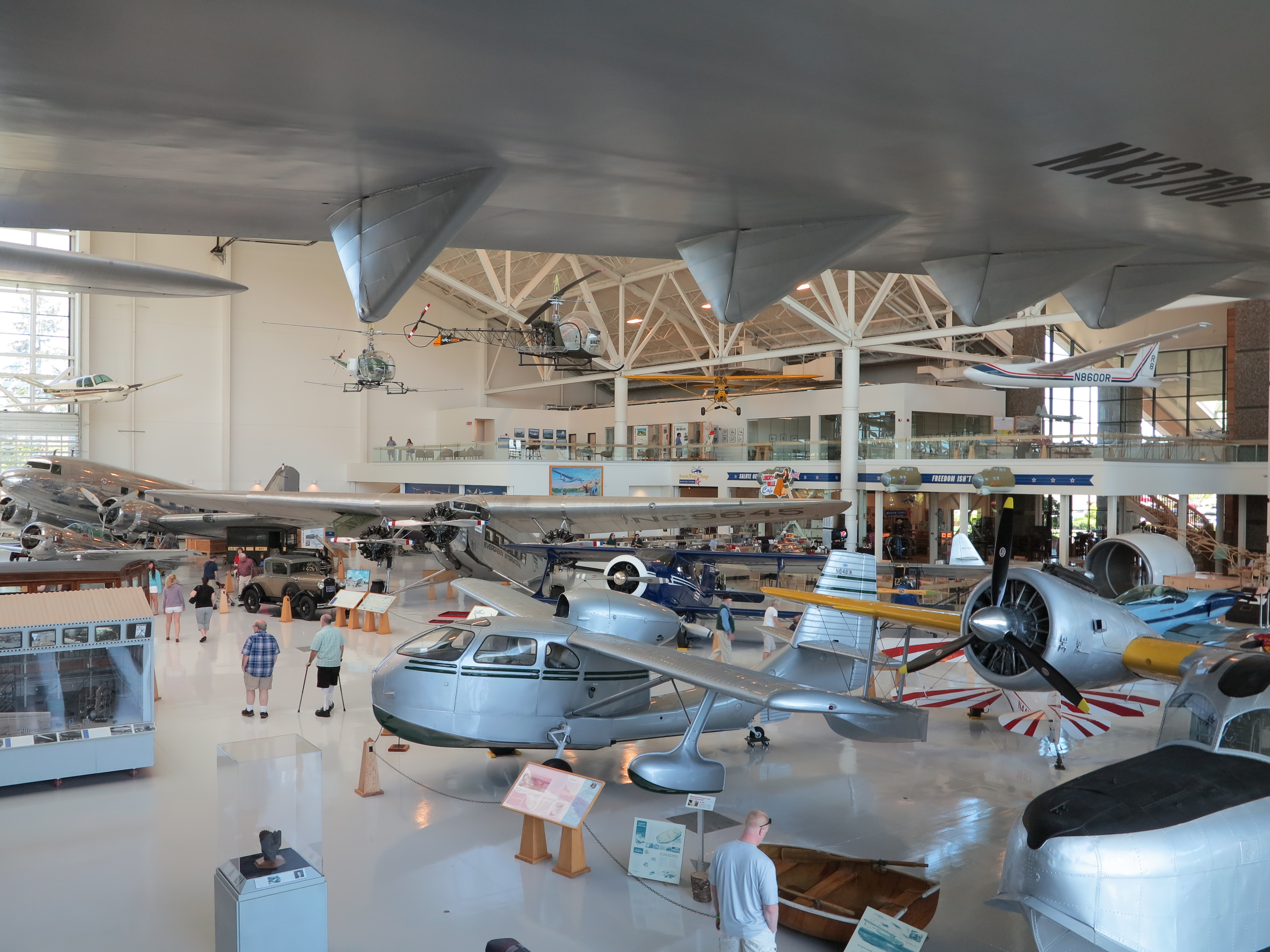
Many planes fit under the wings of the Spruce Goose

Many planes fit under the wings of the Spruce Goose

Time was flying, so I got back to my bike, studied the map briefly and took off towards the coast, the long way south toward my house.

The bike in front of the Evergreen Aviation Museum

The bike in front of the Evergreen Aviation Museum

I took Hwy 18 towards the coast. Just when I was getting close to Grand Ronde, just about passing half way to get to Lincoln City from McMinnville, I got on a traffic jam. That’s when motorcycle filtering would have helped tremendously. Instead, by Oregon law, I was there on the hottest part of the day, sitting on stop-and-go traffic in the middle of nowhere.  After some 20 minutes or more of this nonsense I took my chances and carefully drove on the berm of the road for a few hundred yards until I found my way to an alternate route, via Hwy 22 and eventually the little Nestucca Hwy toward the coast.

I was enjoying my ride on a new road to me, nice curves on a rather narrow old road. I slowed down to get on a one-lane bridge when a sport bike of the Japanese variety (in-line 4 sound was practically all I’ve noticed) flew by me.  This guy was really going fast and caught me completely by surprise!

I continued and after a short while I came upon a group of bikes, six or seven, going slower than me, mostly cruisers. As I generally do, I stayed behind them waiting for an opportunity to pass all of them in one move.  I kept my distance, enough distance to make a move when the opportunity arrived and not being too close to the last guy. And this went on for a couple of miles.  At some point, on a tighter left hander, I noticed their speed was quite good, but maybe too fast for such a tight curve.  I kept paying attention to their last rider directly ahead of me.  I was thinking this guy was going to run out of room as he would need to lean more if he would keep pace of the others, he did not slow down his cruiser.  I started slowing down. And bam!, I saw it coming, his pegs hit the ground and he starts losing real estate pretty quickly.  But this guy was good. Somehow he saved it, going off the road, I imagine the crash, but he kept riding on the gravel outside of the curve, where there wasn’t much more than a few feet before he would hit trees or fall on a ditch. He never stopped, he found his balance, got back on the road, looked down to check the left peg, and kept going as if nothing had happened. Kudos for the guy!

Soon we hit some flats, we were already close to the coast, and I managed to pass all the bikes in one move.  I joined Hwy. 101 several miles north of Lincoln City.

The bike at the coast, somewhere on 101 close to Lincoln City. May 5th, 2013

The bike at the coast, somewhere on 101 close to Lincoln City. May 5th, 2013

I was hoping for some relief from the heat, which is generally the case on the coast, but it was not the case this time. The ocean was uncharacteristically blue, not too much wind, temperature was reading 89 at the bike’s thermometer.  It felt as if I was in South California.

Somewhere near Lincoln City. May 5th, 2013

Somewhere near Lincoln City. May 5th, 2013

However, as I continued south on 101 I noticed a significant wind change. Wind started blowing from the south and south west and the temperature started a radical move to the lower part of the thermometer. From 89 it got as low as 59 by the Heceta Lighthouse, 30 degrees in less than 40 miles. Fog set in and the ocean water changed from blue to gray to greenish/brown. I had never seen such a quick change, so radical in terms of temperature and Ocean water.

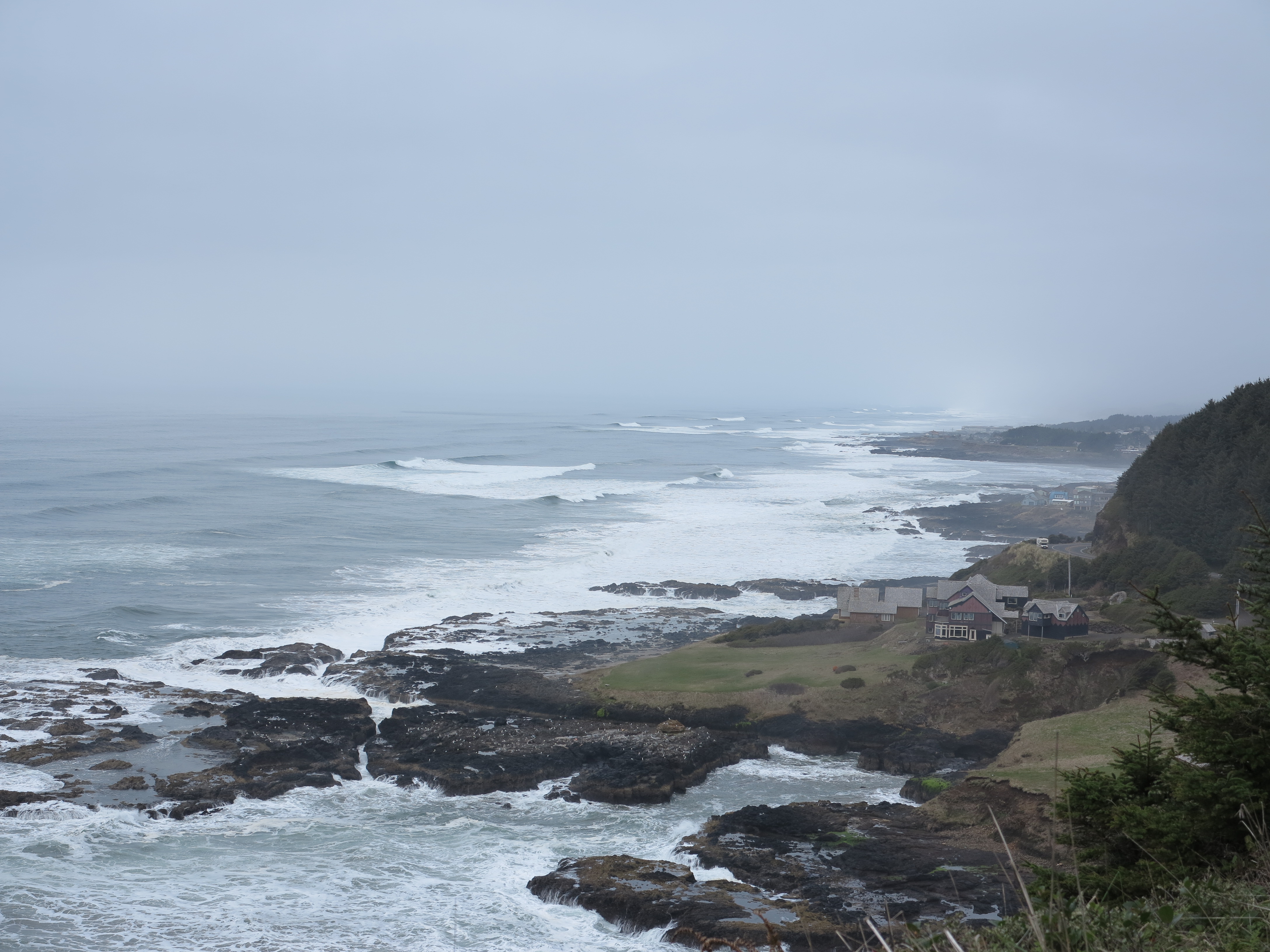
Same day, different look on the ocean. Heceta Lighthouse, May 5th, 2013

Same day, different look on the ocean, fog setting in. Heceta Lighthouse, May 5th, 2013

And as I continued south and arrived in Florence the weather cleared and the temperature was a bit warmer than 59. By the way, I was just about running out of gasoline.  The traffic jam, the long detour and the wind change were all conspiring against my plan to ride to Florence for a non-ethanol gasoline gas station.  But somehow I managed to ride 205 miles in one tank, made it to the gas station with 5 miles to spare according to the bike’s computer.
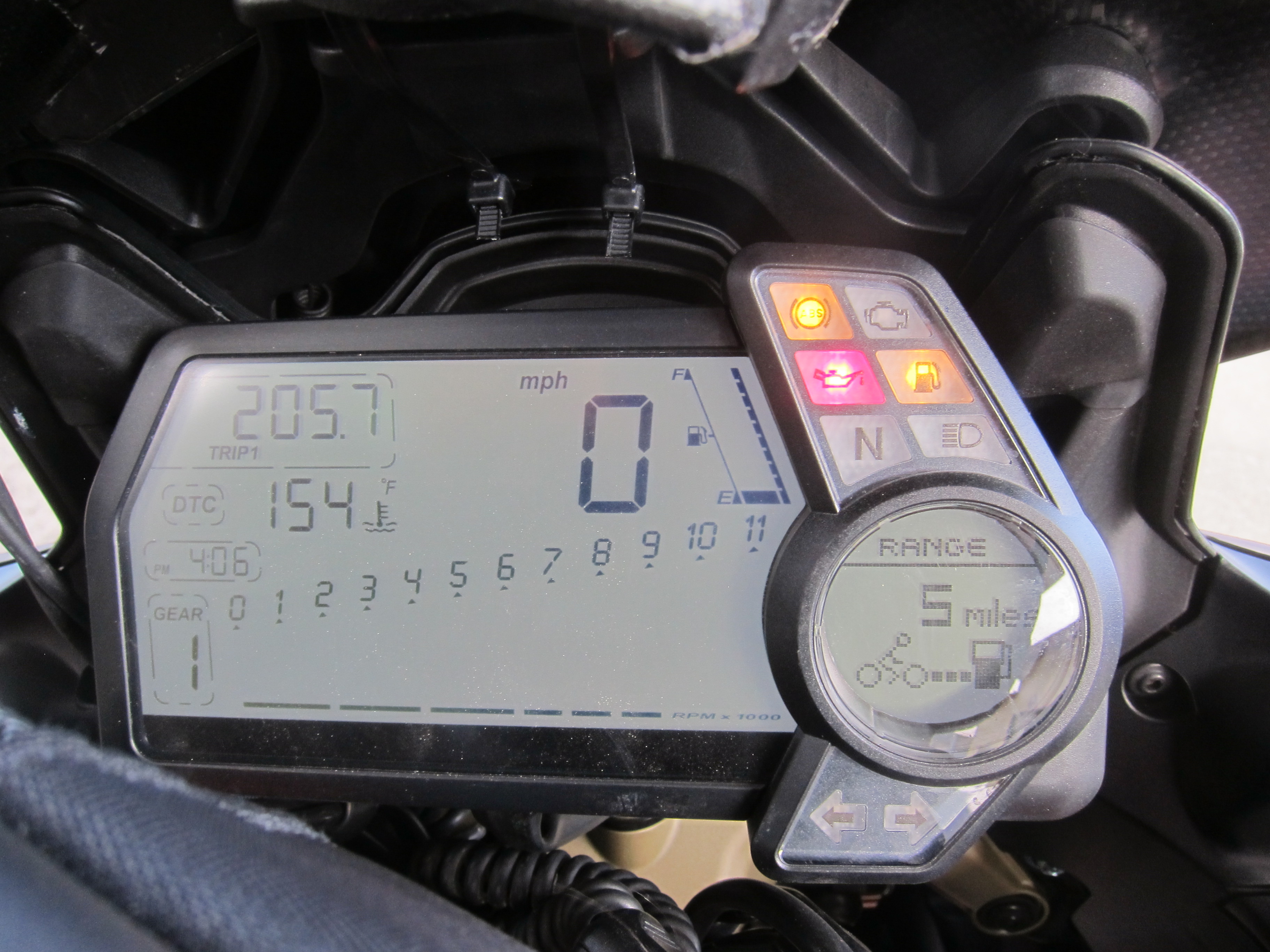
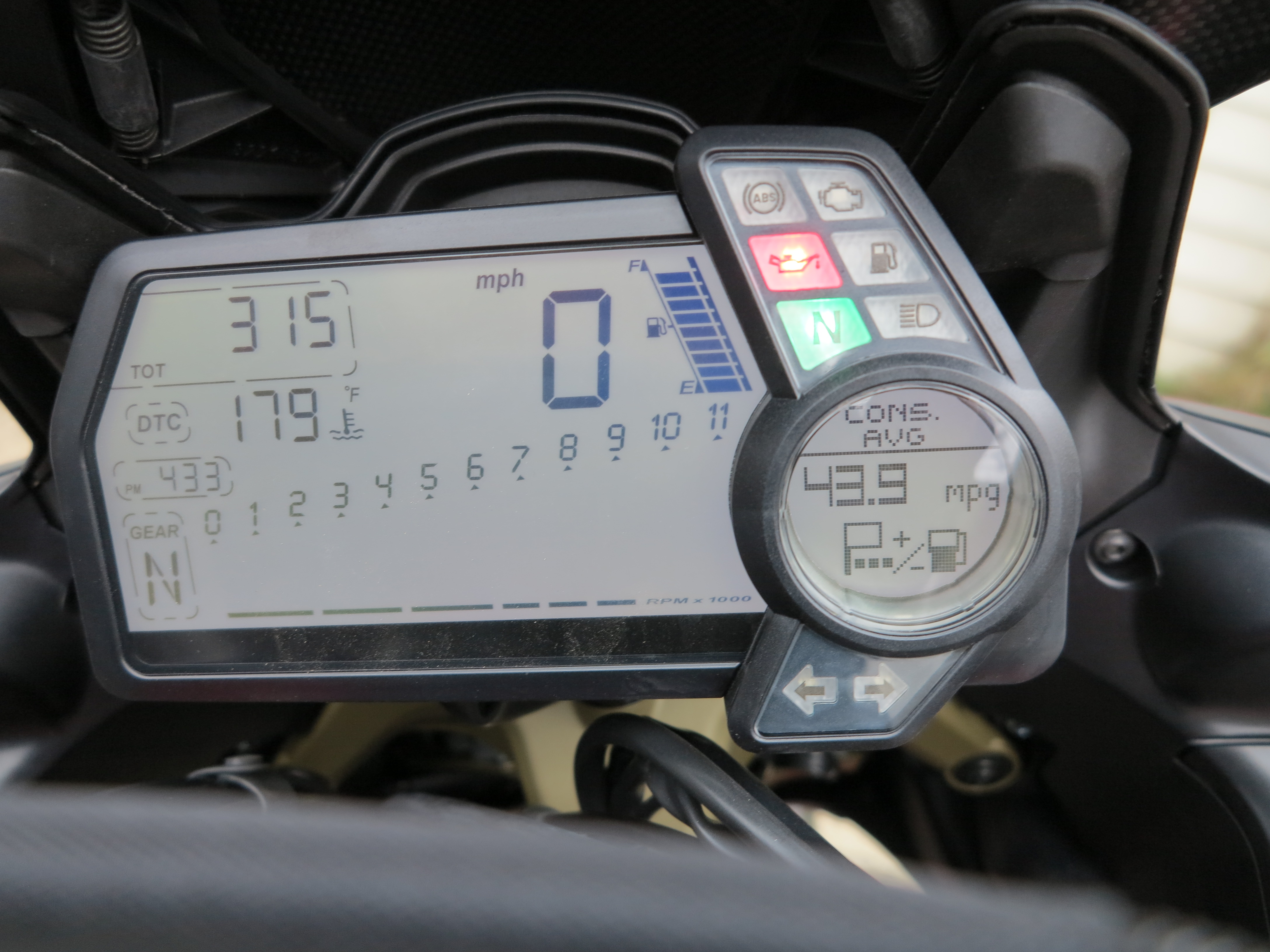
I like this bike's range!

I like this bike’s range!

And because the bike took only 4.4 gallons, it makes 46.6 mpg.  Not bad at all.

205 miles, 4.4 gallons.

205 miles, 4.4 gallons.

From there it was a short burst back home on my well-known Hwy 36, the temperatures went back to the high 80’s soon after I got a few miles out of the coast area.  Made it home at about 5 pm, a long day.

327 miles (526 km)

327 miles (526 km)

Coming up next, a short ride for a can of chain lube that eventually took me on a longer tour, a visit with friends, an old Packard, and a tribute to a dear friend.

Posted in Riding the Ducati, The Book | Tagged , , , , | 10 Comments

Mother’s Day, Dalai Lama, Closed Mountain Roads, and the Pikes Peak

I once heard that in terms of dedication to their children and families, mothers are all alike around the world. The only thing different between my mother, your mother, their mother, his or her mother is the address. My mother is not different. And one special characteristic of hers is that she always has great words of wisdom to offer and to me they have always carried a lot of common sense.  I continue to learn from her each time I talk to her.

Sponsored by the University of Oregon, this last Friday the Dalai Lama was here in Eugene and he spoke to a sold out Matthew Knight Arena. The University streamed his speech to all faculty and staff, so I pointed my browser to it and saw the video and listened to his speech among a work email and another.  Lots of common sense types of words, deceptively simple in his approach and delivery of his words.  I don’t know what I was expecting,  or if I should be expecting more.  Perhaps simplicity and common sense is his message.  Some of the staged questions could have led to some hot topics. But his answers showed the strategy was clearly to stay away from anything that could generate one ounce of controversy. Always simple and to a point, and applying common sense.

He reminded me of my mother and I don’t think he would get offended by that. Among the many common sense ideas the Dalai Lama brought up, one thing he said caught my attention more closely, perhaps because it was close to mother’s day: “Mothers, love your children!” he advised on a very emphatic tone.  “This is one of the most fundamental aspects of life and to the well being of the world,” he continued (paraphrased here, I don’t remember his exact words). I agree with the Dalai Lama on that one.  And I’m lucky to be on the receiving end of that love.

I write this post on mother’s day, and dedicate it to my mother and to all mothers and also to all the women who play a mother’s role to someone!

This post is about a ride that took place on Sunday, April 28th, when I went to Sisters to check the snow level at the areas around Santiam pass and the Sisters’ areas.  I’m late with my posts as you can see. I’m having too much fun riding, spending too much time working, in the end, not enough time writing.

Besides this current post I have three more completed rides to document which I will be preparing and posting in the next few weeks.  I won’t be riding much in these next few weeks,  I will use the time to work in my garage. I started reorganizing it over the last part of the winter, which included the construction of two lean-to structures for storage of garden tools and other materials. But then the new bike arrived and all work stopped. The bike completely derailed my plans, all I wanted to do was ride it. But it is time to finish that work, a few things still need to be done. And I have plenty of rides planned for that bike in the near future.

Sunday, April 28th, 2013

It is Spring and the Eastern Oregon farmers and fire fighters already know this coming year will be a drought year.  Oregon’s rain season has been short this year, snow accumulation was less than normal, we are bracing ourselves for a drought year and its consequences (see chart below from NOAA).

sdohomewebThe week before I went to Crater Lake National Park and checked the snow level in that area.  It is reported to be at 60-70% of what are considered average snow levels for a winter season in that park.  And with this post here I’m reporting my ride to check the state of roads around the Sisters’ area.

Just the day before I had washed the Ducati from my ride to the Crater Lake. This bike had a layer of a mix of the water from melting snow and dust from the red volcanic sand that is laid on the road to help with traction on icy days.  I’m on a “keep the bikes clean” mode these days.

A clean Multistrada

A clean Multistrada

After washing it I went for for a short ride to dry it.  I went to a very conveniently located new gas station in my area, just three miles away, that sells non-ethanol gas.  This Chevron gas station has about a dozen pumps distributed in three islands. Right in the middle of the middle island there is one special pump, Sunoco it says, and it is supplied by Tyree fuels, the attendant tells me. On the left side of this Sunoco pump you get 92 octane non-ethanol gasoline, which is what I use. On the right side of this pump you get 100 octane race fuel or 110 octane leaded race fuel. I don’t know who uses race fuel here, but the 100 octane unleaded is expensive, at $8.99 a gallon.  The 110 leaded was $8.39 a gallon.  The 92 non-ethanol I use is not cheap either at $4.50 or thereabouts. I don’t mind paying the price to run my machines with as little ethanol as possible, including my lawn mower.

Non-ethanol fuel on Irving Road

Non-ethanol fuel on Irving Road

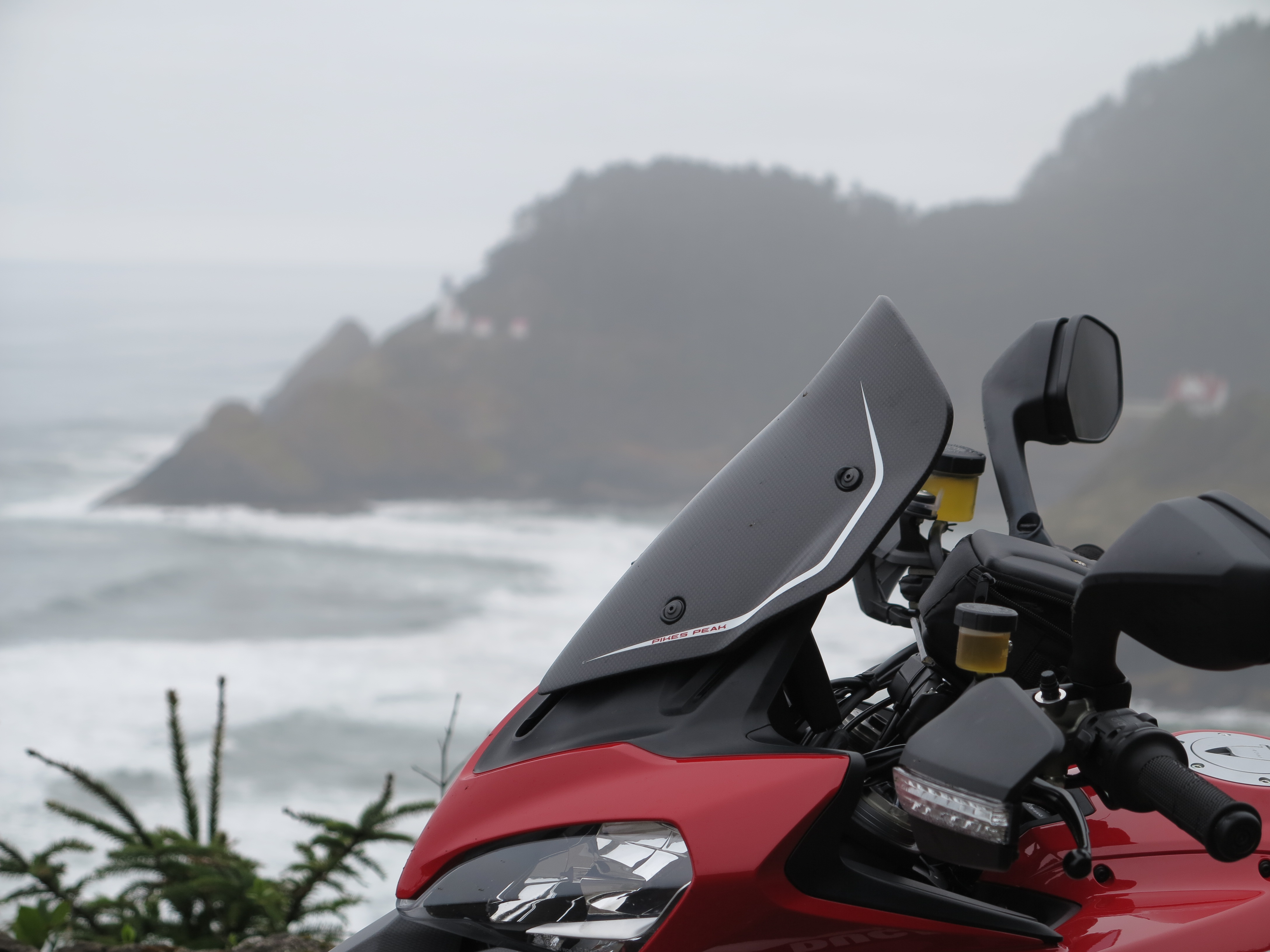
Before I left for this ride Sunday morning, I changed the bike’s screen back to the smaller carbon fiber Pikes Peak screen.  It looks better and gives me more clean air on shoulders and head.  There is still turbulence even with this set up, but I believe it is coming from the bike’s front fairing and mirrors and not necessarily the screen.  One thing I liked about the Hyperstrada I rode the day before this ride, is that you only get clean air. In that case, all you need is a good quiet helmet and you are good to go.

Pikes Peak Screen for cleaner air

Pikes Peak Screen for cleaner air

Because 242, the McKenzie pass road, is still closed, I decided to go up the Cascades via Hwy 20 instead of the busier 126.  And to make things yet more peaceful and relaxing, I took the usually empty back roads north of Eugene to connect with 20 by Sweet Home. I let the GPS pick the specific roads on that route and was surprised by a nice and new to me stretch of road connecting Harrisburg to Brownsville, crossing I-5.  The emptiness of these roads put me on a very relaxed mode. Only thing bothering me were the grey skies with a slight threat of rain.

Gap Rd

Gap Rd, Coburg Hills on the background

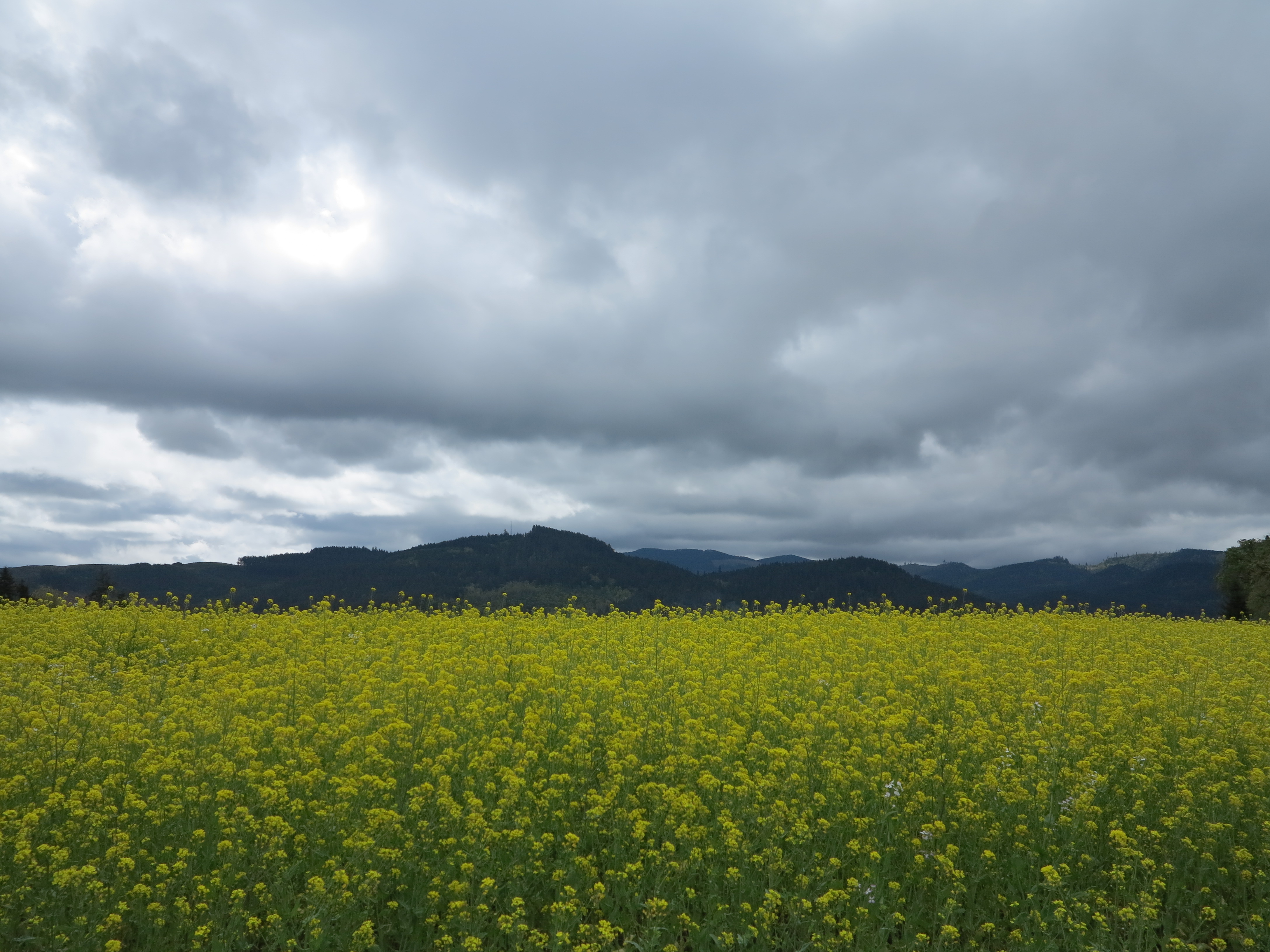
The road is the Diamond Hill Rd, going east from Harrisburg and connecting with the Gap Rd to go north towards Brownsville, snaking a bit through the lower part of the Coburg Hills to the right. I entered Brownsville from the south and connected with 228, now going east towards the Cascades. The grey skies can be threatening, but at the same time it brings life to colors, everything gets brighter and more intensive.  Like the effect it gave to these bright yellow flowers of these canola (I think) fields just outside Brownsville.

Canola, I think, fields just east of Brownsville, OR. April 28, 2013

Canola (I think) fields just east of Brownsville, OR. April 28, 2013

I had never ridden 228 from west to east. Going this direction, it allowed me to see a small park dedicated to the Calapooia watershed, something I had never noticed before. I stopped to take a look and document the Calapooia river.  I learned from this stop that a watershed council was put together not too long ago to improve conditions of this river. They worked with the farmers to improve their practices, providing the once threatened spring Chinook and winter Steelhead with higher quality spawning grounds upstream. Every little effort counts. In the end farmers, the public, and all who like to fish win.

Calapooia River, Brownsville, OR. April 28th, 2013

Calapooia River, Brownsville, OR. April 28th, 2013

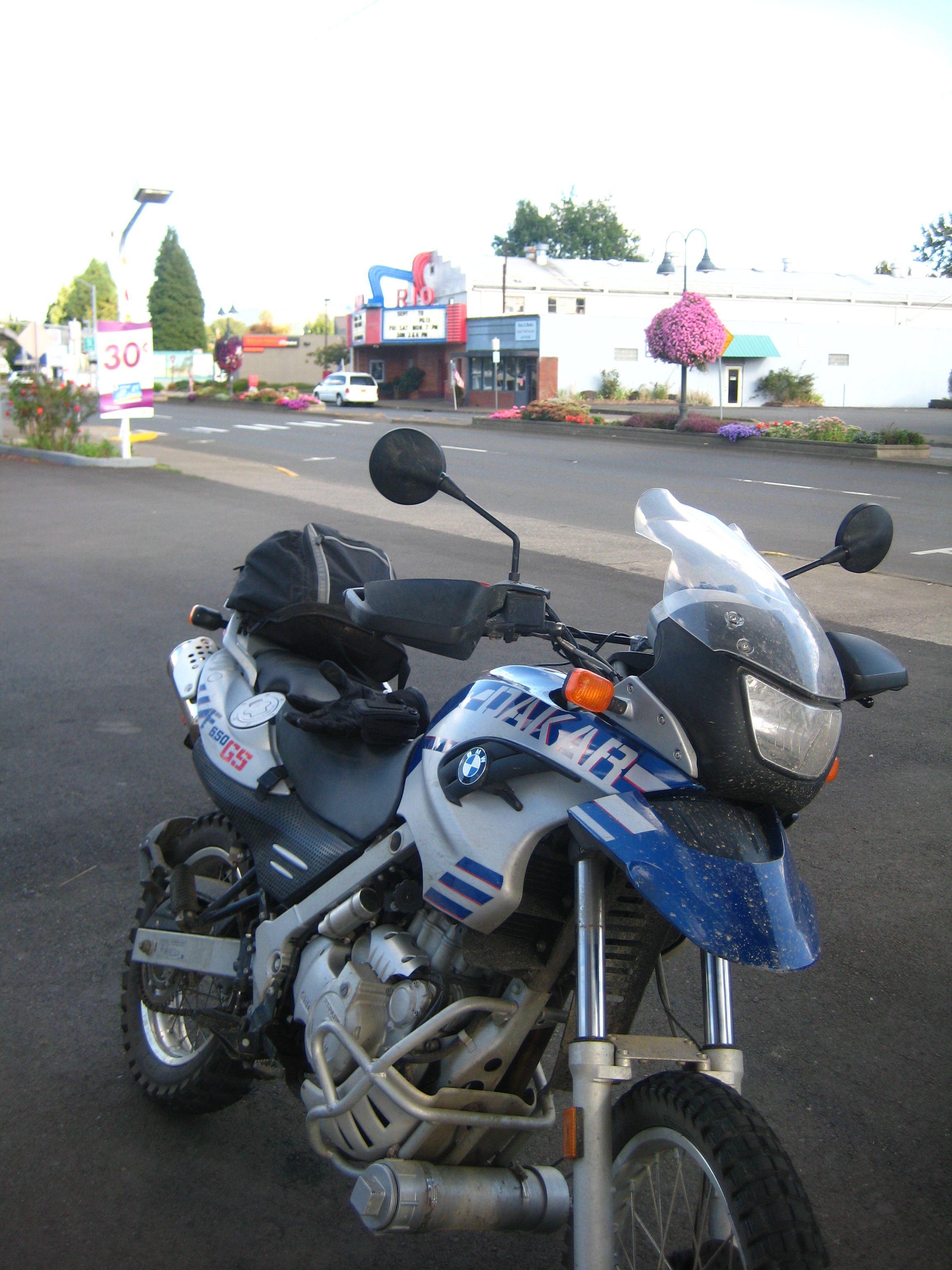
Continuing up the road on 228 I arrived in Sweet Home to take Hwy 20 and start my climb of the Cascades.  While in Sweet Home I stopped to document this movie theater, called Rio. That name had caught my attention before, I had noticed it on previous rides through this area. Perhaps it is named after Rio de Janeiro, which is known simply by “Rio” in Brazil?

The Dakar with the Rio Movie Theater in the background. Sweet Home, September 2009.

The Dakar with the Rio Movie Theater in the background. Sweet Home, September 2009.

There is something about stand-alone movie theaters, I especially like the art deco buildings. But there is more to it, regarding the experience of going to the movies, parking in front of it. Who didn’t take a date to the movies? And there is the building itself, and the street experience of walking out of an intense movie back into reality. Porto Alegre, where I grew up, had at least 15 stand-alone movie theaters of this type. I remember every other Sunday my father’s side of the family had lunch at my grandparents house and after lunch some of us, the 8 grandchildren, when we were pre-teens I suppose, would go to the movies. The matinée session.  We would check on the newspaper the various options during lunch, have a little debate among us and pick one of the movies. I don’t think any of those movie theaters in Porto Alegre survived the multiplex and movies-at-the-mall invasion that happened here and also there in Brazil. Perhaps some of those nice buildings survived, but I doubt they work as cinema houses these days.  And here in Oregon, in this small town, they are still alive! Very nice indeed.

Rio Movie Theater, Sweet Home, OR. April 28th, 2013

Rio Movie Theater, Sweet Home, OR. April 28th, 2013

On a closer look, I noticed a poster, close to the box office, and learned something new. If you like these old movie theaters, there is an initiative called “save America’s Cinemas“.  Their goal is to save America’s small town cinemas, especially the ones going through the costly transaction of digitizing their projecting equipment in replacement of the 35 mm or 70 mm film projectors.  Just this last week I heard on Oregon Public Radio that Eugene’s Bijou theater is going through this very process and they are asking for support from the community.

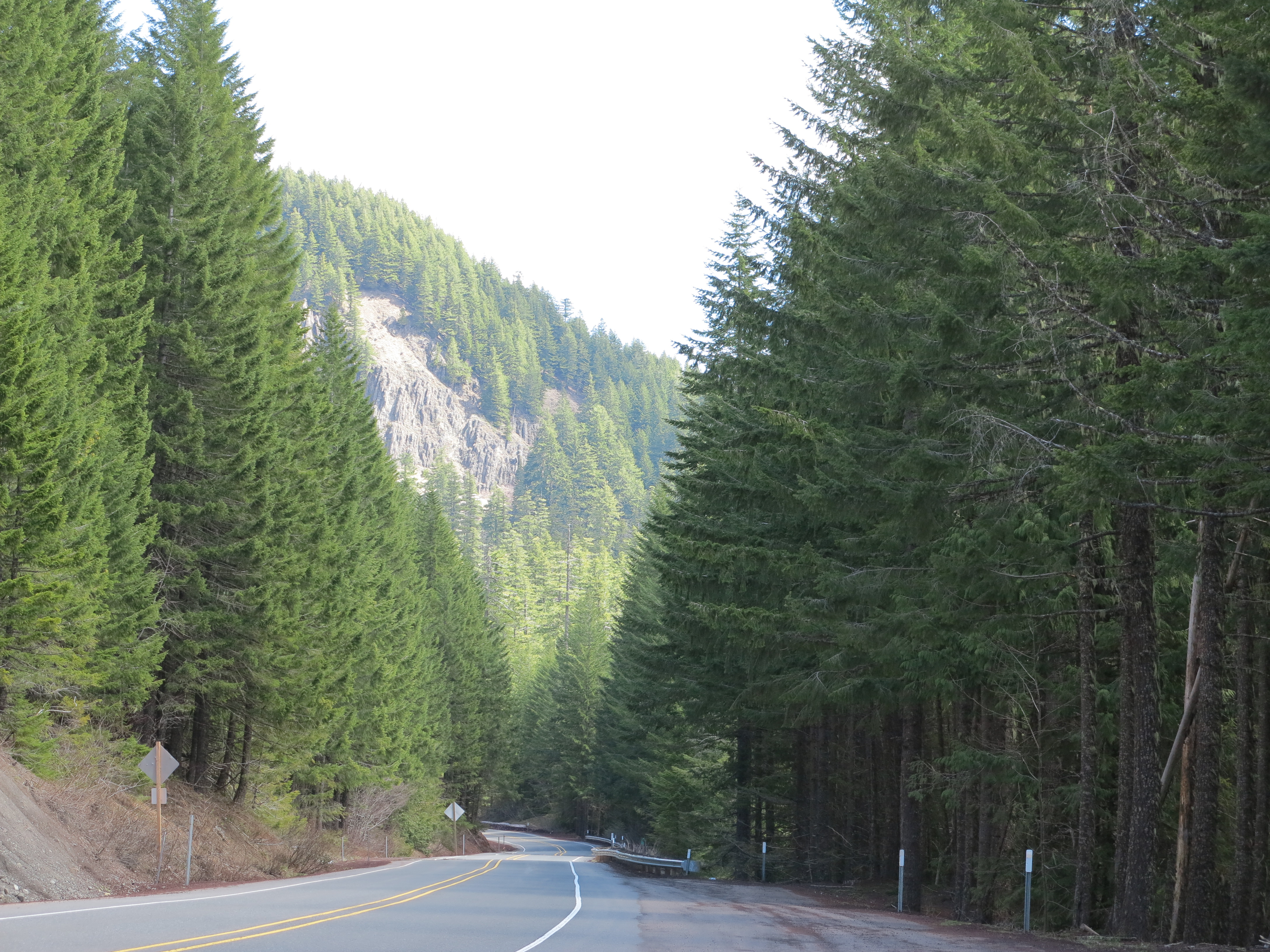
Hwy 20 going up towards Tombstone Pass. April 28th, 2013

Hwy 20 going up towards Tombstone Pass. April 28th, 2013

From Sweet Home I continued east on Hwy 20 and started the climb of the Cascades, towards its highest pass of this portion of the road, Tombstone pass. This portion of Hwy 20 is nice, with less traffic than Hwy 126 (Hwy 126 connects to Hwy 20 at some point). At some point I was looking at the scenery to the right of the road and somehow the green of the trees brought me memories of a postcard my father had sent to our family, from a business trip he had made to São Paulo. That was a long time ago!

Green mountains alongside Hey 20. April 28th, 2013

Green mountains alongside Hey 20. April 28th, 2013

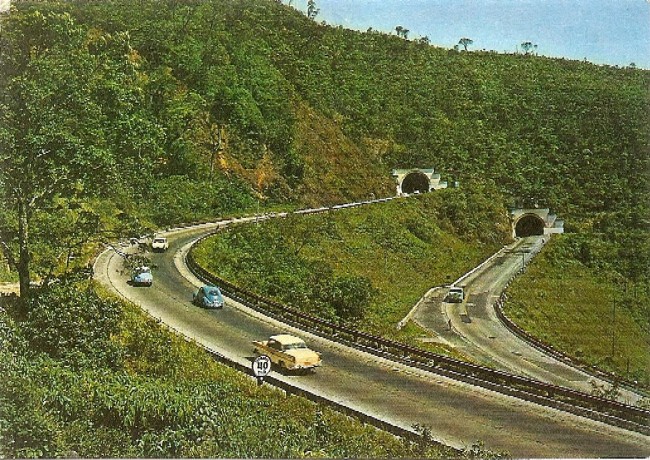
One of the things I’ve been enjoying as years pass are the unexpected moments that bring back memories of long time ago. I enjoy thinking about those moments and try to learn something new from them, seeing them from a grown up perspective. Well, sort of grown up.  This one moment in particular was about the postcard my father sent back to the family, and I’m not sure whether he had sent it to me only or to everyone in the family (very likely it was to everyone in the family).  But I remember I appropriated it as if he had sent it to me only and kept it and stared at it many, many times. It probably had dog ears and all.  The postcard was a photo of a stretch of road on the mountains on the way to São Paulo, with many curves and a tunnel.  Not quite like the postcard I just found on the internet and posted here (below). The way I remember it, it had a darker tone of green for the trees, and the photo had been taken more from a distance. But the one below is close enough. It is in Brazil as well and near São Paulo.  The point is, based on then and now, it seems I’m consistent in what I like.  Riding these curvy roads makes a lot of sense.  The other point is that the past can tell new stories. And teach new lessons.

Old postcard of Highway in Brazil, near São Paulo.

Old postcard of Highway in Brazil, near São Paulo.

After Tombstone Pass Hwy 20 goes down the mountain and merges with 126.  Merging with Hwy 126 and its traffic brought me out of my contemplative status.  The 20/126 combined climbs a bit more to reach Santiam pass and from there Sisters is very close.

Hwy 20, going down from Tombstone Pass before the merge with 126 farther east

Hwy 20, going down from Tombstone Pass before the merge with 126 farther east

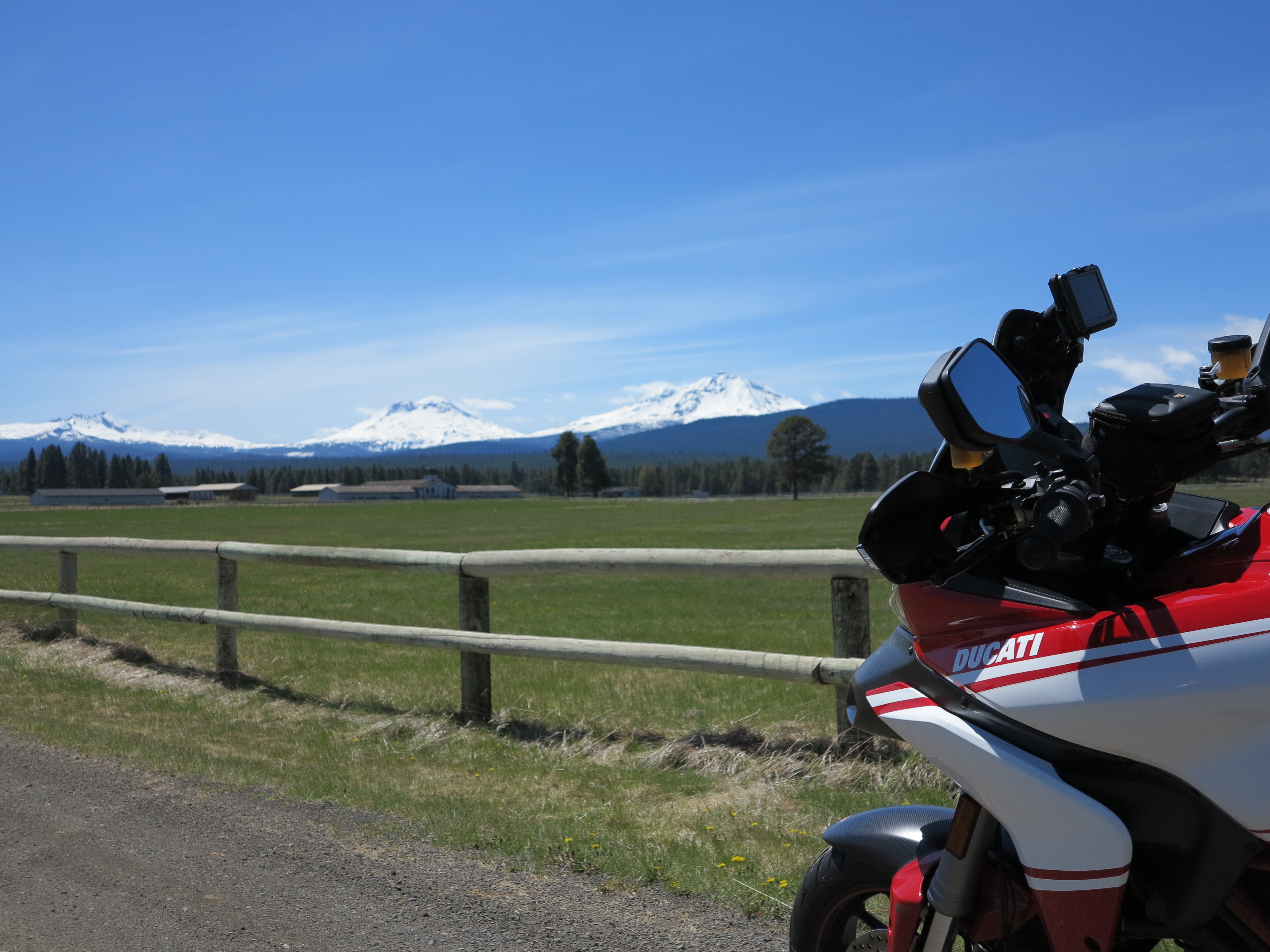
Before fueling up in Sisters I decided to first see how far I could go on 242. It gave me an opportunity to introduce the Multistrada to the three Sisters. All my bikes meet them sooner or later, it’s a ritual.

The Multistrada and the Three Sisters

The Multistrada and the Three Sisters

I had heard 242 was still closed, but I was wondering how far I could go.  Not too far, I found out, despite no signs of snow.

242 still closed but not for long.  I hear around third week of May it will be open. Photo taken April 28th, 2013

242 still closed but not for long. I hear around third week of May it will be open. Photo taken April 28th, 2013

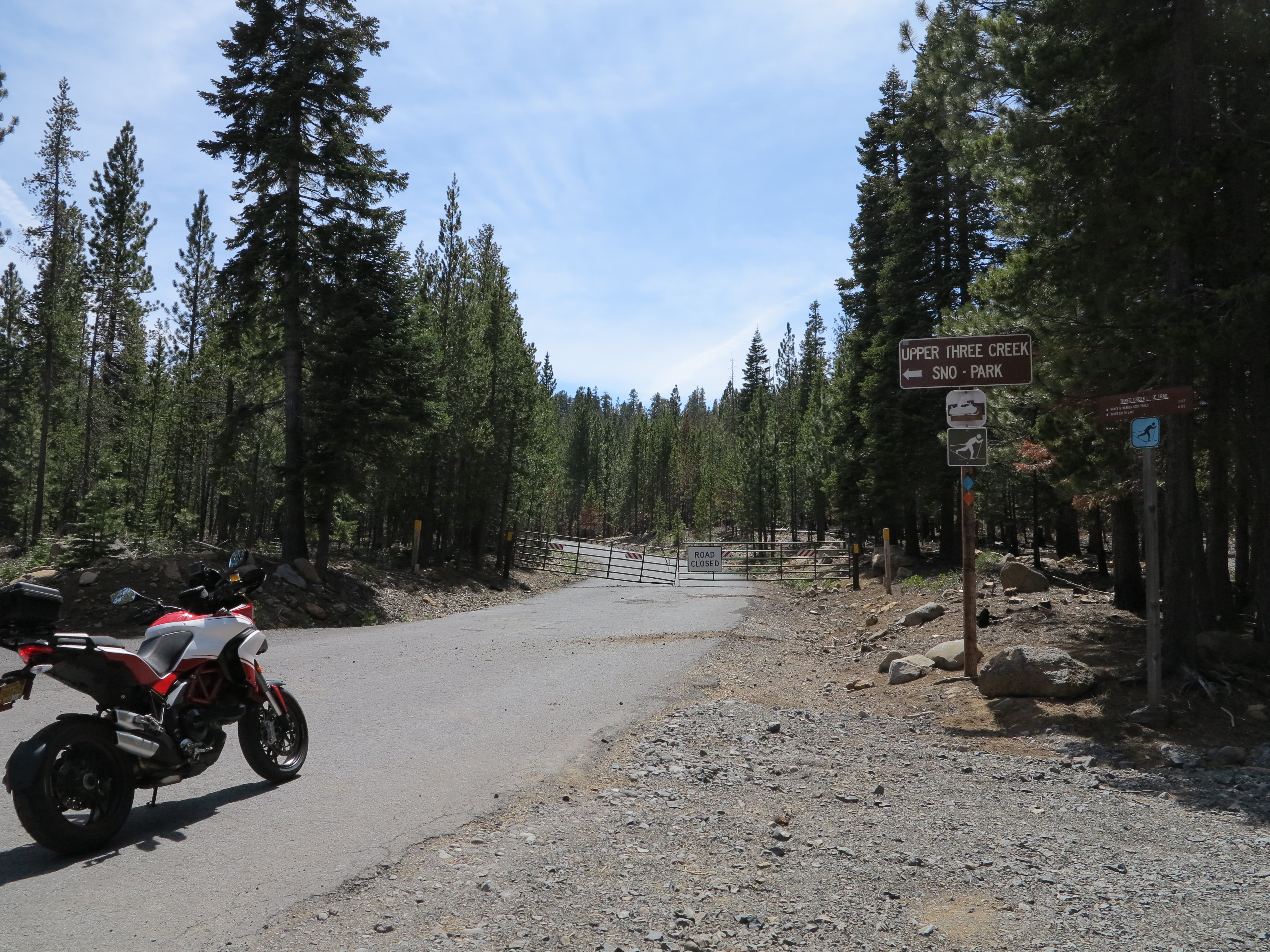
I went back down towards Sisters and tried the Three Creek Lake Rd, that goes a bit more directly towards the south, a parallel direction to the Cascades.

View of session if the Cascades from Three Creek Lake Rd.

View of session if the Cascades from Three Creek Lake Rd.

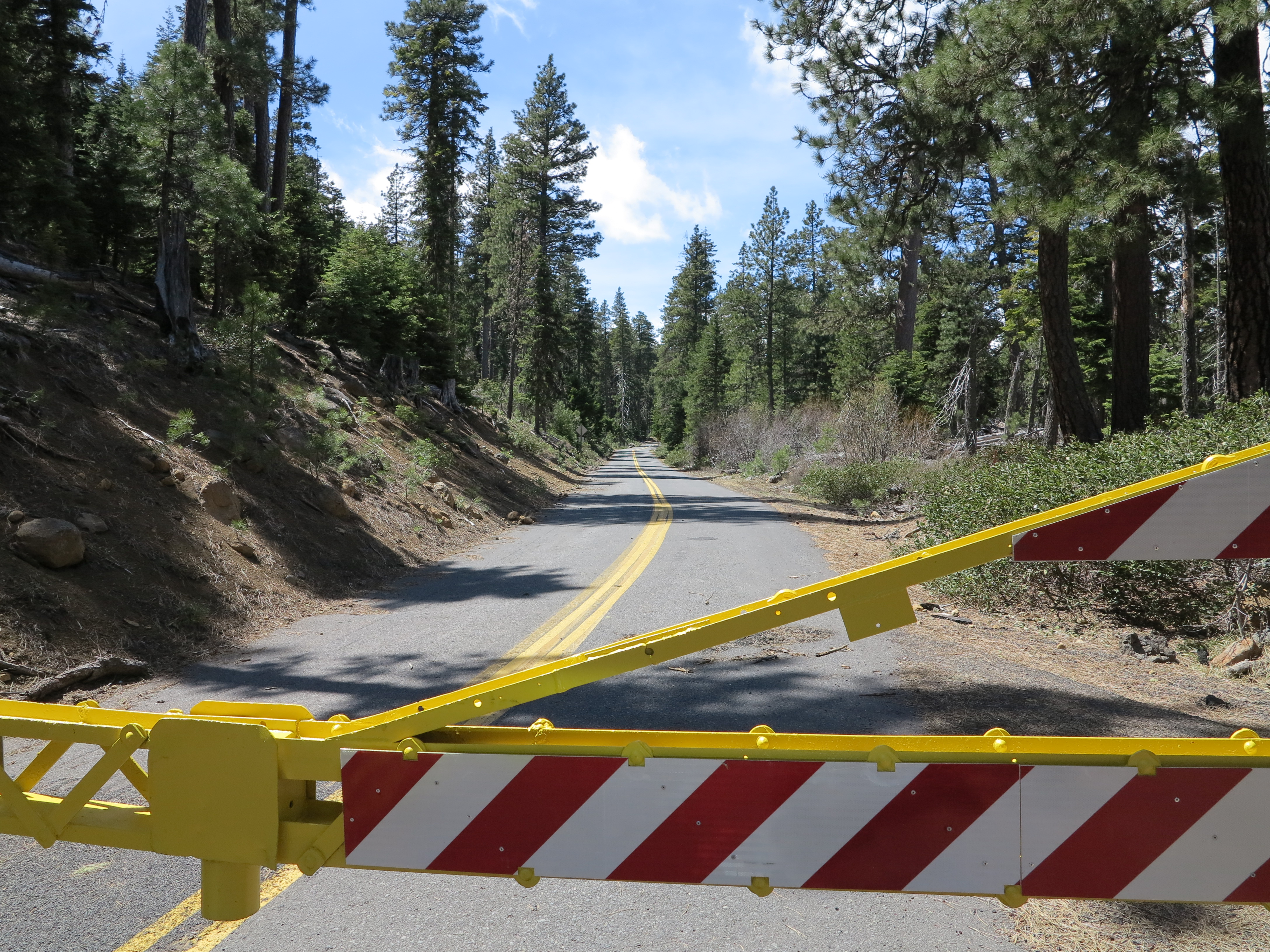
I rode on it for a while, till I reached a closed gate as well.  A guy showed up on a truck and started talking to me, telling me something about the gate and not understanding why it was closed. Or something similar. I had my helmet on and the earplugs, I could not understand a word he was saying on top of his truck’s running motor. A smile here and a head nod there and I went back to my bike.  By the way, at gas stations I usually don’t remove my helmet, so I point to the fuel I want, give the card and the rest is yes and no and common sense (the word of the day, it seems).

Three Creek Lake Rd. Closed as well.

Three Creek Lake Rd. Closed as well.

I resigned to go back to Sisters. Conclusion: no snow on site but roads not open yet. I hear 242 will be open soon. The Cascades Lakes road was opened recently (I rode on it yesterday, May 11).

Sisters, April 28th, 2013

Sisters, April 28th, 2013

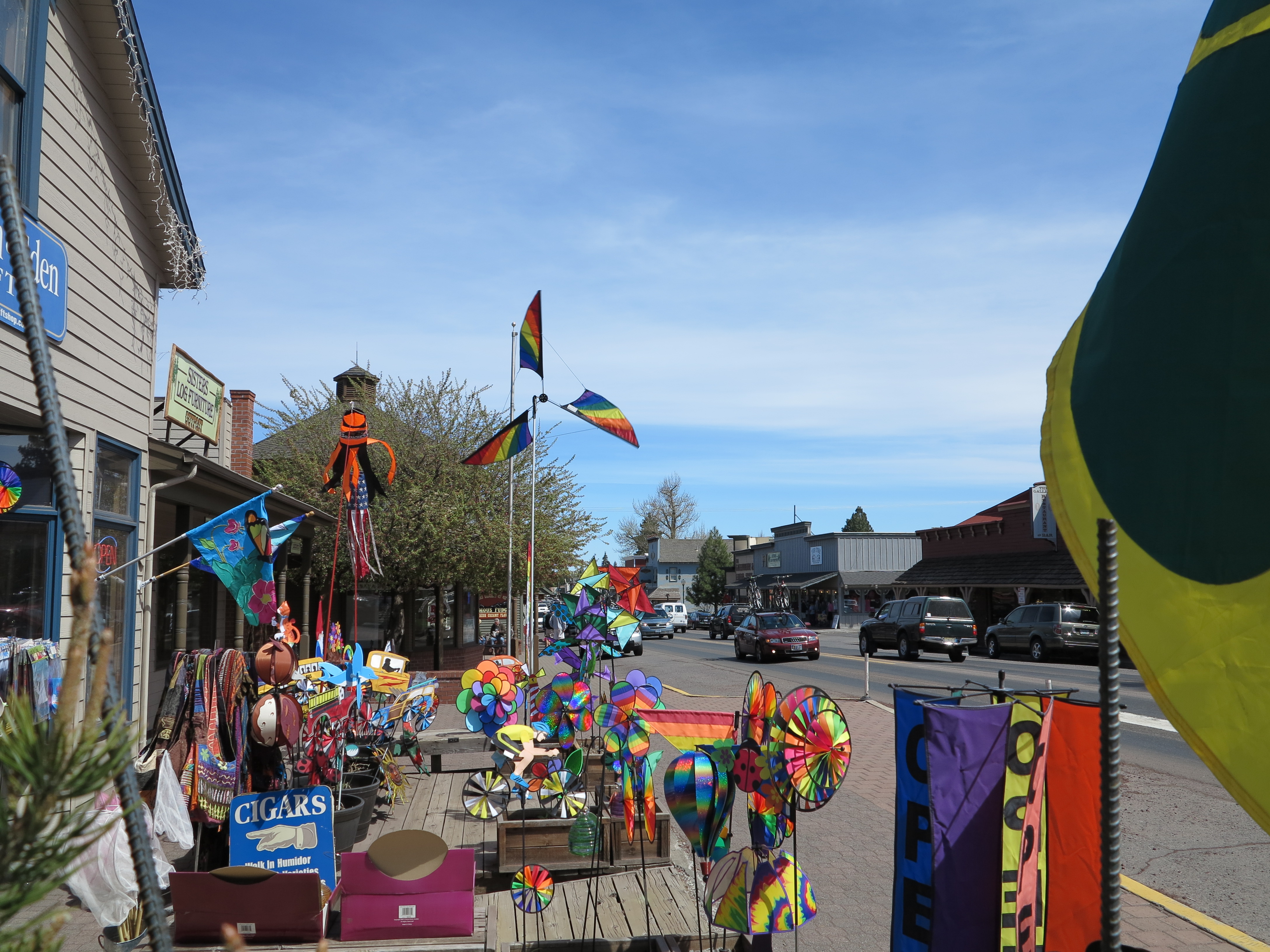
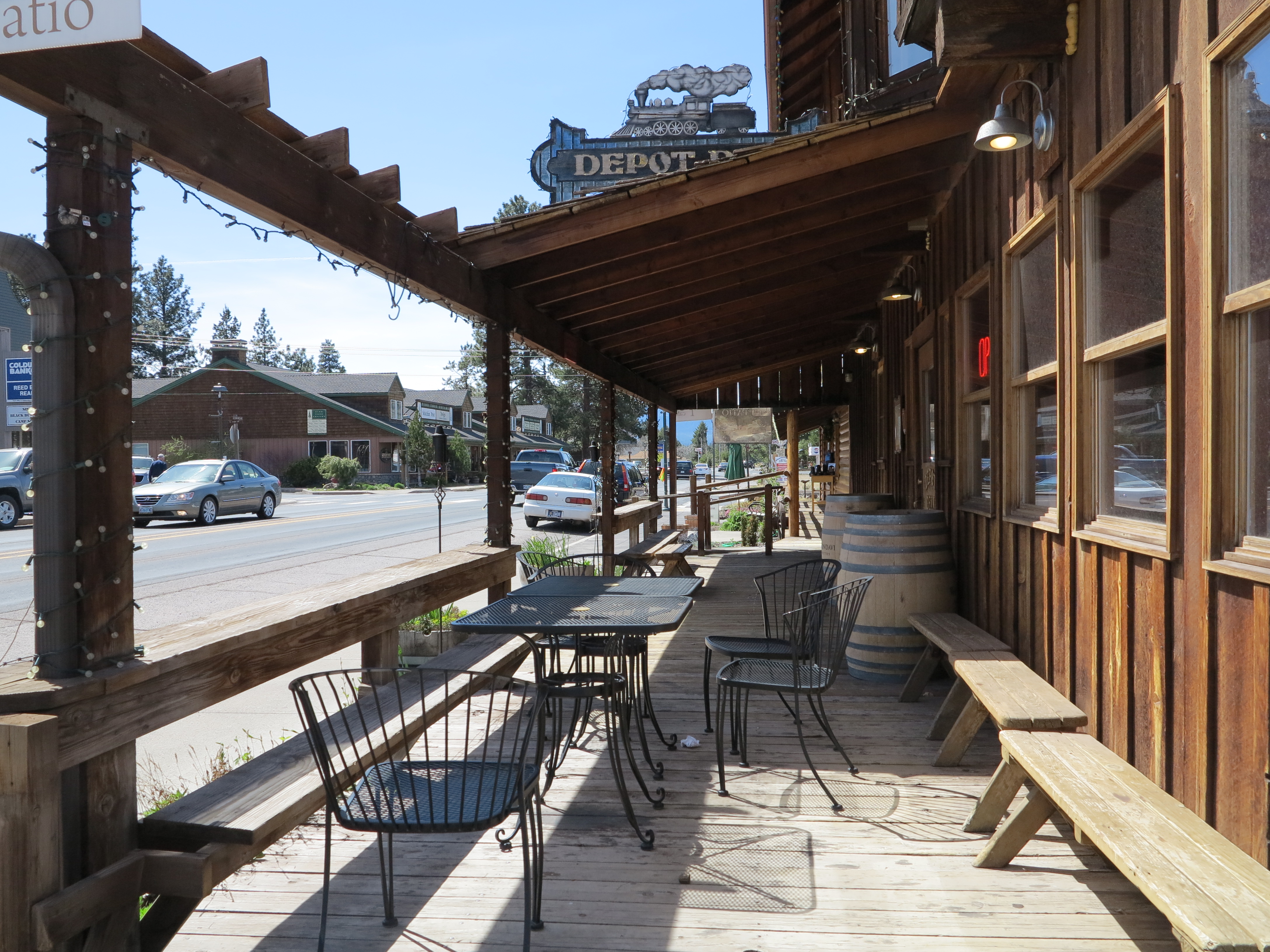
Sisters reminds me of the time I was in a masters degree program on City and Regional Planning at the Ohio State University. When you go to Sisters you know they’ve planned its construction code to make it work as a good business enterprise, a touristic destination with its western theme throughout the downtown area.  But they also make it a place that compels people driving through to stop and check it out.  Highway traffic is forced through a main thoroughfare at very slow speeds.  It is a road that is friendly to pedestrians, not too wide so that business on either side of the road can still be connected with each other, making it a community of sorts. Once you are there you can’t quite tell there is a highway going through the town. But when you are driving, you know you entered a town. You can park your car (or motorcycle) and walk to several of the establishments that are close to each other on both sides of the road and the next block as well. The side streets offer plenty of parking options. During the summer months the side walks, stores, and cafes get busier with people from everywhere.

Sisters, April 28th, 2013

Sisters, April 28th, 2013

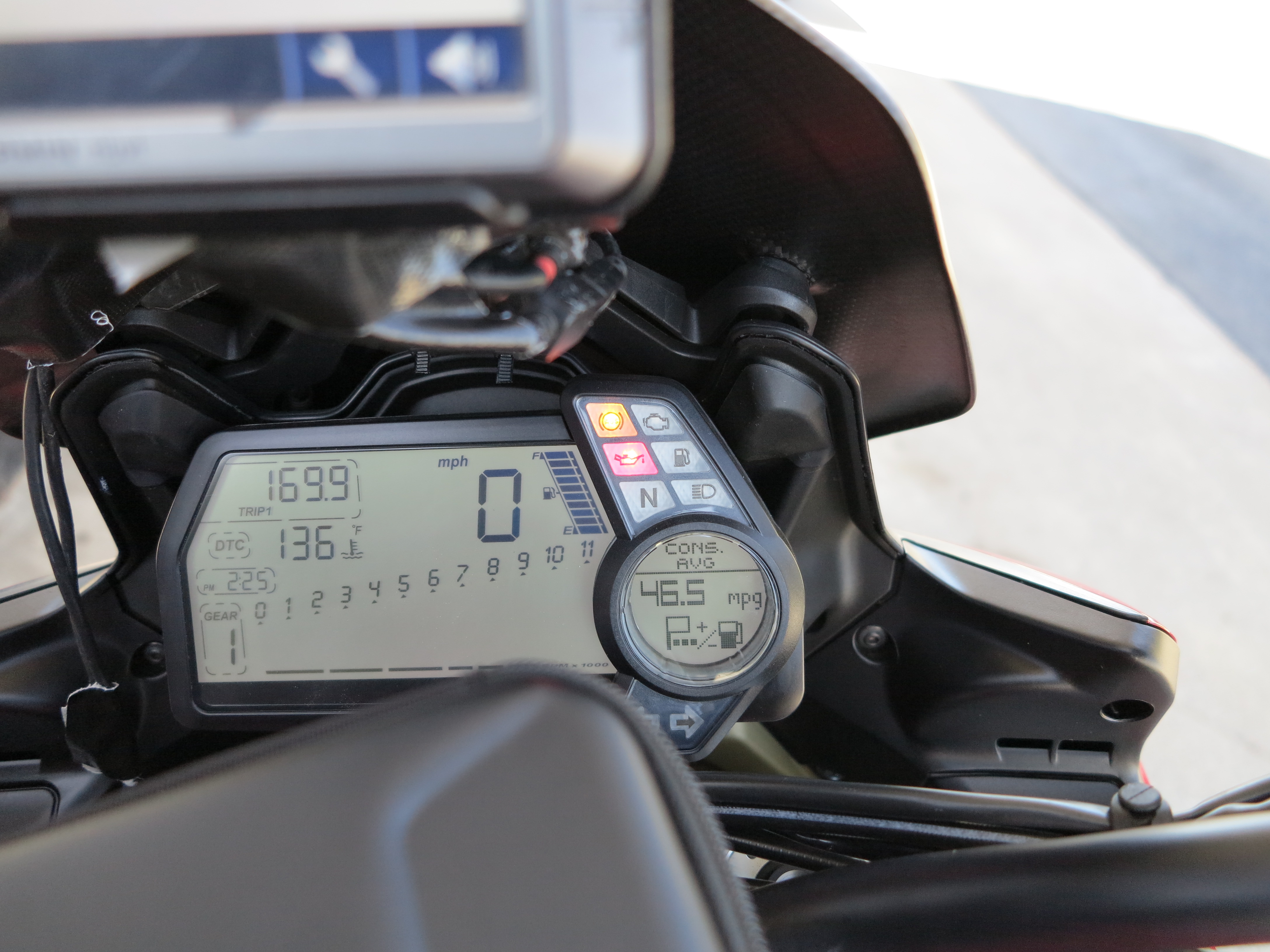
I stopped by the Space Age gas station, at my usual non-ethanol fuel pump.  I have been very impressed with this bike’s fuel economy. It has been consistently averaging above 45 mpg, giving me a theoretical range of more than 200 miles if its tank really holds the 5.3 gallons it says in the manual.

46.5 mpg average consumption according to motorcycle's computer

46.5 mpg average consumption according to motorcycle’s computer

The display indicates 46.5 mpg. The actual consumption calculated:  169.9 miles driven  divided by 3.761 gallons, makes 45.2 mpg.  I’m not riding this bike on cruise mode at all times.  Well, I admit, overall, on straight roads, I only speed up when I have to pass slower vehicles. I try to keep the speed between 60 and let’s say 75 mph, maybe a bit more on empty open roads and those long sweeping curves. Once I hit the tighter curves I have a bit more fun on higher RPM, but in lower gears.  I’m not taking it to the edge of the tires, but it goes fast enough. That is, I’m not babying it and I’m not a racer either.

3.761 actual gallons consumed in 169.9 miles.

3.761 actual gallons consumed in 169.9 miles.

And I’m always on 150 high mode, be it on Touring or Sport modes. I also have it set up for 150 high on Urban, but I’m on Urban mode only when I want the bike lower to the ground for maneuvering purposes and sometimes stop and go traffic. The bike keeps telling me that I have 200+ miles of range, tank after tank. Not bad at all. It could be the non-ethanol gasoline. It does better than my Streetfighter did!

From Sisters I  went back home the easy way, via Hwy 20 and then 126.  On the way I stopped at the Santiam pass and checked the Hoodoo ski area.  Another closed road and another closed ski station.

Hoodoo Ski Area: Closed for the season.

Hoodoo Ski Area: Closed for the season.

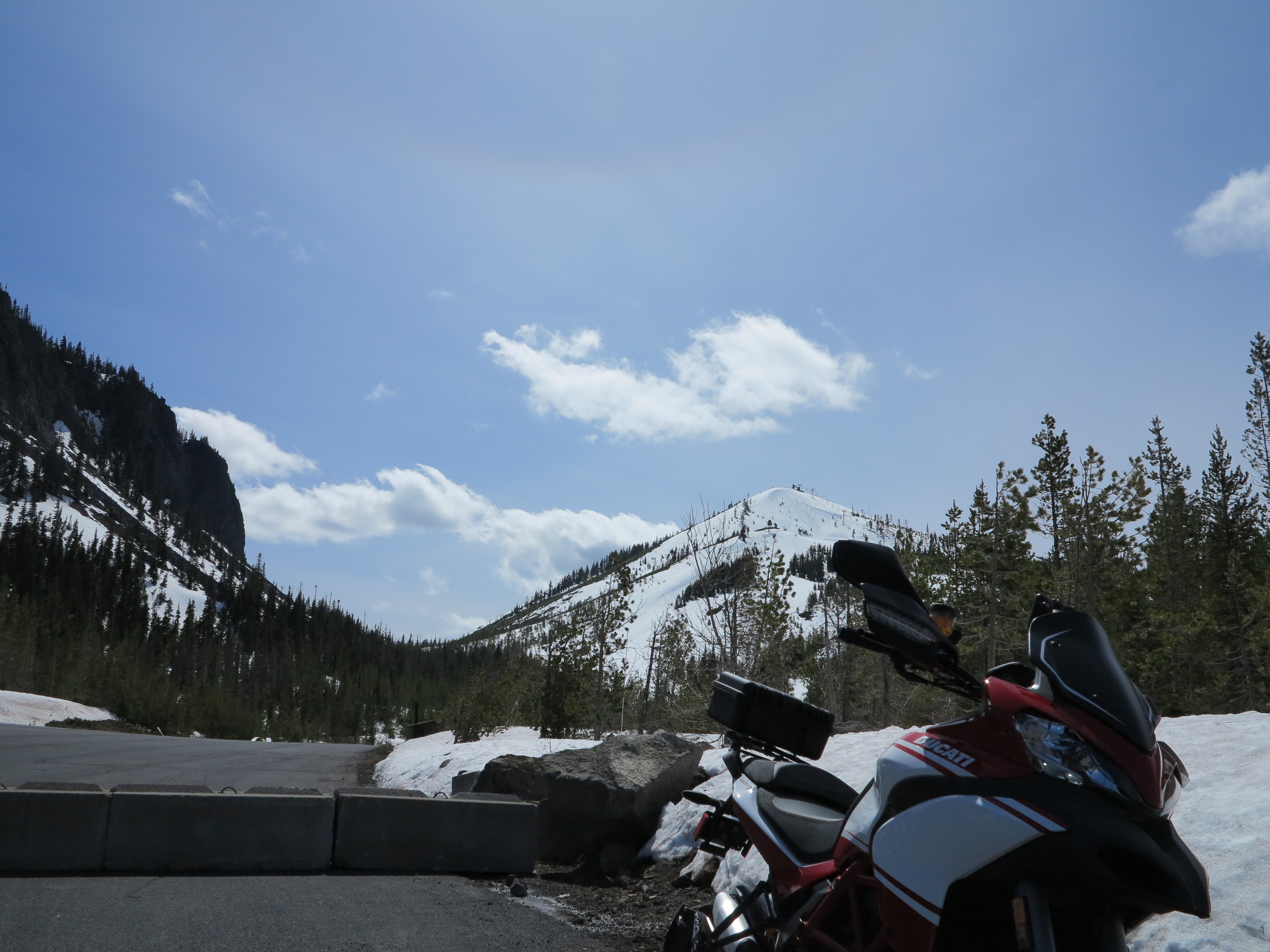
The bike looks good with snow and trees on the background.

At Santiam Pass with Three Fingered Jack on the background.

At Santiam Pass with Three Fingered Jack on the background.

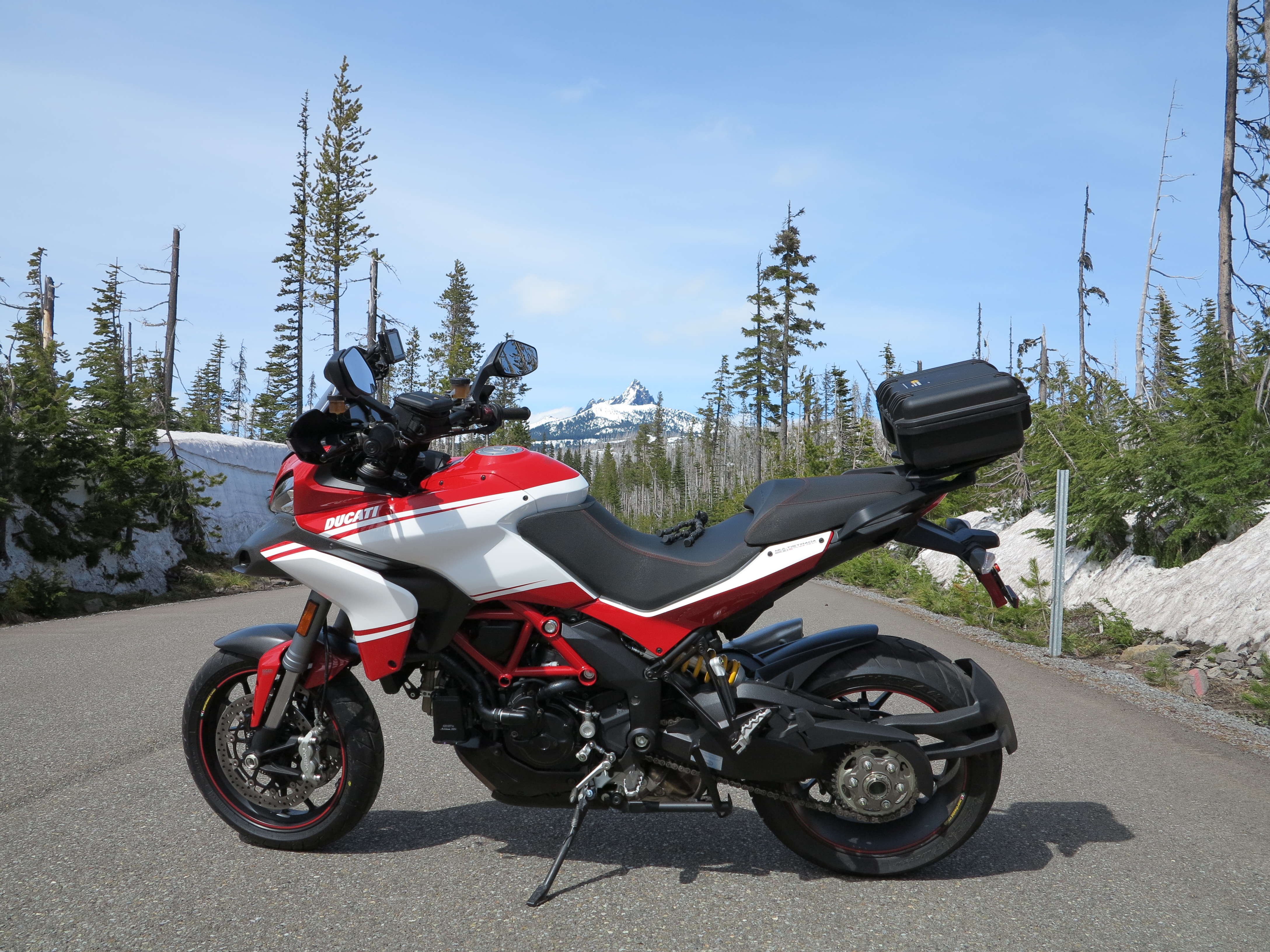
And I’ve never had a chance for a photo op with the bike. So here it goes.

It looks great in black and white. As a matter of fact, I bet it will really look great if the red parts were painted dark grey.

It looks great in black and white. As a matter of fact, I bet it will really look great if the red parts were painted dark grey.

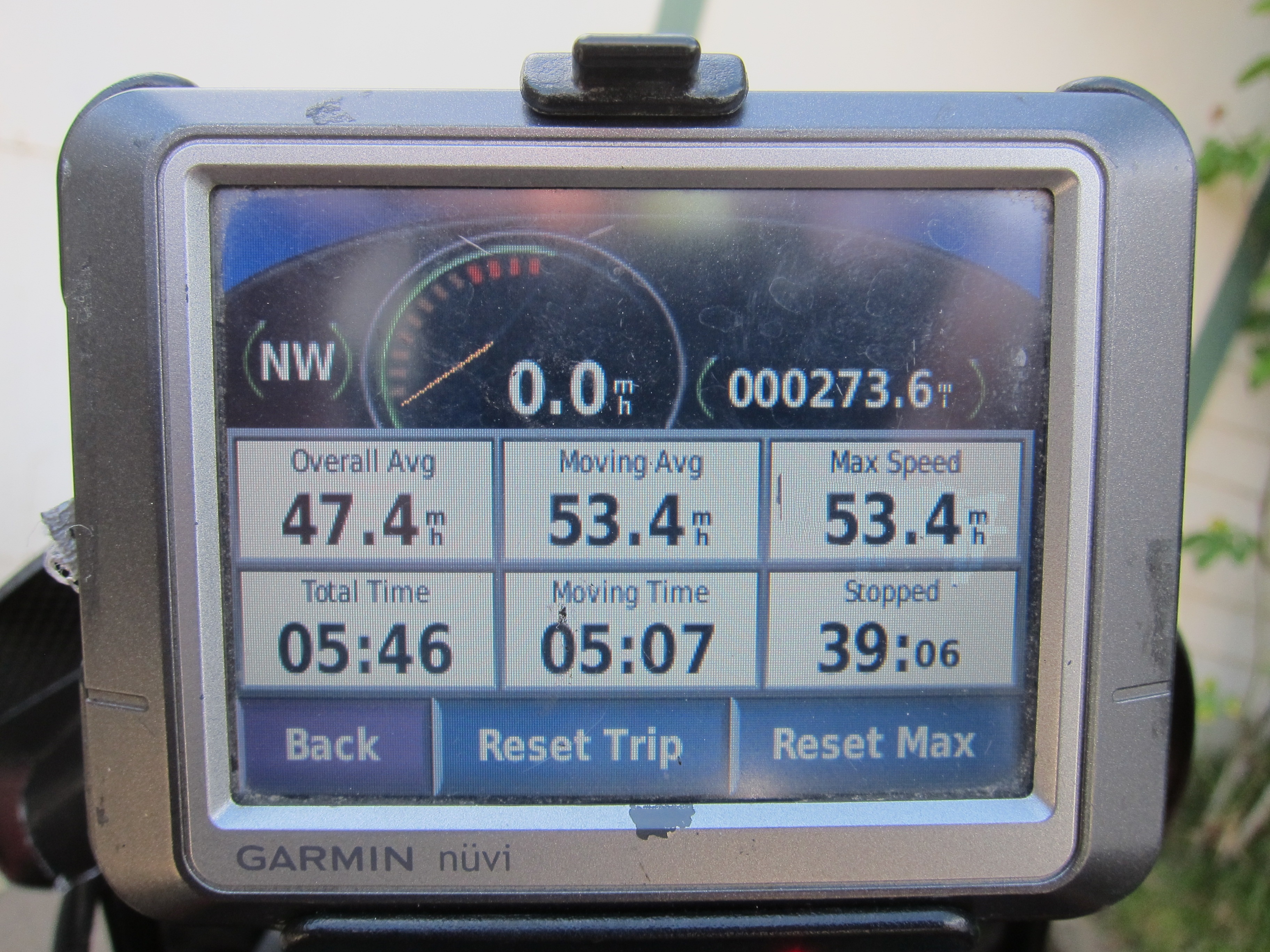
I continued on my way home with no more stops.  273 miles, about 440 km total for the trip.

273 miles, another mission accomplished

273 miles, another mission accomplished

In case you are wondering, this Garmin GPS, a Nuvi 260 of more than 5 years, was designed for cars and not motorcycles.  It is not waterproof and it has been in the rain a few times but it continues to work.  The Oregon 450 that I have, which is an outdoors handheld type GPS, has connection problems between its mini USB and the DC power. Not very good for the bike. Meanwhile I’m in between a Garmin Montana and a 350LM as a possible upgrade.

Bikes tucked away, the only wall of  the garage that has been reorganized.

Bikes tucked away, the only wall of the garage that has been reorganized.

Next there will be a ride to the Evergreen Museum in McMinnville, a short tour with the Triumph including a visit to a 1939-40 Packard, and a tour of the Cascade Lakes Rd., which I completed yesterday.  These rides will offer plenty of materials for weekly posts, with nice inspiring photos and good stories to share with you in the next few weeks.

Thanks for reading!

Posted in Riding the Ducati, The Book | 6 Comments

2013 Ducati Hyperstrada – Launch and First Ride

When I heard rumors about the Ducati Hyperstrada, a touring  version of the revised Hypermotard line, I thought of it as a great fun machine. I had ridden the Ducati Hypermotard before, and I knew how nimble it was, a truly hooligan machine, the essence of motard, and on steroids in the case of the 1100 Evo SP version I rode. Lots of fun but it missed travel manners.  There is nothing wrong with the bike if you want a perfect urban machine which is also excellent for short bursts of extreme fun on the country side and the curvy roads on the hills around town.

The Ducati Hypermotard. September 2011

The Ducati Hypermotard 1100 Evo SP that I took for a spin in September 2011

But if you wanted something more versatile that offered that wicked fun but also allowed you to take it on trips, you probably looked elsewhere. Until now, that is.  With the Hyperstrada, Ducati is offering another side to its Hypermotard line. It is part of a trend in the Ducati’s line, where some bikes get the “strada” treatment, subtle but important changes to their design and equipment making these bikes more touring oriented.  It started with the Multistrada years ago, from the ground up a completely different beast than traditional Ducati motorcycles. Ducati has now added a GT (Gran Turismo) version to its Multistrada line, taking touring yet to another level in that line. The Hyperstrada confirms the trend. Next in line will be the Diavel, with its Diavel Strada version.
Scott and Madelyn of the European Motorcycles of Western Oregon invited me to attend the Hyperstrada’s launch party. It took place last Friday, April 26th, at their shop on West 11th Ave., here in Eugene.

Unveiling of the Hyperstrada at the EMCWOR - April 26th, 2013

Unveiling of the Hyperstrada at the EMCWOR – April 26th, 2013

My work schedule has never collaborated with Ducati’s launch parties calendar. I missed the launch for the Multistrada 1200, the Diavel, and the list goes on. But this time I was in town and I made a point to be there. And I was not disappointed.

Ducati Girls... Bike? What bike?

Ducati Girls… Bike? What bike?

Hey, I’m talking about the bike.  But besides the bike there was something to eat, drink, and well, there were the girls, Ducati girls, giving that special Italian flavor to the launch party.  Since I have an Italian passport, I felt right at home. In reality I see it as the youth and excitement, that upbeat feeling we experience (well, I do) when riding Ducatis. EMCWOR added an Eugene touch to it, promoting local businesses in the process.  The beer being offered was from Claim 52 Brewing one of the local up and coming breweries.  The nice and friendly girls are from the Ballet Fantastique here in town. If you are a local rider and would like to be part of a next Ducati launch party, the Diavel Strada being next in line, contact EMCWOR and ask to be included in their mailing list.

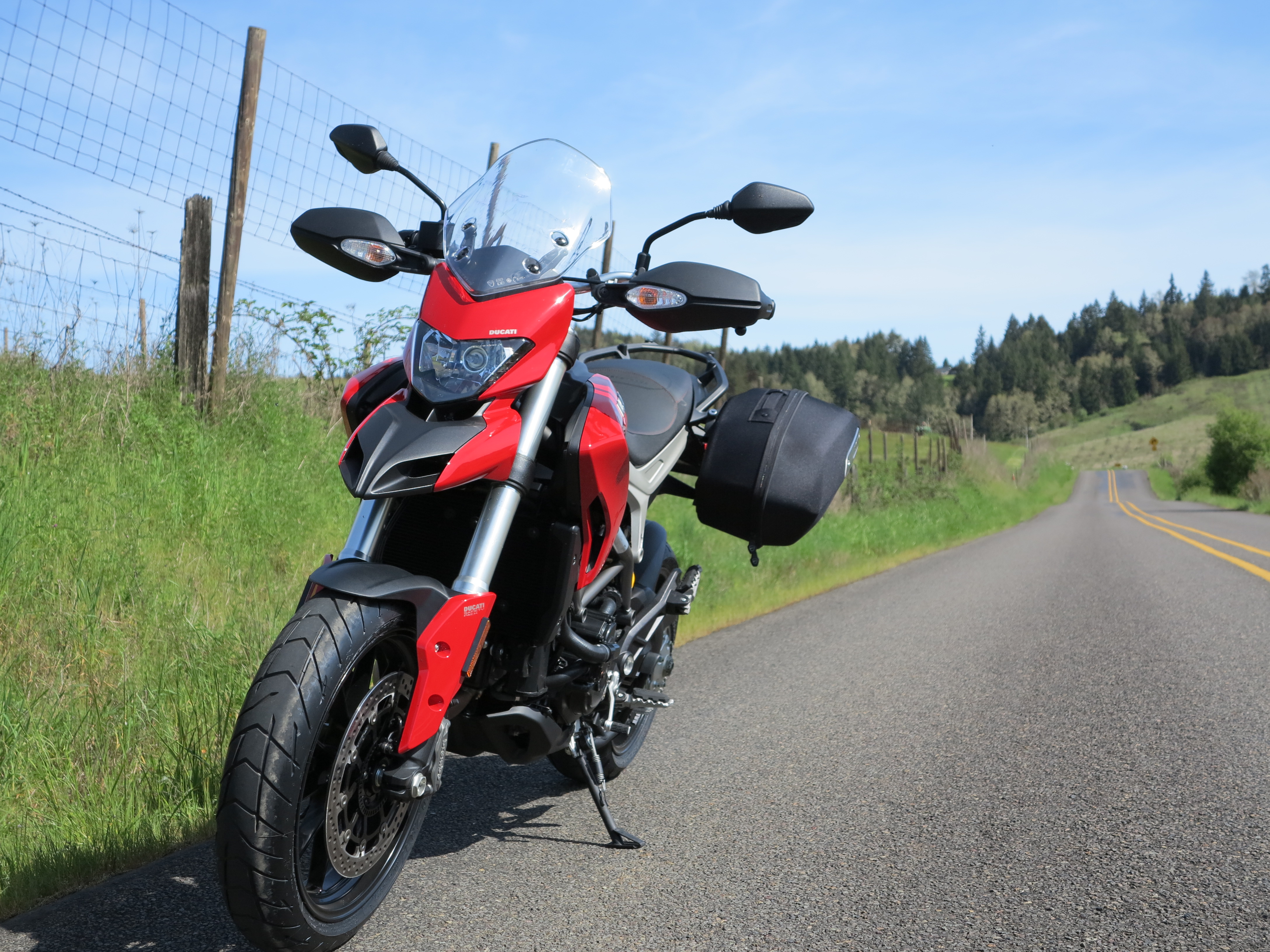
The 2013 Ducati Hyperstrada

The 2013 Ducati Hyperstrada

So, what about the Hyperstrada?  What are these revisions to the Hypermotard line for 2013?  This bike comes in three versions: Hypermotard, Hypermotard SP, and the HyperStrada. All of them with a new V-twin motor, an 820 cc water-cooled 11 degree Testatretta motor:

  • Motor: Testastretta 11°, L-Twin cylinder, 4 valve per cylinder, Desmodromic, liquid cooled
  • Displacement: 821.1cc
  • Bore x Stroke: 88 x 67,5 mm
  • Compression ratio: 12,8:1
  • Power: 110hp (81kW) @ 9250rpm
  • Torque: 89 Nm (65.8 lb-ft) @ 7750 rpm

For more technical specifications on this bike, check the Ducati USA site.

The three bikes in this family come with three riding modes (Urban, Touring and Sport), the Ducati Safety Pack (ABS, and Ducati Traction Control) and Ride by Wire as standard equipment. The Hypermotard is the base model.  The Hypermotard SP comes with Marchesini forged wheels, fully adjustable suspensions with Marzocchi forks and Öhlins rear shock, besides the SP colors (the nice red, white and black color scheme). Also, the riding modes are different in the SP, it follows a more aggressive set up.

Photo from Ducati USA Site of 2013 Hypermotard SP

Photo from Ducati USA Site of 2013 Hypermotard SP

The Hyperstrada is the touring version, equipped with 50 liter semi-rigid side panniers with the incorporated supports, touring windshield, touring seat, passenger grab handle, center stand, larger front and rear mudguards, engine sump guard, and two 12 V power outlets.

The 2013 Ducati Hyperstrada

The 2013 Ducati Hyperstrada

While at the launch party I organized with Scott to be at the shop the next day, first thing in the morning, to take it out for a spin. So the next day I took my Triumph, which needs to be ridden, and went to the shop.

The Triumph need to be ridden!

The Triumph need to be ridden!

I arrived at 9:00am as the staff were still cleaning up after the party. We quickly processed the paperwork and I was out.  I took off towards the south hills of Eugene on a picture perfect spring day in the Willamette valley.

A picture perfect spring day in the valley and a nice motorcycle to put me in it

A picture perfect spring day in the valley and a nice motorcycle to put me in it

The first thing you will notice when mounting the bike is how you seat on the bike, not in it. And despite the small wind screen, from where you seat you have the impression there is nothing in front of you, just the road beyond the handlebars. It feels very compact, with the handlebars being tall providing the rider with an upright riding position. The ergonomics feel very similar to what I get on my WR250R.  But that is as far as I would go when comparing my little 28hp WR to the Hyperstrada.

Not a Streetighter, but not bad looking at all! Great job on the minor changes.

Not a Streetighter, but not bad looking at all! Great job on the minor and subtle changes.

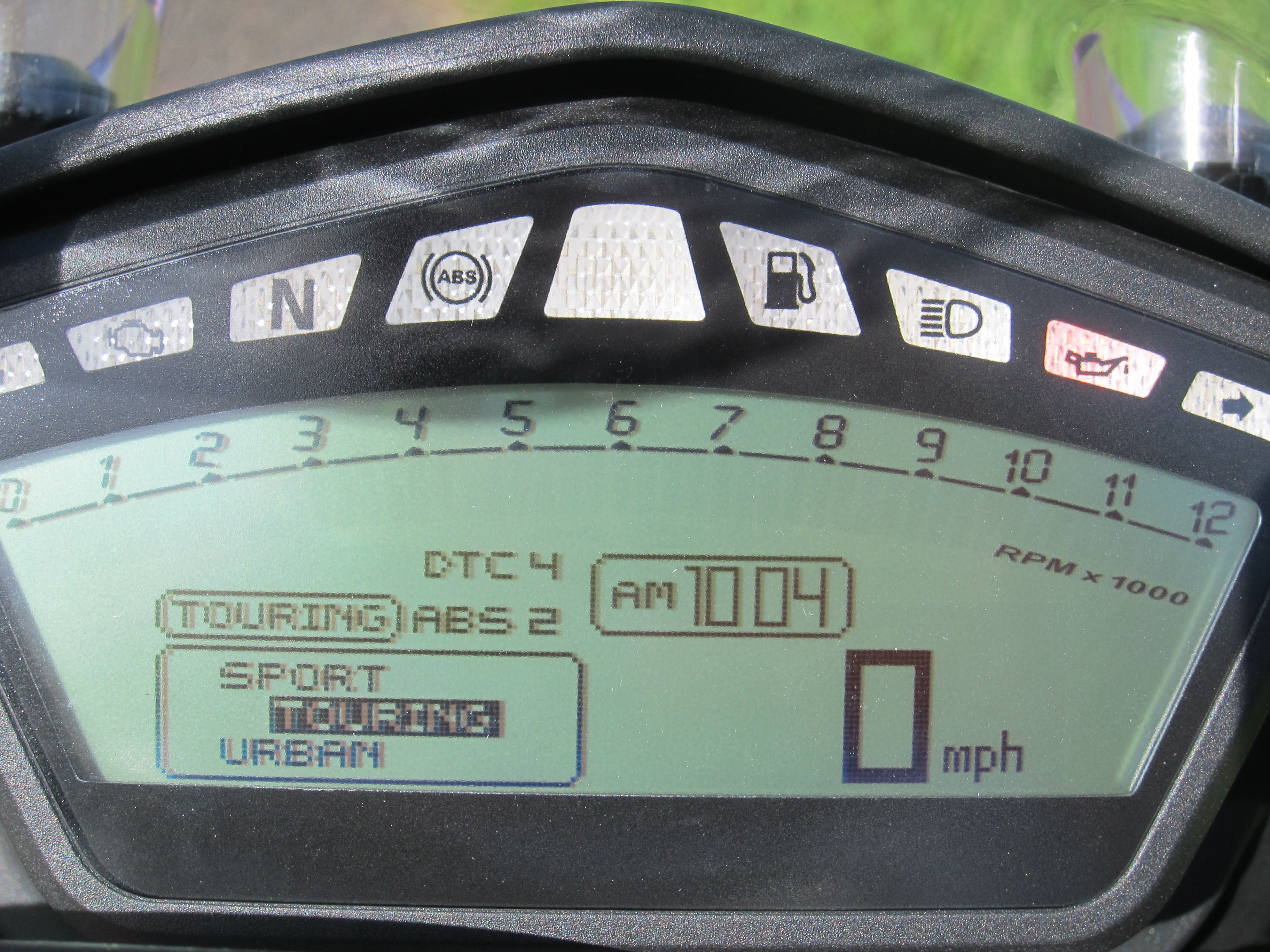
I selected the Urban mode (modes are selected the same way as in the Multistrada), it is always nice to start in the tamest mode as you get to learn about the motorcycle.  As soon as I reached the open roads, not more than 3-4 miles from the shop, I switched to Touring mode.

Touring defaults to DTC at level 4 and ABS 2.  Sport defaults to DTC 3 and ABS 1. You can customize these settings.

Touring defaults to DTC at level 4 and ABS 2. Sport defaults to DTC 3 and ABS 1. You can customize these settings.

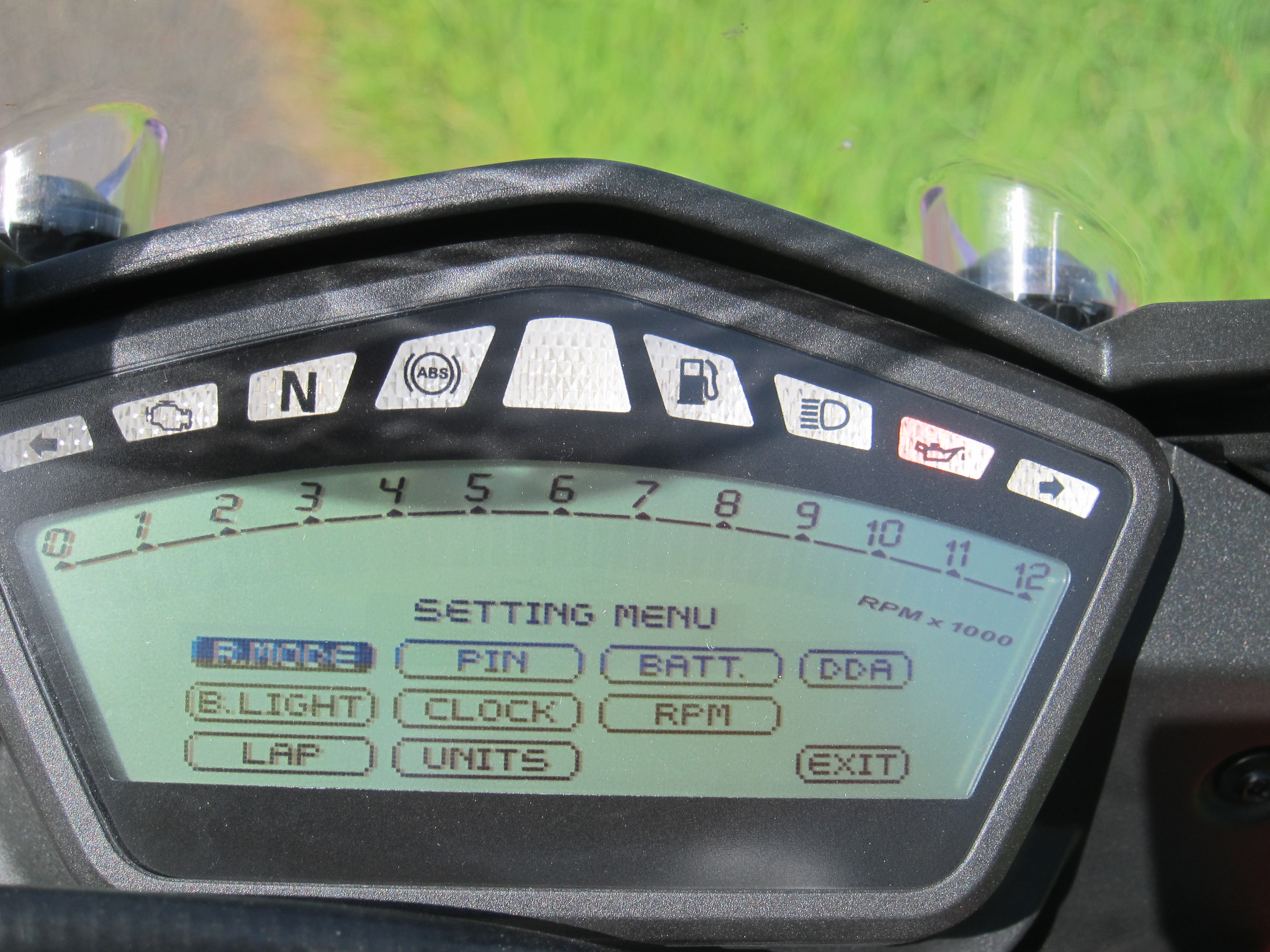
In each mode you can adjust ABS and Traction Control levels. And you can customize a few host of other variables in the display.  The one thing I have an issue with Ducati is their information systems. Except for the Panigale and the Diavel, they are all monochrome, digital sets. And for the case of the Hyperstrada (and the Hypemotard line), Streetfighter and Monster, I wish they provided more information as well. A fuel gauge is one critical information missing on these bikes’ information cluster.  Gear selector is another information missing on these bikes, this last one is not so critical, but it is nice to have it.

Pressing "R.MODE" on the settings menu allows you to reconfigure DTC and ABS settings within the riding modes

Pressing “R.MODE” on the settings menu allows you to reconfigure DTC and ABS settings within the riding modes

Because I did not spend much time on the Urban mode, I can’t quite say what is the difference between Urban and Touring.  But I can say this bike is a lot of fun, the motor is very smooth and very responsive. Similarly to what Ducati has done with the Multistrada 1200 motor, the Hyperstrada’s 820 cc motor was born with dual spark plugs and the other recent refinements delivering smooth power with no hesitations or surges. It is brilliant.

The 2013 Ducati Hyperstrada

The 2013 Ducati Hyperstrada, perfect for the country roads

The wind screen did not create any turbulence. I just got a very clean rush of air from the chest and up.

No turbulence, just nice clear wind flow.

No turbulence, just nice clear wind flow.

The bike is narrow and feels extremely light, with a very fast turn in, but very stable as well. Not different from the Hypermotard I tested a couple of years ago. And I could not tell there were two bags attached to it.  The bags appear to be very light, but I wondered how the bike would feel without having them installed, after all they must offer some wind resistance.

The bags are symmetric, courtesy of a lower exhaust.

The bags are symmetric, courtesy of a lower exhaust.

I kept riding this bike and I was really getting inspired by its smooth power delivery, its immediate turn in, enjoying the crisp air on that sunny spring morning with the beautiful vistas of fields and hills outside of Eugene. Something was missing, however. I had flashbacks of my Yellow 848 Streetfighter, the motors are similar in terms of displacement, but this bike was not quite telling me the same story.  Then I looked at the dash… I was on Touring mode. Let’s try Sport mode! I checked my mirrors, no one behind, brought the clutch in, switched to Sport mode. Holly desmodromics, Batman! That’s what was missing from this ride! What a transformation. Now I could experience the soul of my Streetfighter, but with a much smoother power delivery and a nice and comfortable riding position.  Ducati should call it “Hooligan” mode instead of Sport, it would go a lot better with the theme of the Hypermotard line.

Horses and horses

Horses and horses

Talking about horses, the Hyperstrada’s motor is rated at 110 hp to the Streetfighter’s 848 132 hp.  The 820 motor  in the Hyperstrada has a smaller bore and longer stroke than the 849. This is what gives the 820 cc motor a better power delivery, more torque down low, and perhaps a more useable gearbox (it could be only the torque issue here).  The result is that you can actually use 6th gear without breaking the speed limit (too much). It seems either the torque is really useful, the motor really smooth, or the gear ratios are closer.  What I can tell you is that it delivers a lot more fun charging the hills and its curvy roads than I remember by 848 could deliver.

The horse could surprised when I said: 110 horses!

Love at first site

The difference between Touring and Sport? On Touring mode you can actually use this bike to engage yourself on and in the scenery. On sport mode the bike engages the hooligan in you. Be careful!

The revised beak, a welcome modification in my opinion

The revised beak, a welcome upgrade in my opinion

And the Hyperstrada may not be a looker as much as the Streetfighter is. But it is not too bad.  I liked the revised nose, the subtle changes to the tank fairings to accommodate the radiator.  Actually, Ducati did a great job with the plumbing on this bike, something the Streefighter does not have in its favor, with a few coolant hoses looking out of place on that bike.

Not too bad.

Not too bad.

And the bags, 50 liter each,  since the exhaust is low enough they can mirror each other without cutouts. Not too bad looking. The bags open and close with a zipper. I wonder about the durability of this system. But these bags certainly make this bike capable of touring for several days. Specially if you add a top box.

Plenty of space. Even more if you add a top box

Plenty of space. Even more if you add a top box

The bags are very light, semi-rigid plastic and come with dry bags, which makes me think they are not water proof.

Dry bag inside each pannier

Dry bag inside each pannier

All in all, this is quite a nice machine. I was really impressed by its road manners, its power delivery, the smooth gear box, the gear ratios (or torque or both), the power itself, and its capacity to move from Touring to Hooligan modes with the touch of a button. If I could have four bikes I would get this bike right away.

What a nice and sweet, hooligan machine

What a nice and sweet, hooligan machine

But let me think of excuses to get this bike… A “Terra Mostro” thought crossed my mind, what if I could transform it into a gravel ready beast?  And does it come in yellow? These bikes come in red or white. Or the SP version, with the nice three color scheme.

The open curvy roads and this bike, nice combination

The open curvy roads and this bike, nice combination

I’m really glad I had a chance to ride this fine machine. This bike was perfect for that Sunny Spring day, a perfect day to ride it in Touring mode, in open air, see the new green and the blooming flowers. And then let the bike engage me in Sport mode for a well composed multicolor blur, with the hooligan in me enjoying the machine and what it can do.

Be careful out there!  This is one engaging machine.

Posted in Bike Reviews | Tagged , , , | 21 Comments

To Crater Lake and other nice places with the Ducati Multistrada

This post is written in memory of my Uncle André Benito D’Agord (Tio Benito).

After several days of rainy and cold weather I was more than ready to ride when things cleared on the weekend’s weather forecast. And to compensate the time I was away from riding, my plan was to go far. What about a 600 mile loop for Sunday, April 20th?  But I played soccer Saturday and one of my buddies missed the timing on a tackle and knocked me down, blocking my left foot, forcing it to a sudden stop, sideways, provoking an about 90 degrees sideways torsion to my ankle. First thing I thought when I realized the damage to my ankle was that I wouldn’t be able to ride Sunday as planned! And the bike was all nice and clean and ready to go the distance with two GPS’s, the touring screen and a full tank of non-ethanol gasoline.  All dressed up and nowhere to go.

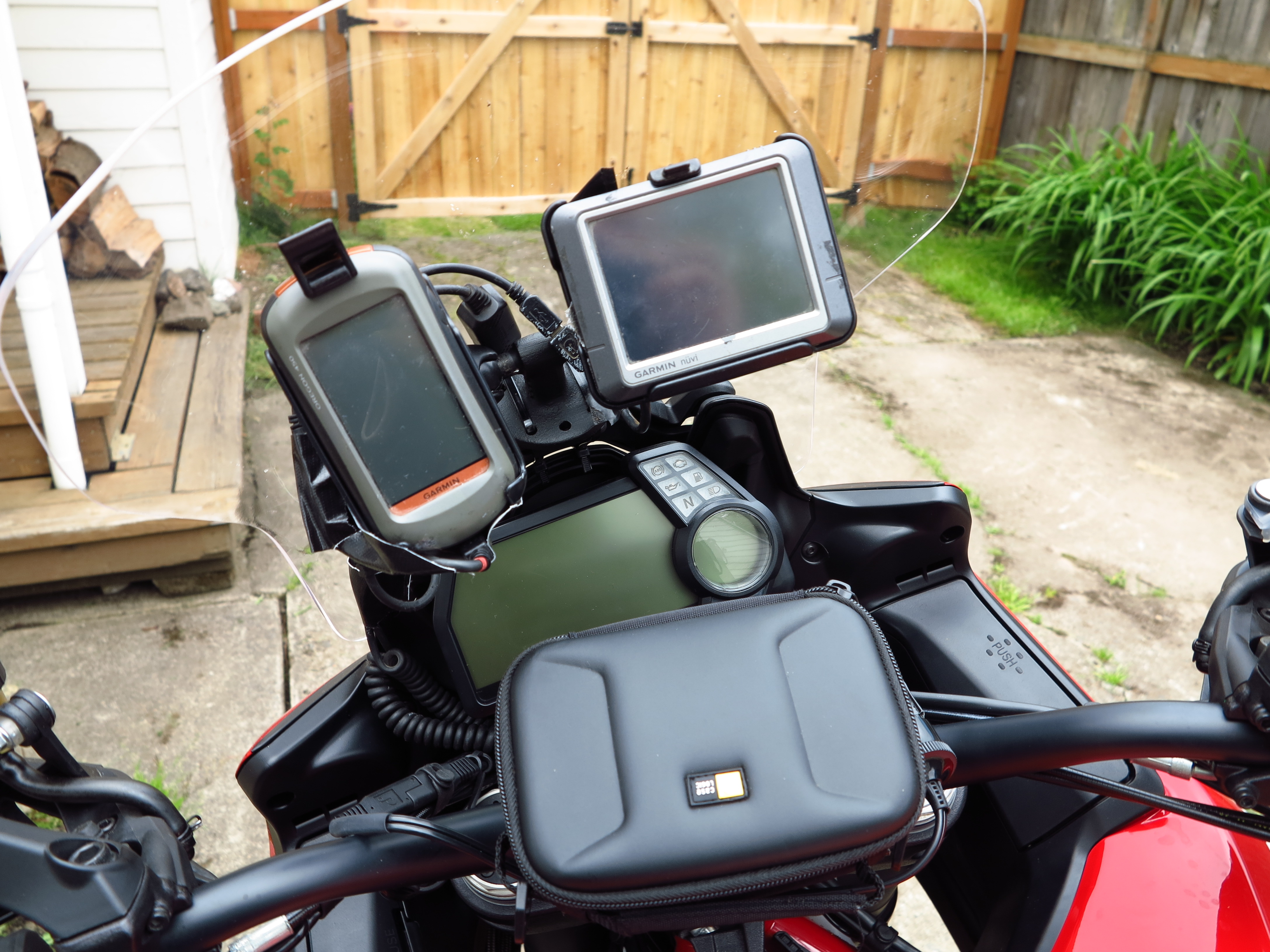
Why only two GPS's? Because three would be too much And I only have two of these things.

Why only two GPS’s? Because three would be too much Or because I only have two of these things.

Saturday evening the pain in my ankle was a solid 5 on a 1-10 scale, but then I woke up Sunday morning feeling better and decided to try on my riding boots. I put them on, tightened it up and I could put my left foot down and it held my weight okay and without (much) pain and I could walk (with a limp). So let’s go for a ride. By the time I made this decision it was already late for my 600 miles plan, so I decided on a shorter route, via Hwy 58 in the general direction of my original plan, the Crater Lake, minus a few hundred miles of detours. And the idea was to re-evaluate at some point and decide if I could go as far as Crater Lake or not.

Got the beautiful bike ready to go! Let's see how far can I go.

Got the beautiful bike ready to go! Let’s see how far can I go.

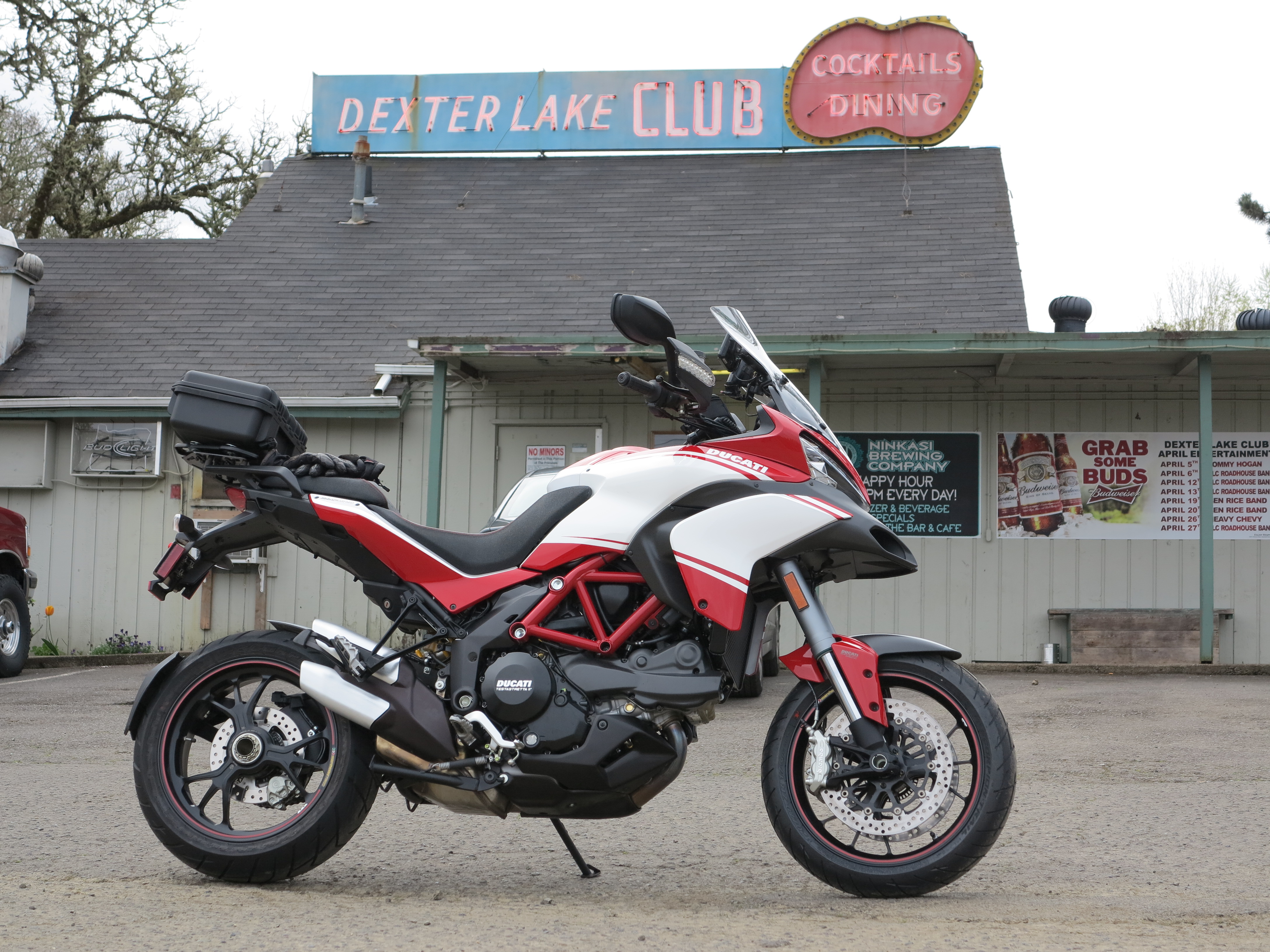
I first needed to know how I would mount the bike, using my left foot as the pivot to swing my right leg.  Well, it worked okay with only minor pain. I started carefully down the road, afraid when stopping, when I would touch the ground with my left foot, I had visions of my ankle collapsing, taking me and the bike down. So the idea would be to always when stopping use only my right foot to support the bike. In the end, no problems at all, left or right foot stops, except for that psychologically induced fear that never quite went away in the first several stops. My first stop was at Dexter Lake, to check out the Animal House film’s club where the guys were beaten up when they showed up at that club, unannounced and with that pseudo-conquer-it-all quasi-frat attitude.

Dexter Lake Club, portrayed in the Animal House film

Dexter Lake Club, portrayed in the Animal House film

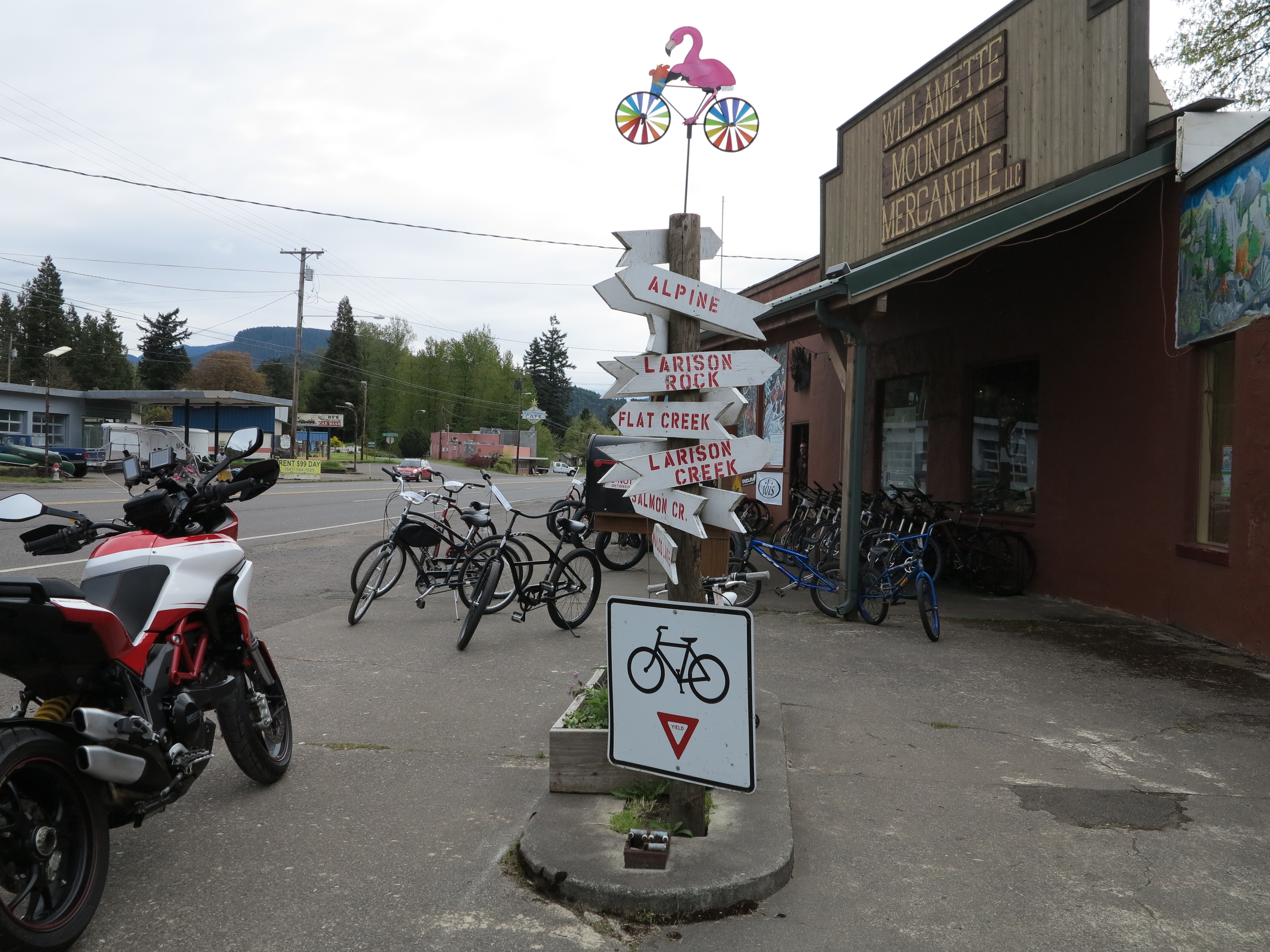
Next stop was Oakridge, where I filled up the tank. Oakridge has been through a renovation in its approach to business in the last few years.  From a run down logging town it discovered mountain biking a few years ago (or mountain biking discovered Oakridge), becoming a leader in this type of sport and one of the meccas for mountain biking in the region.  There is also a brewery and other attractions.  Hoping it continues its resurgence. Check here to read an article on NPR about Oakridge and its transition from a lumber town to becoming a Mountain Biking destination.

There is also a very good documentary, Pedal Driven, about how mountain biking gained space in the western region, it includes a description of the area around Oakridge.

Willamette Valley Mercantile in Oakridge, Oregon.

Willamette Valley Mercantile in Oakridge, Oregon.

I used to race cross country mountain bikes when I lived in Ohio. I still have a couple of mountain bikes, maybe I should get them ready and ride the Oakridge trails some day this summer. Larison Rock and Creek trails are on old growth forest areas, I hear. In the summer, when it all gets dry that area must be a really nice place to ride a mountain bike.

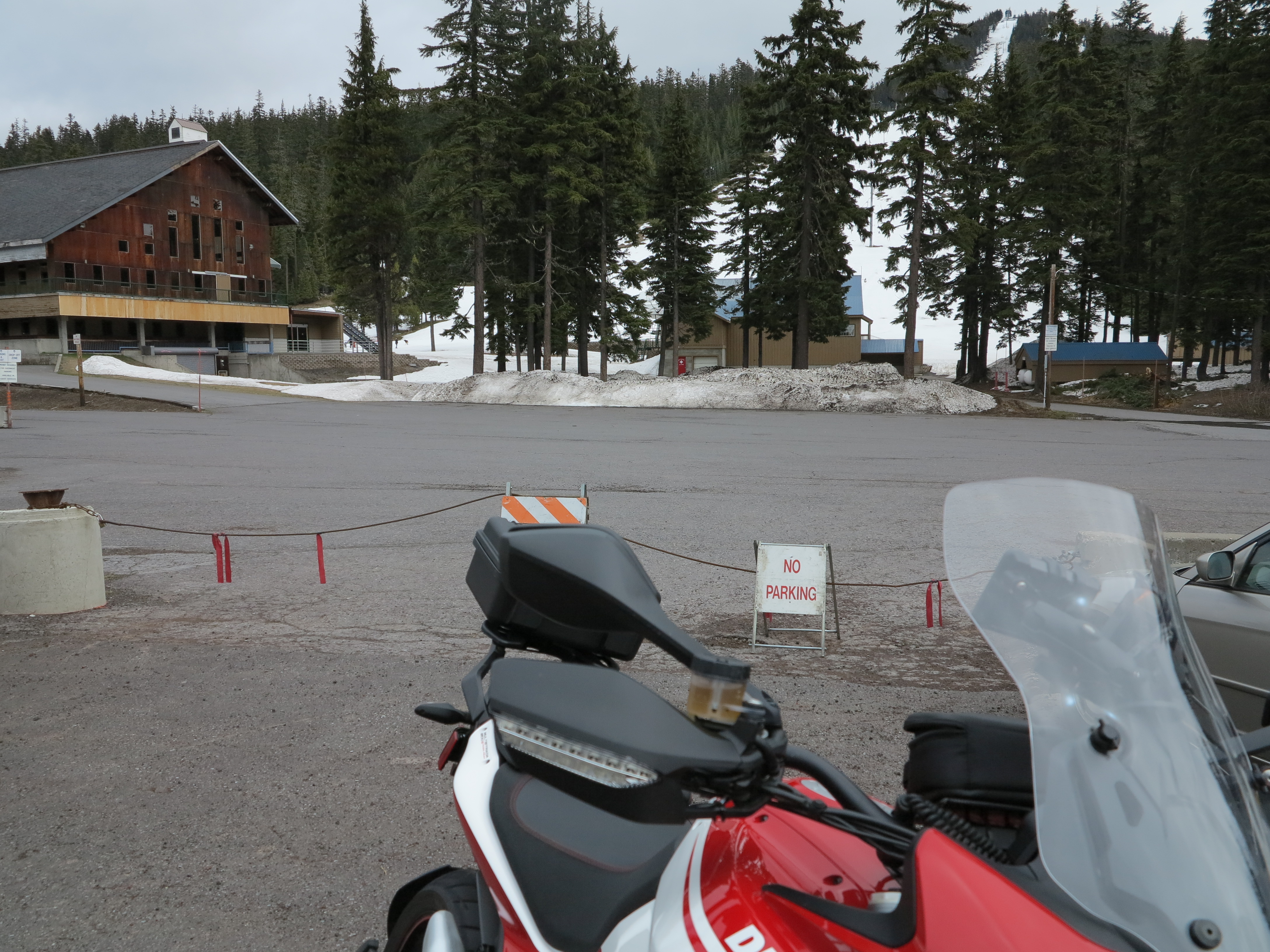
From Oakridge I continued up and southeast on Hwy 58 and soon I learned the tunnel is still under construction with traffic in only one lane. I made my third stop at the Willamette pass and found out the ski season is over.

Willamette Pass - Ski season is over. April 21st, 2013

Willamette Pass – Ski season is over. April 21st, 2013

This is at about a 5,000 ft elevation, it was a bit chilly here, low 40’s.  But I knew it would only get worse from now on, towards the Crater Lake at something more than 6,000 ft of elevation.  By this time here I had completely forgotten about my left ankle and that painful soccer injury.

Next stop was at the entrance to the Crater Lake National Park.  The West entrance was the only way to the park this time of the year.  It starts from Hwy 62, so I had to do an extra set of miles to get there.  The north entrance, the one closest to where I was coming from, was still closed, blocked by a wall of snow.

West Entrance to the Crater Lake National Park. April 21st, 2013

West Entrance to the Crater Lake National Park. April 21st, 2013

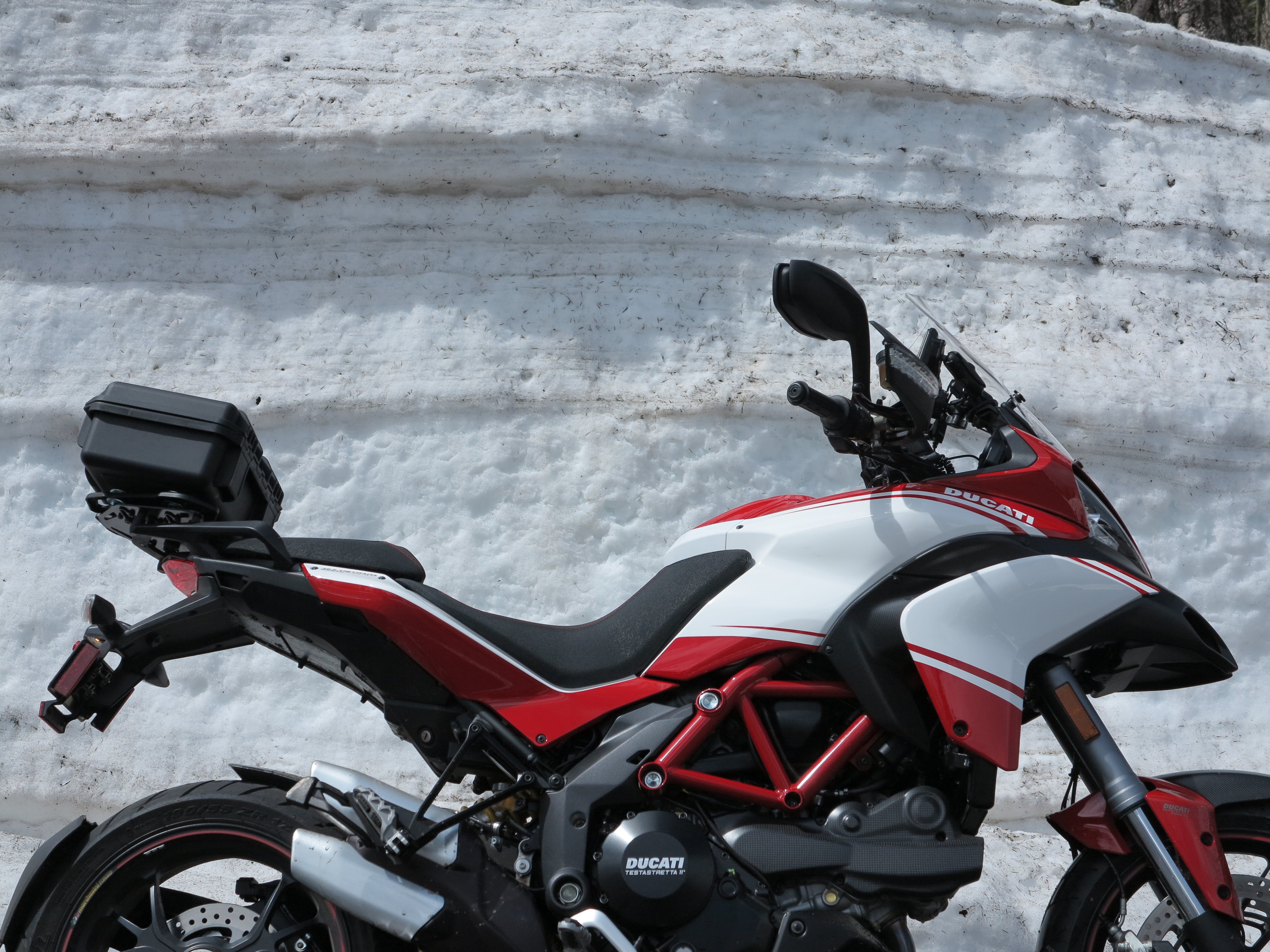
I continued up and soon I was there, walls of snow on both sides of the road. At the top the store was open, a few tourists around, we were all confined in a small area of the park, the only areas where the roads are kept clear of the snow.

Walls of Snow. Crater Lake National Park, April 21st, 2013

Walls of Snow. Crater Lake National Park, April 21st, 2013

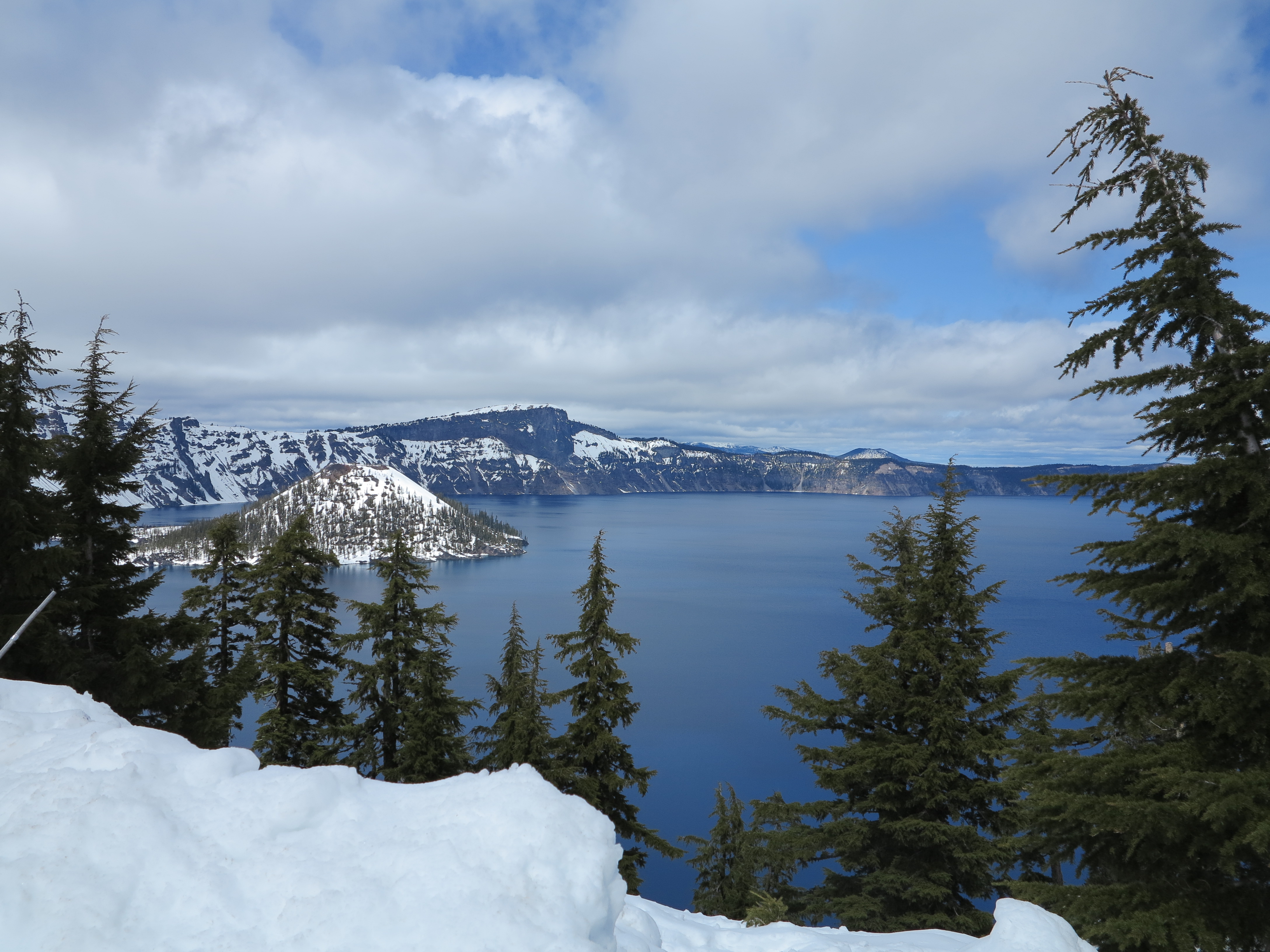
The lake is always beautiful, no matter the time of the year you go there.

Crater Lake in the Spring. April 21st, 2013

Crater Lake in the Spring. April 21st, 2013

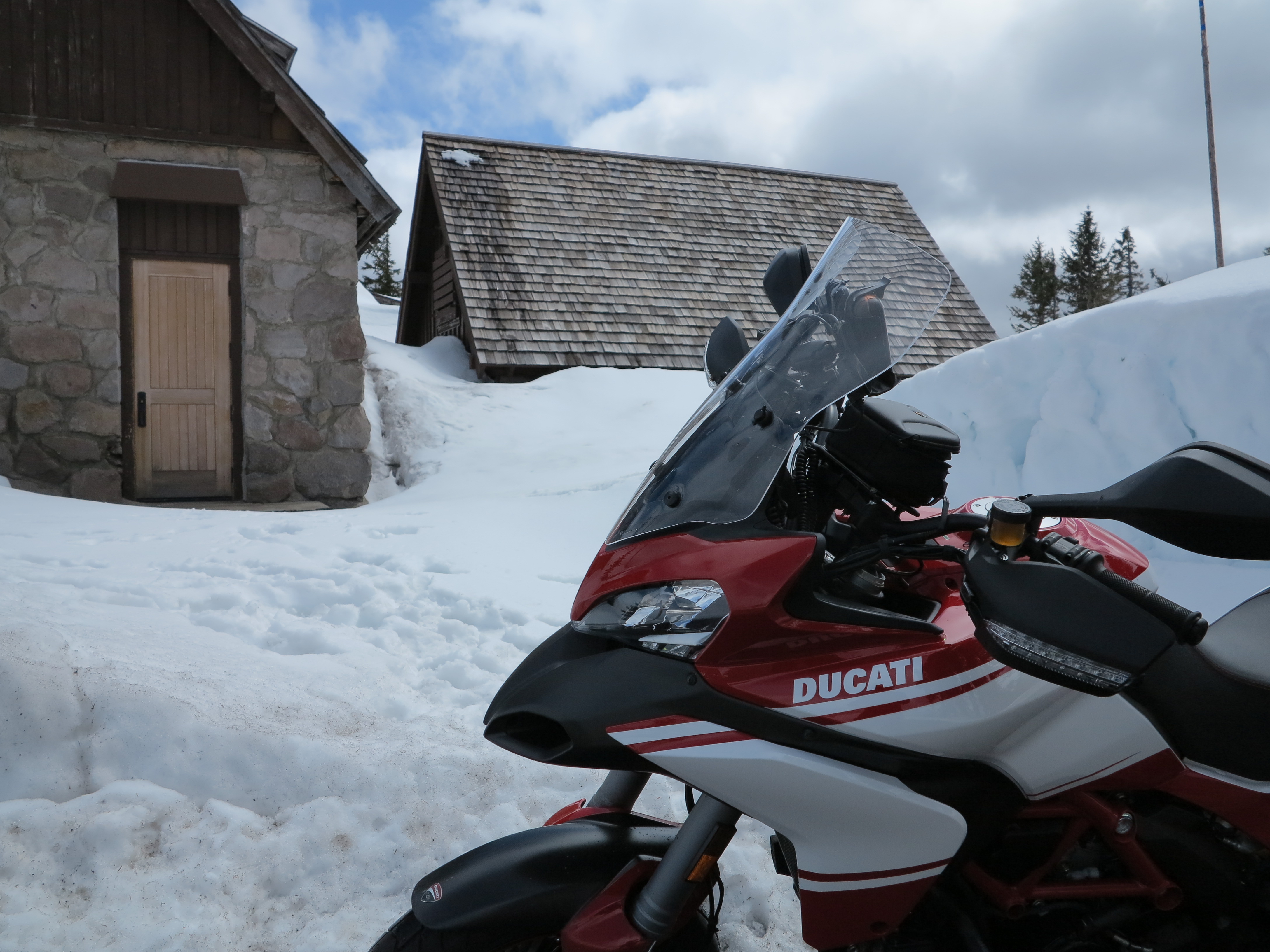
An opportunity to photograph the bike with the snow.

The Multistrada and the Snow. Crater Lake, Oregon. April 21st, 2013

The Multistrada and the Snow. Crater Lake, Oregon. April 21st, 2013

Soon all these roads will be open and I will come back for a proper visit to Crater Lake.  By the way, I was here a few other times before. And I have a report of my visit to Crater Lake, last year, with the Triumph.

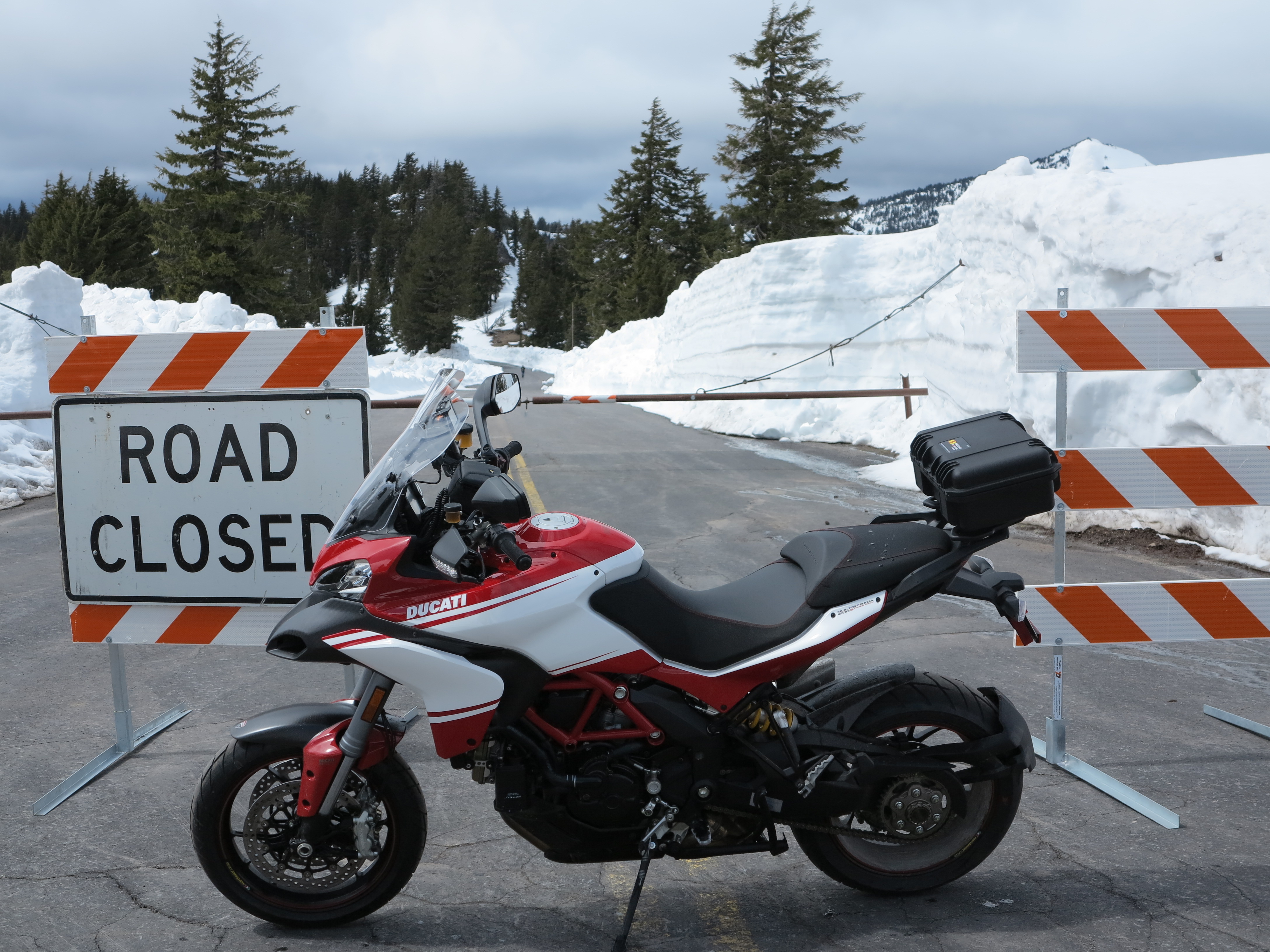
Te road that goes around the rim, closed April 21st, 2013

Te road that goes around the rim, closed April 21st, 2013

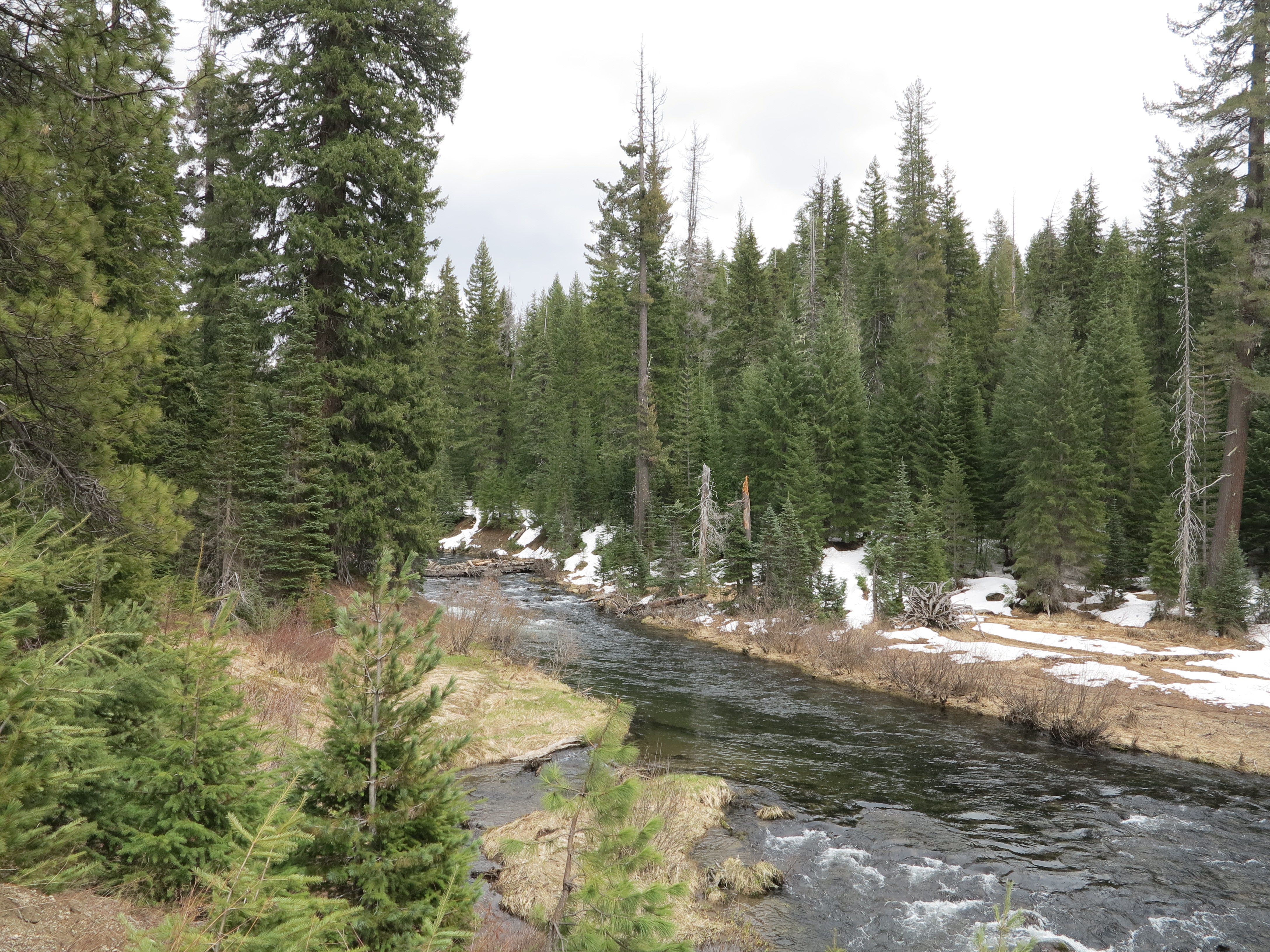
The Rogues river goes from north to south on the west side of the Crater Lake. I followed it for a while, I was traveling north, the river is traveling south in this area.

Rogue River

Rogue River

My goal was to reach Hwy 138, and follow the Umpqua river down to the Willamette valley and from there I would be home quickly.

Non-ethanol fuel in Diamond Lake.

Non-ethanol fuel in Diamond Lake.

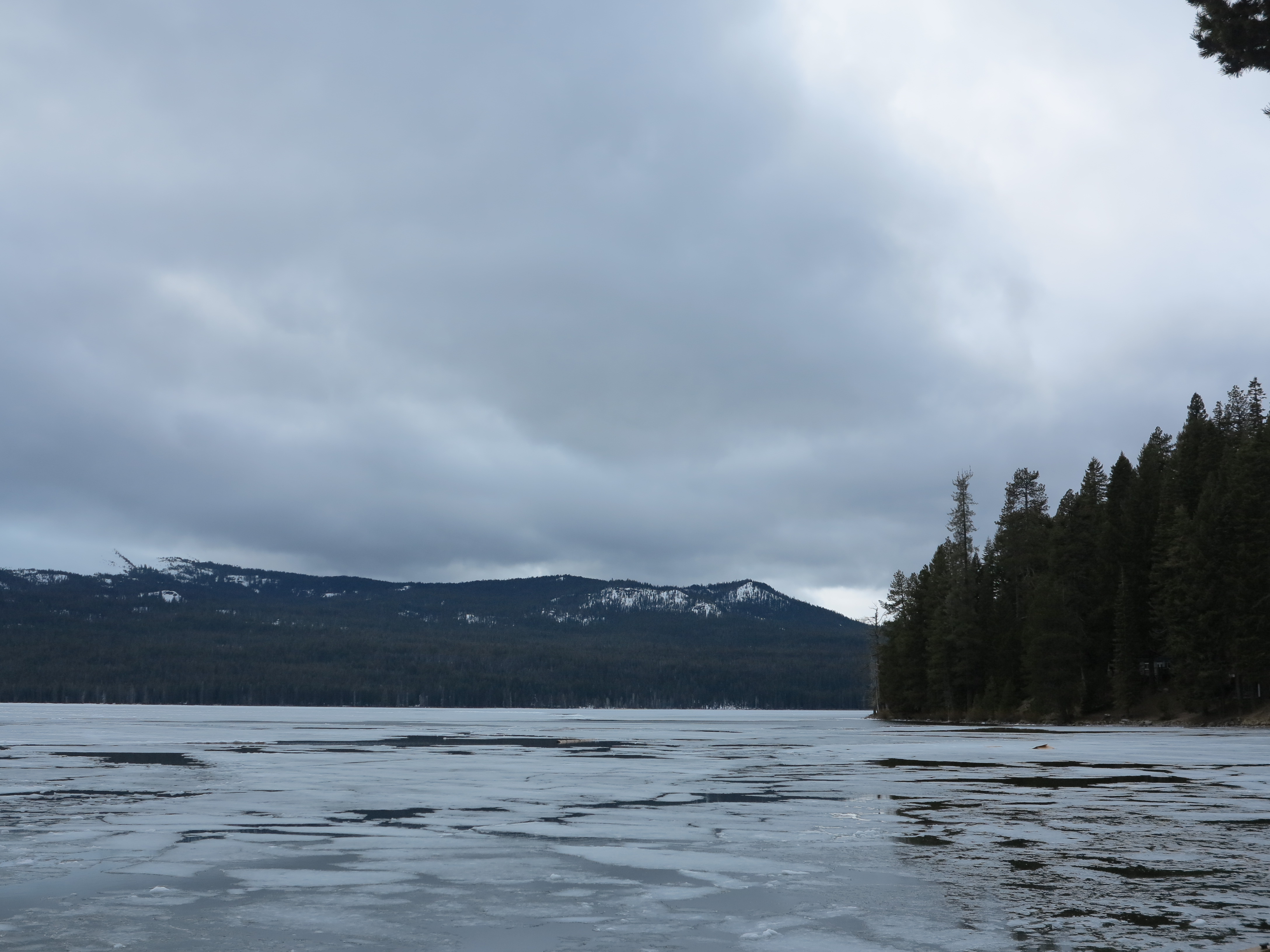
I checked the lake itself, and it was still somewhat frozen.

Diamond Lake still somewhat frozen

Diamond Lake still somewhat frozen

Yes, the bike was there too.

Diamond Lake, somewhere behind the bike.

Diamond Lake, somewhere behind the bike.

I asked it to move so I could take a more decent picture of the lake.

Diamond Lake. April 21st, 2013

Diamond Lake. April 21st, 2013

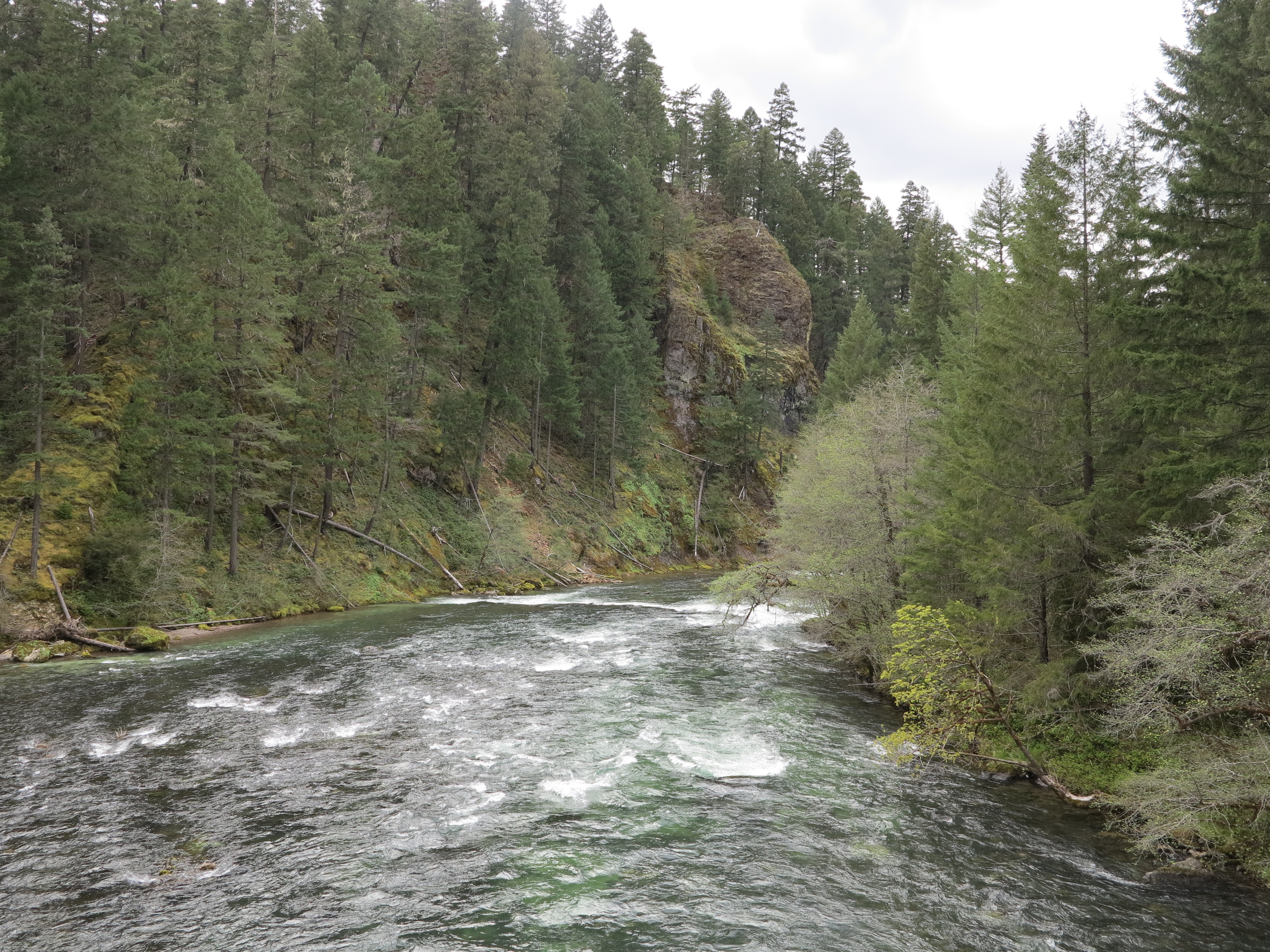
The weather is not looking too good, as you can see from the pictures. I felt a few drops of rain, and it was getting late, so let’s go home! From here I’m a good 175 miles from home, so it would be a long way.  But, my friends, Hwy 138 is a treat for a motorcyclist. Besides great curves, it is beautiful following the Umpqua river, with nice rock formations on both sides of the valley carved by the river. On my other report about the Crater Lake I reported some pictures from this road.  Today, with the possibility of rain I decided to just go down the cascades towards the valley.  Eventually the weather cleared and I stopped to check Watson Falls.  Can you see it up there on the very top?

Watson Falls

Watson Falls

I tried to hike towards the falls, but my foot did not cooperate. It was actually not bad, but I thought about the damage I could be generating. But I walked a little bit towards the falls on a nice, well groomed trail.

Typical Cascades creek and falls.

Typical Cascades creek and falls.

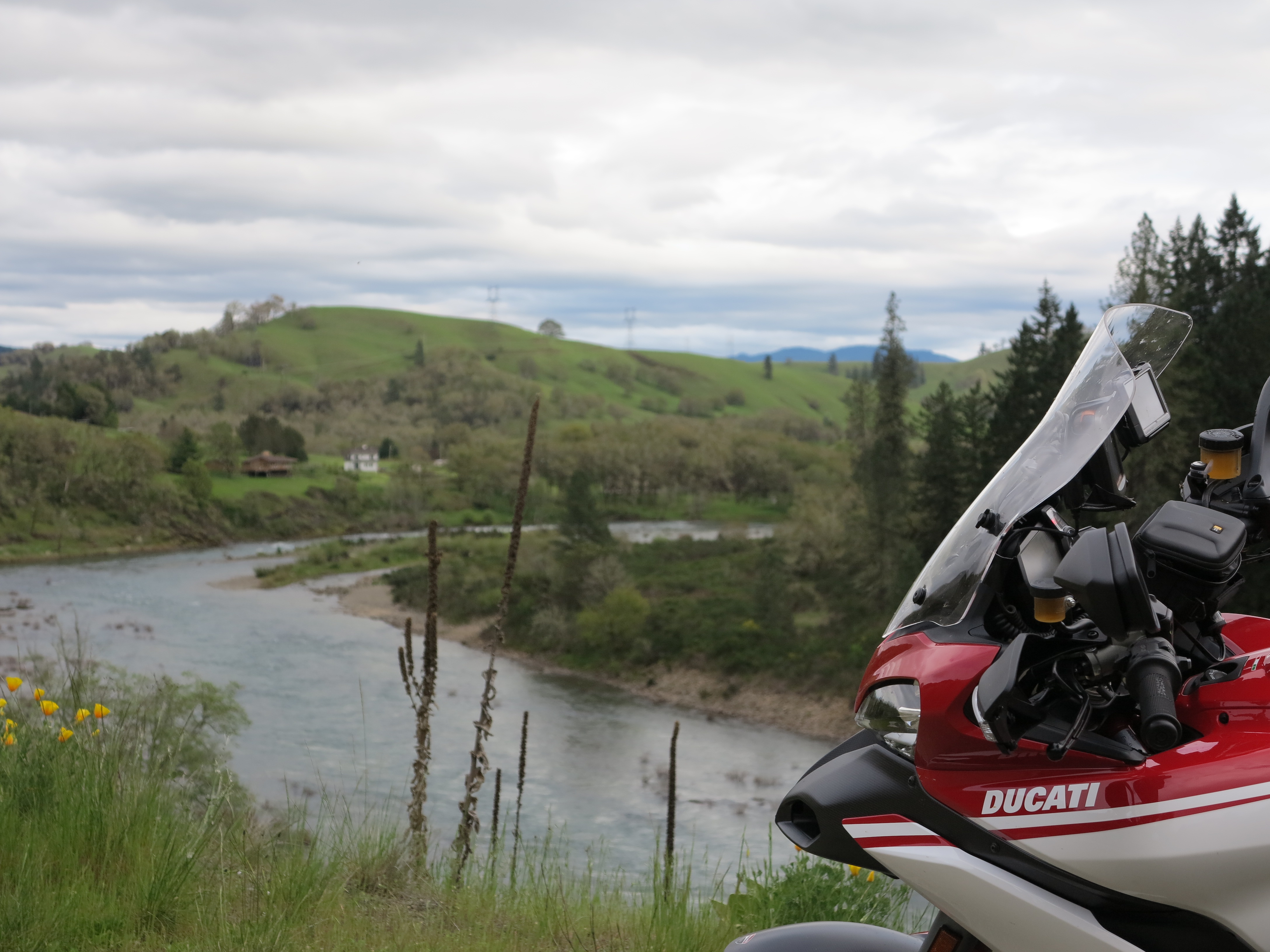
Continuing west, I stopped to check the river by the Horseshoe Bend.
The Umpqua River by the Horsehoe Bend

The Umpqua River by the Horsehoe Bend

And from there all the way to the valley. I took the North Bank Rd., a nice short cut to Hwy 99 where I would go north towards Eugene.

North Bank, on the Umpqua River.

North Bank, on the Umpqua River.

When I stopped here I checked my phone and I noticed my father had tried calling me several times.  It was already too late for me to call them back, they are four hours ahead.  But I thought something had gone wrong.  I made a quick stop in Oakland. It was rather empty today.
Oakland, Oregon

Oakland, Oregon

Continuing north on old Hwy 99, the plan was to cross I-5 towards Drain and from there find Territorial and Lorane Hwy back home.  But then I came across these wild turkeys by the road.

Turkeys along the road.

Turkeys along the road.

And worse yet, deer.

Deer

Deer

It was getting dark, the deer were becoming active, I thought I would be better off taking I-5 and doing the last 40 miles on the slab.  I really don’t like riding on a freeway, but I believe it was the safest bet at that time.

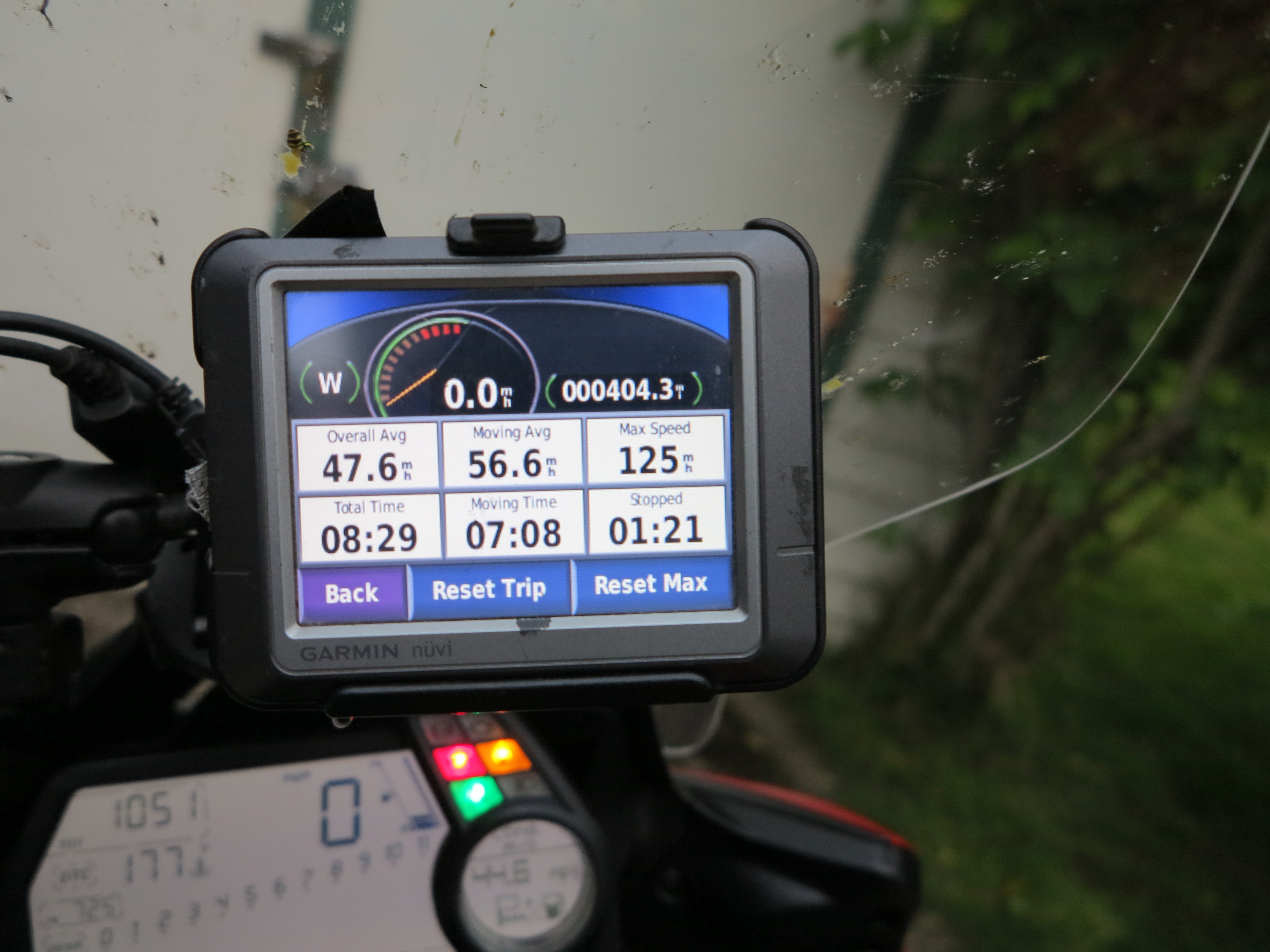
400 miles

400 miles

That 125 mph must be an error… What matters is that this was a nice long trip in this nice motorcycle.  I was out riding for 8 hours and a half, 400 miles of fun.  I realized the regular screen does not do the job well when you ride at speeds higher than 60 mph.  I will install the Pikes Peak shorty screen. I think it does a lot better in terms of wind turbulence. It may protect less against the elements, but clear wind is a better deal than chopped wind in terms of noise.

Back home.

Back home.

And once again we made it home safely.  I put the bike in the garage, went inside and got the news that my uncle, my father’s brother, had passed away.  André (Tio Benito) D’Agord died peacefully while taking his afternoon nap, at about the same time I was on my way to Crater Lake, this last Sunday, April 21, 2013. Tio Benito was born in November 30, 1931, had a long live but lived quietly and in somewhat close boundaries. I don’t know if he had ever left our state, Rio Grande do Sul. But I know his mind traveled to many places. He never asked much off life or anyone. But the few things he asked off me, I tried to oblige. When I saw him in April of 2012 he asked me for a postcard from Oregon. When I saw him again a few months later, in November of 2012, I gave him a few postcards from Oregon. One of them was of the Crater Lake. Whenever I travel again to Crater Lake I will think about Tio Benito and his gentle soul. Rest in peace Tio Benito!

Posted in Riding the Ducati, The Book, Travel | 4 Comments

Riding the new 2013 BMW 1200 GS

The 2013 BMW 1200 GS represents a major development in the evolution of this very successful motorcycle. Perhaps it is the largest step since 1979-80 when the first GS was introduced to the market. I was glad that EMCWOR offered me a chance to ride this motorcycle. My impressions are that overall what has kept this bike for more the 30 years as the gold standard of this segment of the industry is still there. And from what I’ve read from others who had an opportunity to ride it off road, the 2013 model continues to offer the most balanced experience in terms of on and off pavement capabilities. This is what has kept this bike at the top of  the charts in the first place. And more specifically, the 2013 bike offers clear improvements on engine performance and engine response. This bike also offers well designed rider aids based on the highest technology available and latest innovations from the field.

The 2013 BMG 1200 GS

The 2013 BMG 1200 GS

BMW GS bikes have made history and are perhaps responsible for creating the very successful “Adventure” segment on the motorcycle industry.  The GS line started in 1980, its success happened at a very fast pace, as if the world was just waiting for such a machine to be developed.  BMW promoted it with a vision that continues to be discovered today by many riders: “Sports machine, touring machine, enduro… Welcome to a motorcycle concept with more than one string to its bow.”  In the first year it sold more than 6,000 motorcycles. Soon riders started using it for long adventure rides across the world. Then it won the Paris to Dakar race. The Long way Round and Long way Down series where Ewan McGregor and Charlie Boorman took these bikes on round the world travel helped consolidate the GS at the top position in its segment.  It is a bike with history and tradition. The 2013 model is carrying that tradition forward, while writing its own history.

Demo 2013 BMW 1200 GS at the EMCWOR

Demo 2013 BMW 1200 GS at the EMCWOR

During the latest economic downturn the adventure segment was one of the few areas of the motorcycle industry which maintained or increased its sales.  The sustained popularity of the BMW GS and this segment’s growth brought increasing competition to the market, with other manufacturers returning to this segment or developing new bikes or improving their bikes to better compete with the GS.  And it seems like the GS’s 1200 cc motor size, where the BMW has been since 2005, has become the chosen displacement for this higher end area of the adventure segment.

Today I count seven motorcycle companies that in my view are more directly competing with BMW in the 1200 cc adventure segment. KTM (new 1190 Adventure and Adventure R), Ducati (1200 Multistrada, including the GT model), Triumph (Explorer), Aprilia (new 1,200 Caponord), Moto Guzzi (Stelvio), Yamaha (Super Ténéré), and Honda (Crosstourer) are bikes with 1200 cc motors (+/-) that have touring capability with some level of sport riding and some level of dirt riding capability included. At least four (including BMW) of these eight major options have great improvements in their 2013 line up from what they offered in 2012.  Three of them offer semi-active suspensions: The Ducati Multistrada, the BMW GS, and the Aprilia Caponord. Almost all of them offer riding modes that electronically change different fuel maps and levels of ABS intervention, and traction control. It is a new world out there. And if you are ready to acquire a higher end Adventure motorcycle, 2013 is perhaps the greatest year to be in this market.

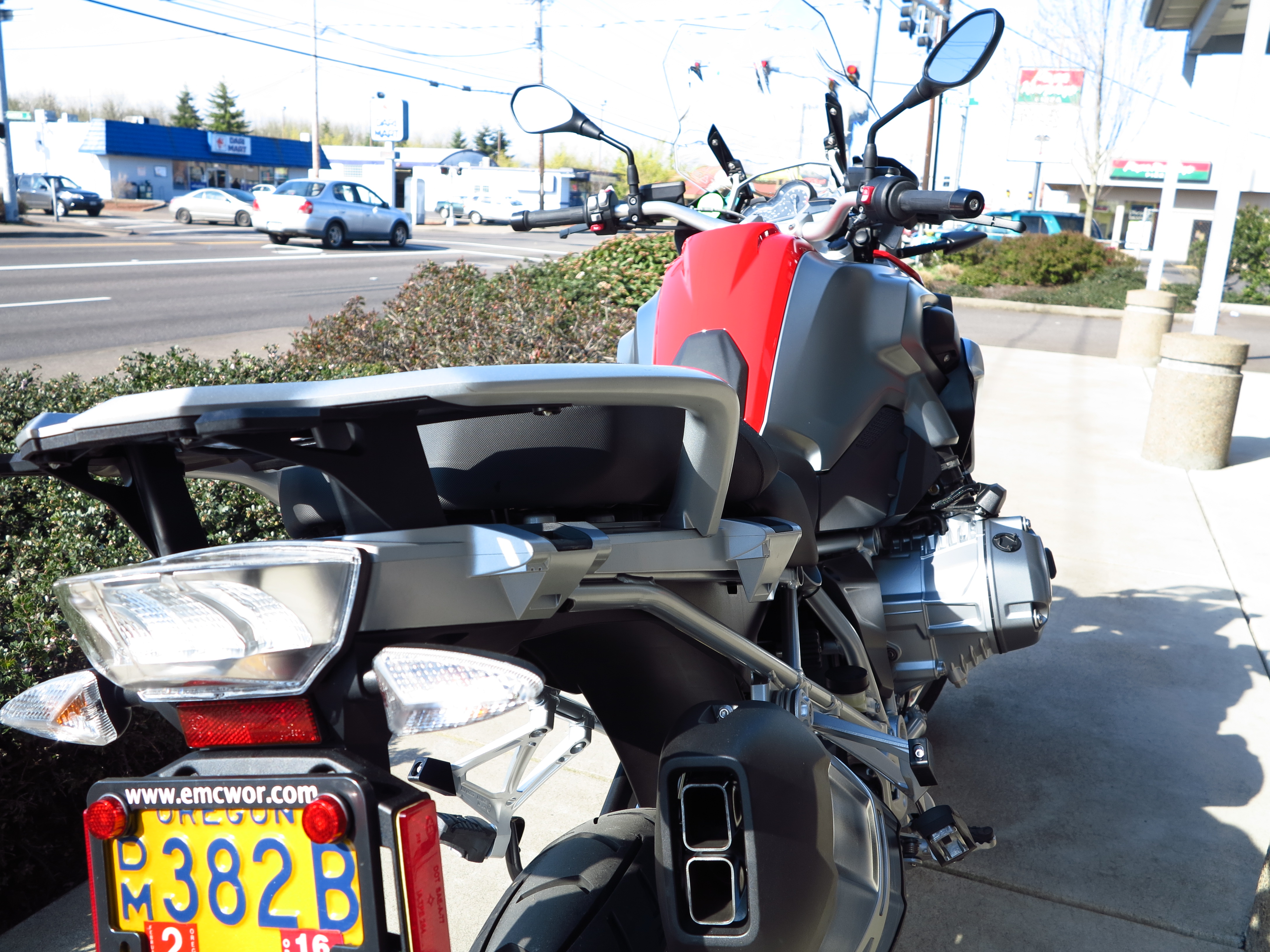
The 2013 BMW R 1200 GS

The 2013 BMW R 1200 GS

Although a share of the BMW market may have been lost as new bikes entered this segment, the BMW 1200 GS has remained the best seller by a great margin. But never before so many options have been available to the market. I can’t imagine the challenges the GS development team must have taken to come up with the revised bike, knowing how critical the moment is.

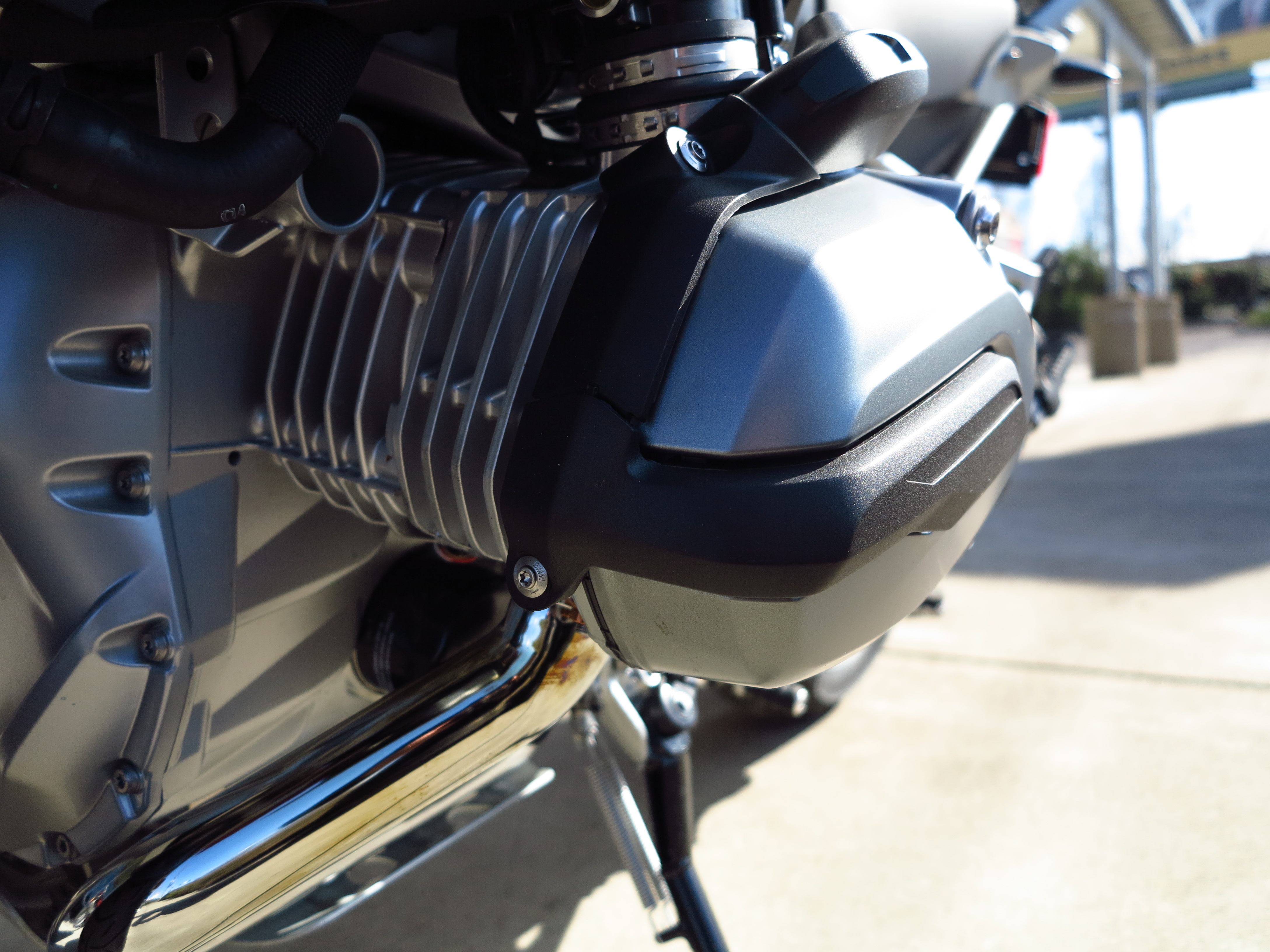
The boxer motor stays. Cylinder heads continue to be mostly air cooled. Intake moves to the top, exhaust at the bottom.

The boxer motor stays.

Changes to the 1,200 cc Motor

Considering the little I know about motors, I thought BMW’s real challenge was to water-cool the motor and maintain it as a boxer motor, as boxer motors are not exactly an easy format for water-cooling, in my layman’s view of the situation.  Air cooled motors were the standard of the industry in the not so distant past but as emissions controls and performance standards were gradually raised, motors gradually transitioned to water cooling. Air cooled motors are designed with wider tolerances to cope with a wider range of operating temperatures.  Although water cooling a motor increases weight, it allows engineers to work on a narrower band of tolerances, allowing for more efficiency and improved performance.

Improvements to the motor are noticeable!

Air cooling remains important at the cylinder heads. Intake is now  from the top of the cylinder head, exhaust on the bottom.

I have a feeling BMW engineers never considered getting rid of the boxer motor and starting from scratch as a parallel twin or some other format. How could they end more than 30 years of tradition, a motor that is intrinsic with what the GS is, and with the most successful period of BMW motorcycles, right?

The 2013 BMW 1200 GS

Two small radiators on each side of the side fairings do the water-cooling job

In the end, much like Porsche did with their 911 series, BMW engineers found a way to water cool their boxer motors. In the case of BMW, they managed it by water-cooling only critical areas of the motor, keeping it air cooled where air would be a more efficient cooling method. And they managed to keep it in a compact package by integrating the gear box with the motor.  In a certain way, it is a new motor, but one which kept its boxer tradition intact. I perceive it as a great solution with touches of innovation.

Integrating gear box with motor, result in smaller package, despite water cooling portions of it.

Integrating gear box with motor resulted in smaller engine/transmission package.

Changes to Suspension

The second major change on the 2013 bike is regarding suspension.  Although I only rode the basic model, riders have an option of buying the 2013 GS with semi-active suspension, not unlike what Ducati offers in its Multistrada or Aprilia offers in their 1200 Caponord.  In fact, these three bikes have most of the semi-active hardware developed by the same company, Sachs. The software and the application is individual for each bike.  I wish I had tested a BMW 1200 GS with their version of the Sachs semi-active suspension. If it becomes available as a demo bike I will ride it.

I took the 2013 1200 GS to my usual "testing grounds".

I took the 2013 1200 GS to my usual “testing grounds”.

Riding Impressions

I had the seat on the lower position and it gives slightly better reach to the ground than the Multistrada.  The seat appears to be narrower, which helps with the reach, but it turns out, despite being narrow, it is impressively comfortable.

The rider's seat is very comfortable!

The rider’s seat is very comfortable!

The ergonomics are spot on for me. I’m about 5’10” with 30/31″ inseam, and the seat to pegs and seat to handlebars distances allow me to be upright and very comfortable. This is not a surprise considering BMW has always been great with ergonomics that work for all types of riding on the GS line. Fit and finish are top notch, another characteristic of this German motorcycle. You can tell the design team cares for the big picture of what this bike represents but they do not let go of the detail.

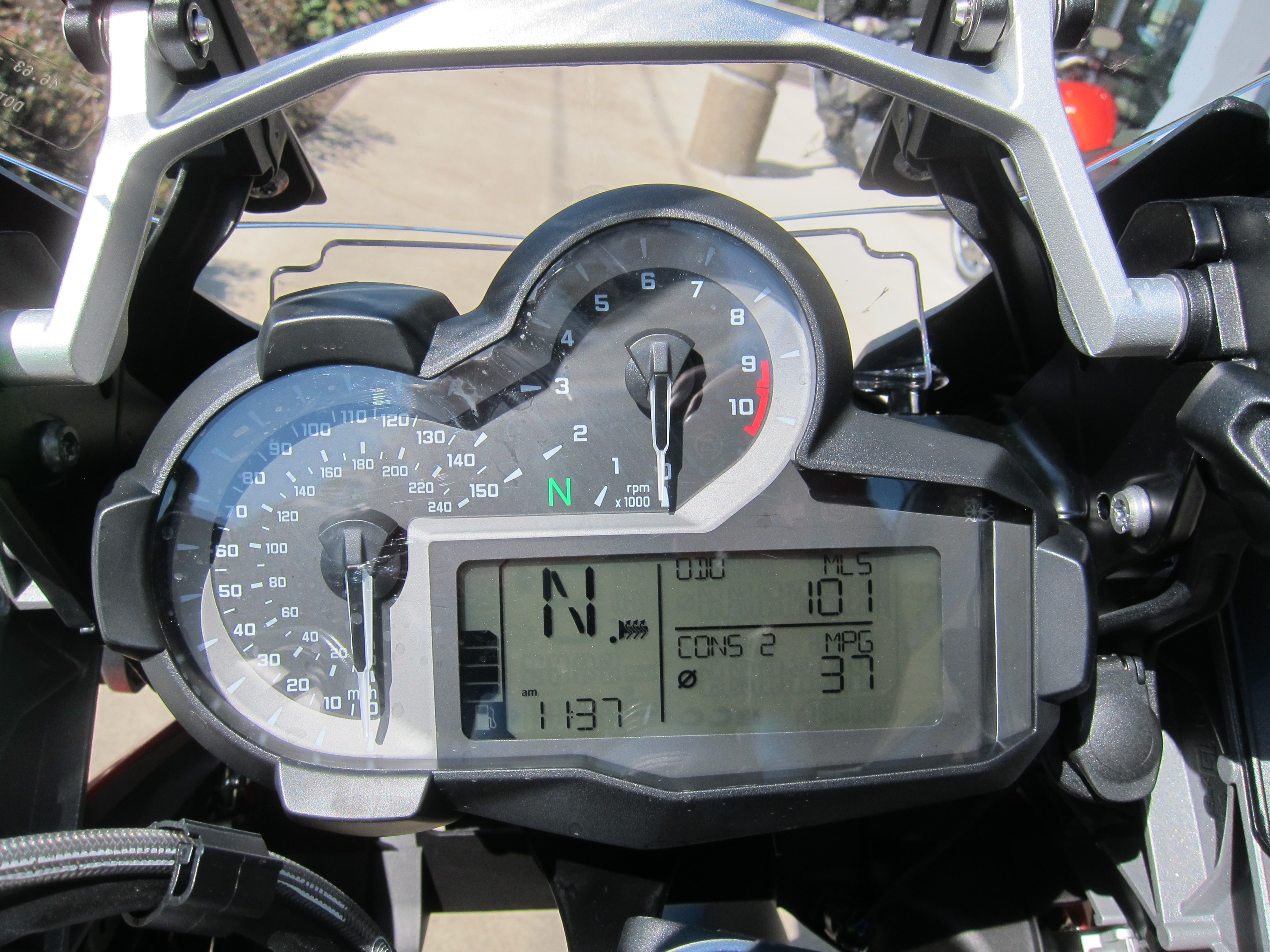
The revised BMW 1200 GS Information Cluster

The revised BMW 1200 GS Information Cluster

While on the move it took me some getting used to be able to check the speed.  I think I remain with a favorable opinion towards analog speed and analog RPM displays. But it is interesting that now that my three motorcycles only show the speed in digital format, how difficult it was to read the speed on BMW’s needle-based gauge.  I would have preferred to see information displayed differently on the speedometer, by perhaps eliminating the wider gray band close to the border so that numbers could be larger. And perhaps keep speedometer and tachometer more separate, like the older models. But at least BMW keeps speed and tachometer information via analog displays. I like that. Guess I need to get reacquainted with the functionality of the speed being displayed by the traditional needle format.

Empty spot between heat grips and ignition/engine cut off button - probably a button on bikes with more options

Empty spot between heated grips button and ignition/engine cut off button – probably for a button on bikes with more options

This bike was the base model, so I don’t know what other information is available on the cluster related to riding modes and semi-active suspension on the models that come with those options. Despite this version being the base model, it was well equipped. Liked that it had heated grips, cruise control and a handlebar button to turn ABS off.  The cruise control is excellent option for touring and the ABS button makes it easy to transition from pavement to off road riding (other bikes, such as my Multistrada and my Triumph Tiger require navigating several menus to turn ABS off).

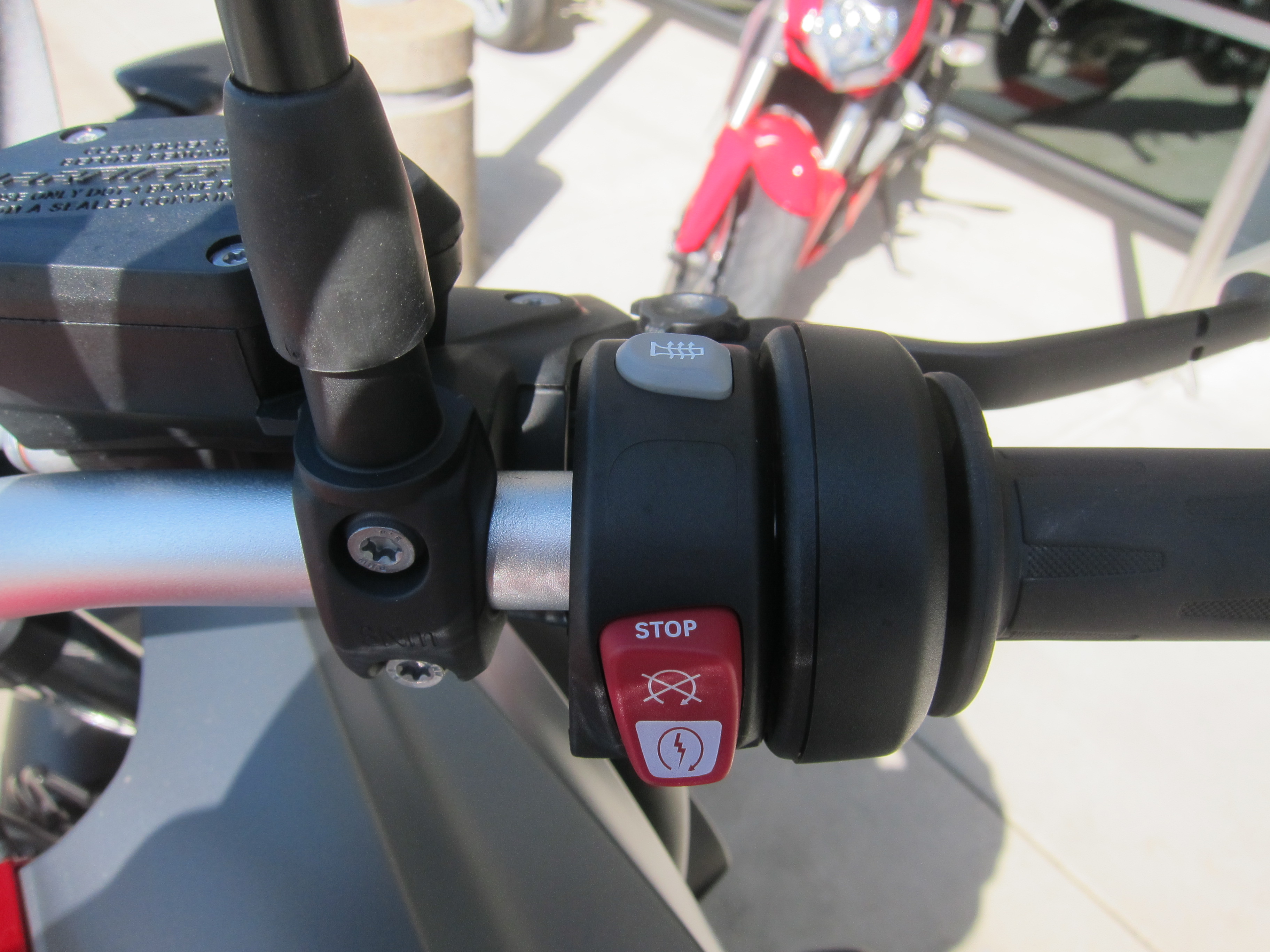
Cruise control and ABS button.

Cruise control and ABS on/off button. Above the trip button there is space for another button.

When I turned the motor on, first thing I noticed was that it sounds a bit crisper than the older motors. I like it better now. Second, I had forgotten how BMW’s have such a light clutch actuation. One thing I noticed was when I engaged first gear the clutch disengagement does not happen until the very last inch from being completely released. I asked the technician about this upon my return to the shop and he explained that is the way it is meant to be. It took some getting used to it, in a couple of times I had adjusted my left hand to its engagement position and all was good.

Exhaust has a nice note

Exhaust has a nice note

The motor feels a lot smoother than the previous iteration, it revs more freely as well. I clearly felt the presence of its power increase.  But the increase is not felt at the low side of the RPM range. The motor is very smooth starting from low RPM, but it doesn’t give you the perception of high torque at the low side of the RPM band as the previous bike did. It still has plenty of torque, mind you. On the other hand, it appears to rev happier, giving the motor a more sport-like attitude on the higher range of the RPM. In my opinion this is a welcome change, this was something the BMW missed when compared to some of the other bikes in this segment in the past. Again, it has become more balanced now based on the three strings of the original bow: enduro, touring and sport. And that is how this bike, in my opinion, remains at the front of the pack.

I perceive it is now more balanced across the enduro, touring and sport charatceristics

I perceive the 1200 GS is now more balanced across the enduro, touring and sport characteristics, more true to the original idea behind this bike

Having said that I do not think the BMW is as engaging as the Multistrada is.  The caveat here is that we know the Multistrada is more focused on the sport side of the spectrum – less on enduro, for example. On that same day I rode my Tiger 800 XC and could tell the BMW is now clearly ahead of it in the power department. The 2013 GS motor is rated at 125hp, a good increase from the 110hp of the 2012 bike.

One interesting detail I noticed when I stopped the bike and went looking for the side stand, where was it? I had a semi crisis moment, as my foot could not find the tab to lower the side stand. Finally I looked down and noticed the small tab. The second time, when I knew what I was looking for, and where it was, it was easier, of course. I don’t remember if the previous model was different or not. This side stand appears to deploy further ahead on the motorcycle.

On my first stop it took me a while to find this thing and deploy the side stand.

On my first stop it took me a while to find this thing and deploy the side stand.

As you approach curves more aggressively, this bike feels very planted. Turn in is fast and bike feels very light but composed. Again, the Multistrada is better in this department with its 17in front wheel and more sport oriented design, but the BMW is surprisingly agile, considering its weight and the telelever suspension (bike does not shorten its wheel base upon braking and nose dive as other bikes do, and it doesn’t have much of a nose dive either). And when I took my Tiger 800XC for a spin after riding the BMW, I could tell how sluggish the Tiger is compared to the BMW. Well, the tires on the Tiger have about 6K miles on them, and have started to square off so I can feel a small resistance to lean on beginning of the counter steering, and with its 21 inch wheels it is expected that the Tiger will have a slower turn in than the BMW with its 19 inch front wheel. But the point here is that the BMW is a very nimble bike which makes it fun to ride the curves with it.

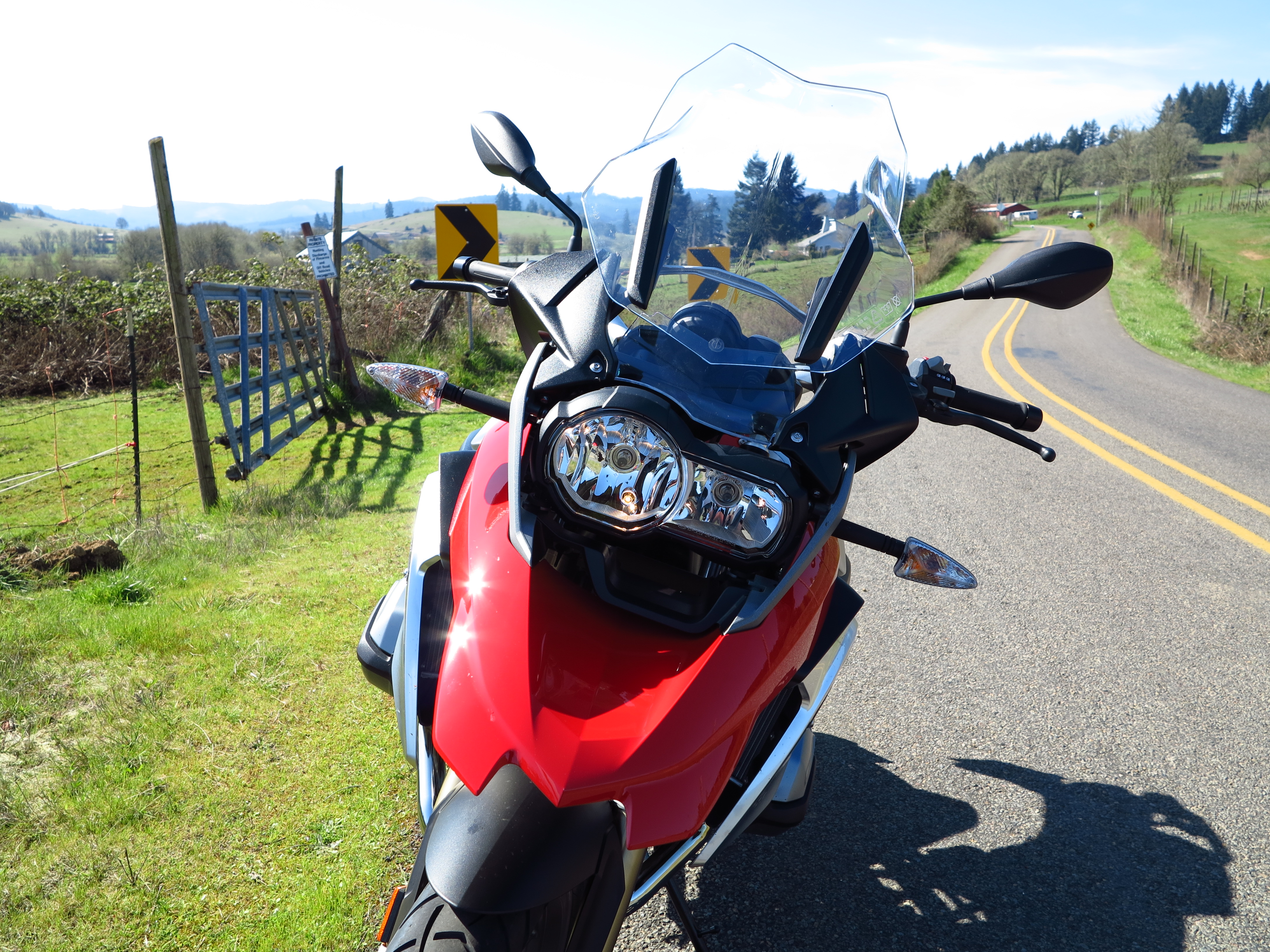
Large button for windscreen adjustment

Large button for windscreen adjustment

Windscreen protection is really good. There are a few elements to it, such as the two pieces of black plastics on each side of the screen (first plane on photo above) and a small fixed wind shield under the main screen, besides the main screen itself. The combination of these three elements offers really good protection and very low buffeting. The large button on the above photo allows you to operate the main screen, offering continuous positioning of the screen.  And although the button is on the right side, it is easily operated by the left hand while in motion. Perhaps this is not a good idea and probably the bike’s manual recommends not to do it, but the button’s position felt very easy to operate the screen while in motion, with the left hand, and the button is large enough to make it easy to turn either way.

While in my Multistrada I like the screen in the lowest position, on the BMW I liked it on its higher position, and that’s where I kept it after experimenting it at the lowest and several intermediate positions.  By the way, at its lowest position the top of the screen tilts towards the rider, directing more clean air from the top and the bottom of the screen, where a gap opens up. I think the lowest position is going to be the favorite position for riders taller than me, when the option is to eliminate buffeting at the helmet height while keeping some protection to the shoulders. The wind protection is slightly better than what I get in my Multistrada, and a lot better than what I get in the Tiger.

Well balanced machine.

Well balanced machine.

As I mentioned earlier, on that same day I rode my 2013 Multistrada with the Semi-active suspension, the 2013 1200 GS with passive suspension, and my 2012 Tiger 800 XC, also with passive suspension. My conclusion: I’ve been spoiled by the Semi-active suspension.  My Ducati feels really connected to the road, the suspension feels even a bit harsh on regular roads when riding at speed, but whenever you enter an area with potholes or any road imperfections, it soaks it in and keeps the bike in its arch, undisturbed, if you are midway through a curve for example. The Ducati always feels planted.  The BMW and the Triumph, and especially the Triumph, feel really soft overall, but when you hit road imperfections, you feel it strongly at the handlebars, pegs and seat. It is not a problem with the standard suspension on these bikes. It is just that I’ve gotten used to semi-active suspension in my Multistrada. I would want to test the 2013 BMW GS with its semi-active suspension option. Chances are I will like it. And if it works as well on the BMW as it does in my Multistrada, I would recommend that option.

As a matter of fact, I would buy the BMW with all these options:

  • The ASC and the five selectable riding modes – “Rain”, “Road”, “Dynamic”, “Enduro” and “Enduro Pro”.
  • The Sachs Semiactive suspension option, called the BMW Motorrad Dynamic ESA.
  • And the LED lights (which this base mode also didn’t have). As a matter of fact, when riding my Multistrada with its LED lights, I have the impression cars stay away, do not merge or cross the road from greater distances.  I believe the LED lights are making the motorcycle more visible from longer distances.
The base model does not have LED lights, but if available, I recommend it.

The base model does not have LED lights, but if available, I recommend getting that option.

I rode the 2011 BMW 1200 GS a couple of years ago for the first time. There was something about the boxer motor, how it vibrated on its side to side “boxing” motion. I didn’t like it. If you have read the book called Bodies in Motion, Evolution and Experience in Motorcycling, by Stephen L. Thompson, and I’m sure you know this from your own experience, you know that how a motorcycle vibrates is part of the riding experience. For me, the 2011 BMW boxer motor felt as if the pistons were having a disagreement with the crankshaft. Or the pistons were really fighting with each other, “boxing” with each other.  It turns out, most everyone actually enjoys the riding experience of the boxer twins, people like me are the exception.  I remember talking about the vibration to other BMW riders after my first test ride on a boxer bike, and they were puzzled by it: “What vibration?”, they asked. It goes to confirm Thompson’s assertion, it is a personal experience. And in regard to the BMW, I know I’m the exception.

Having said that, the 2013 BMW 1200 GS offers a better experience on that respect, in my opinion than the 2011 I had tested. Although still a boxer, so still has that transverse vibration, it is much smoother now. At 70 mph, the motor is turning at about 4,000 rpm, it is very smooth and if we add the improved wind protection, it makes this bike a perfect tourer. I can imagine riding this bike mile after mile, enjoying the scenery, going towards the horizon. I have to say that in that respect, this bike has gotten closer to me. If you are familiar with the GS, and like it, you will still be at home with it, but I would assume you will appreciate the smoother and more powerful motor.

Therefore, in my opinion the 2013 GS has maintained and improved its capabilities for touring (and enduro capabilities based on other reviews) and it expanded a bit towards the sport riding side of things.  The sport “string of the bow” has probably been its weakest point up to now. Or perhaps it was not as desired by its customers as the touring and enduro modes were.  But now this bike has more of it, and hence it is more balanced.

What we know is that when Ducati entered this market, sport riding was clearly the area where Ducati excelled and it has drawn riders to this side of the equation of the adventure market. Interestingly, KTM, which traditionally has been the off road expert of this bunch, has made a move towards the sport side of the equation as well with its 2013 1190 Adventure (not the Adventure R) and from what I’ve read so far it seems to be a large leap towards the sport side of the gradient, more directly challenging what Ducati and what the Multistrada brought to this segment. On the other hand, Ducati, with its GT version of the Multistrada, improves its touring capacity, an area where it was somewhat lacking.

In the end, the adventure bikes seem to find themselves more and more in the middle of the spectrum, in a quest towards developing a better balance among touring, enduro and sport modes, while maintaining their individual characteristics.  And of all of them, I believe the BMW 1200 GS is still the more balanced option. When you ride a BMW, you have a feeling the development team thinks and takes care of every angle of the riding experience.

The 2013 BMW 1200 GS

The 2013 BMW 1200 GS

Would I buy the new GS?

I have to say I’m really happy with my 2013 Ducati Multistrada and my 2012 Triumph Tiger 800 XC.  The Multistrada pushes my happy buttons better than any bikes I’ve ever ridden. And when I want to ride on gravel roads, get in the adventure mode, I have the Tiger 800 XC which does a reasonable job at it.

But if I had to have only one bike, or I would think about going on a round the world ride, the GS certainly becomes a strong candidate among what are the other possible bikes for the job. I like the changes to the motor, I like how the bike feels better on the road, with improved sport riding characteristics.  I like that it has improved its touring capabilities. And I hear from the many journalists who have tested this bike off road, how the rider aids have made this bike a better enduro machine.  On that note, based on my experience with the Ducati Multistrada, I would certainly recommend, if you are interested in the BMW, test a bike with the dynamic, semi-active suspension. It should be good.

Stop at the EMCWOR shop here in town (or at the BMW shop closer to your location) and take it for a ride!

Check my April 2014 review of the 2014 BMW 1200 GS with the Dynamic ESA.

Posted in Bike Reviews | Tagged , , , , | 26 Comments

Getting Acquainted with the 2013 Multistrada

Each time I take the Multistrada out for a ride I like it better.  After the first set of rides I reported here I have taken my Multistrada out another three times and I have also ridden my Triumph 800XC for a short burst and the new water cooled BMW 1200 GS as well (report on that ride soon). The BMW and the Triumph are excellent motorcycles, but the Multistrada is different… it is on another league in terms of performance. And I’m really feeling at home with it.  Worse yet, I’m starting to think it really is a beautiful motorcycle as well. Am I getting my senses impaired?

2013 Multistrada 1200 Pikes Peak in Brownsville, OR. March 17, 2013

2013 Multistrada 1200 Pikes Peak in Brownsville, OR. March 17, 2013

I scheduled March 30th for the first service of the Multistrada with the folks at EMCWOR. Now I need to add miles, a total of about 620 miles for the first service, which will complete the first phase of the break in process for the motor. This time of the year it could have been raining a lot more, but it has been unusually cold and dry for this corner of the world and for this time of the year. A few good days showed up and I took the bike out on rides to make the miles. I first took it to Briggs Road, one of my favorite locations around the Eugene area.

Briggs Road, March 15th, 2013

Briggs Road on the valley, March 15th, 2013

Soon we will see green on these vines, another life cycle starts. Hoping here for another great summer for the Oregon wine industry. Meanwhile, I am really appreciating how this bike is coming along. Definitely there is only one fueling setting acceptable: 150hp High. That is the one setting that gives you the most power and delivers it smoothly but strongly from just a slight twist of the throttle. For my personal taste this is one of the characteristics that makes this bike special. I know I’m not alone on this one.

Pelican Storm iM2100 installed on the Multistrada

Pelican Storm iM2100 installed on the Multistrada

That was a short ride, some 40 miles or so. I took it back home and installed the Pelican case I had ordered the week before. If you’ve read my posts from 2011 you probably came across the post where I discuss the Giant Loop bags, and you will know I think tank bags are perhaps the worst accessory ever invented for a motorcycle. Although very practical, tank bags disrupt a critical element on the bike’s design, the tank, and it may impede your body movement on the bike as well as visibility to the instrument panel. Actually, anything attached to a motorcycle is a bad idea in my opinion. Including the extra weight and when space is made available, you carry more things. But you need to carry something, especially on longer riders, so a compromise needs to be reached. For the Multistrada I have the camera box in the handlebars, a minor nuisance, the Pelican case on the back, a slightly larger nuisance, and the Ducati side cases, a bigger nuisance.  The side cases are for overnight trips, so they will stay off the bike most of the time.  This pelican case is smaller than the one I have in my Triumph (Pelican iM2200 in the Triumph).  The iM2100 is the right size to fit my computer, cameras, snacks and other small items. Tools and tire plugs fit under the seat.

The Triumph's iM2200 on top of the iM2100. March 17th, 2013

The Triumph’s iM2200 on top of the iM2100. March 17th, 2013

Sunday March 17th turned to be another good enough day for a ride, the sun was out, a bit timid but it was there, so I took off towards Brownsville, the Castlerock town of “Stand by Me”, the movie filmed here in Oregon based on Stephen King’s “The Body” novel. It is a great story and I have written a post about the film and about Brownsville here already. Besides its connection to the film, Brownsville has other things going for it. One of them is the Marcola Road to Brush Creek road I take to get to 228, arriving in Brownsville from the east.

Earnest Covered Bridge, near Marcola, OR

Earnest Covered Bridge, near Marcola, OR

Once you get out of the Springfield urban area on Hwy 126, you go north on Marcola Rd, the first part is not too interesting, but soon after you go past the covered bridge you get into a nice set of curves with elevation changes on a forested area and later the curves are in more flat fields, with full view of where you need to go, what you need to do.  This is a fun road, my friends. Eventually you get to 228 and from there you arrive in Brownsville, make a right on the main road and you get to the steel bridge with a view of the old downtown. This steel bridge (below) is part of one of the last scenes of the movie, when the four boys cross it on foot, on their way back to town, a final chapter on that adventure.

The location of the last and first scenes of "Stand by Me" in Brownsville, OR (Castlerock in the film)

The location of the last and first scenes of “Stand by Me” in Brownsville, OR (Castlerock in the film)

And that building on the background, with the arch windows, is the background of one of the first scenes, when the main protagonist is walking across town describing Castlerock.

Background of first scenes of Stand by Me.

Background of first scenes of Stand by Me.

Brownsville also has a reputation for its breakfast/brunch restaurant, or so I’ve heard. I have not tried this feature yet, but will soon.  Blue Point Diner is also featured in the film, by the way.

Blue Point Diner, another feature in the film (fight on the back)

Blue Point Diner, another feature in the film (boys fighting on the alley on the back)

And my dentist, also a rider, told me about this museum, so I decided to take a closer look.

The Pioneer Museum in Brownsville

The Pioneer Museum in Brownsville

I parked the bike in front of the museum and took my time getting my helmet out, putting my gloves in the box, taking pictures. When I get inside the two ladies working there were admiring my bike. The older one made a comment about it, saying she had seen advertisements about this bike. I don’t watch TV, so I don’t know where else this bike may have been advertized outside of motorcycle magazines. I was a bit unsure she really knew what this bike was.  But this lady turns out to be quite a connoisseur of vehicles and mechanical things. Her husband (or was it her father?) used to work on Studebaker cars. And it so happen this museum has the grandaddy of all Studebakers, in the form of a Studebaker Wagon, a real wagon that has made the cross of the mid-plains and the Rockies from Independence (Missouri river) to Oregon, arriving in the Willamette valley in the fall of 1865.

Studebaker Wagon, circa 1860

Studebaker Wagon, circa 1860

If you want to know details about this wagon I recommend you visit this museum.  The friendly lady working there will let you know in detail the workings of this wagon, the capabilities of this wagon, and how these trips were organized those days.  She will also let you know the advantages of the Studebaker vis-a-vis the Canistoga (another brand of Wagon of those days). Something like a Ford and Chevy, Apple and PC of those days, I think. And this museum has a lot more to offer than this wagon.

Isn't she lovely?

Isn’t she lovely? Patiently waiting outside

Brownsville is worth a trip, especially if you have the breakfast (although I should not advertise something I didn’t do), the curiosity about the town as the “Stand by Me” location, the nice roads getting there and the museum. As I was getting ready to leave, the younger lady advised me about the rain. Yes, the sky was turning dark, so I took off towards home, took 228 straight west towards Hwy 99 and went south from there.

Rain on my way

Rain on my way

I stopped to photograph the dark skies and the rain when I noticed water dripping from the Pelican case. My water bottle opened and flooded the case…  Luckily nothing got damaged (I had another camera in there, a map, and other things). Lesson learned.  And it turned out the rain did not last, so all was good. I made it home dry. The bike had 429 miles at this point.

IMG_2508

The following Sunday I took it out for another ride. Her sisters observed closely.

That Triumph has an intense look

That Triumph has an intense look

Since I had about 200 miles to go to complete the 620 miles for the first service, I decided to go check the Pacific.

Traveling at 110 mph, in 24 hours I could be in Hawaii

Traveling at 110 mph on a straight line, I could be in Hawaii in 24 hours

It was a very nice day, almost no wind, waves were 5ft with 11 second intervals earlier. Perfect for surfing.  I stopped by the Heceta Lighthouse, finally I could see the result of the renovation.  It looks great, too clean as a matter of fact, it looks like a toy.

Recently Restored Heceta Lighthouse

Recently Renovated Heceta Lighthouse

That was it, I turned around and came back home. By the time I made it home she was ready for her first service.

Beautiful motorcycle

Beautiful motorcycle

Yesterday (Saturday, March 30th) I took her in for her service at the EMCWOR. While I waited for her to get ready I found this machine sitting outside, ready to be taken for a test ride.

Demo 2013 BMW 1200 GS at the EMCWOR

Demo 2013 BMW 1200 GS at the EMCWOR

I collected the Multistrada and brought it home. I’m glad this time my bike felt better than the one I tested on my way home, first time ever, although the 2013 BMW 1200 GS has many improvements from the previous model. It is worth a test if you have an older GS model or you want to see what a GS is all about. This bike will not disappoint you. Check my next post where I will report my ride on this excellent machine.

Posted in Riding the Ducati | 10 Comments

2013 Ducati Multistrada 1200 Pikes Peak – First Ride

As you have guessed from my previous two posts, I chose the Multistrada as my next step from the Streetfighter. I picked it up Saturday morning, March 9th, a nice sunny day making it a great way to start this new partnership. I needed to go back home, yard work was calling me… instead I did a little detour and some 90 miles later I made it back home. Those first miles are critical, so I took it on some roads where I could vary engine speeds, use engine braking, all the while keeping engine speeds below 6,000 RPM, paying my dues for buying a new bike.

First ride on this awesome machine. March 9th, 2013

First ride on this awesome machine. March 9th, 2013

There are plenty of roads around here that are perfect to take this machine in its break in ride, with no traffic, nothing to interfere with a leisurely paced ride.  I’m not religious, but thought this little church looked nice with its white walls for a picture with the bike and for a symbolic blessing on the bike’s first day out.

Symbolic blessing on its first day out. March 9th, 2013

Symbolic blessing on its first day out. March 9th, 2013

It is not yellow, but it is not bad looking, right? It certainly isn’t a looker like my yellow Streetfighter was. Well, okay, I admit it, it is an acquired taste at best. Here I present you with the 2013 Multistrada 2013 Pikes Peak. In this picture it is exactly the way it was when I picked it up about 15 minutes earlier at the shop, with the touring screen (it comes with the smaller carbon screen as well) and the side bags. I also added heated grips, a rear rack and a center stand. And I ordered a small pelican box to be installed on the rear rack. It arrived yesterday so installing it is this weekend’s project.

2013 Ducati Multistrada 1200 Pikes Peak

2013 Ducati Multistrada 1200 Pikes Peak

The way I see it this Ducati is my sport/touring motorcycle. The Triumph Tiger 800 XC will be the touring/enduro bike with some accessories I will eventually add to it. And the Yamaha WR250R remains the enduro/dirt bike. It makes for a nice gradient: from dirt to enduro, from enduro to touring, and from touring to sport on three motorcycles, and all of them under the adventure riding umbrella. I’m all set now. It took me exactly seven years to arrive at what I believe to be the perfect stable for my favorite types of riding!  You may think it is too much, and I agree it is perhaps too much. But I counterbalance that feeling with the reality that I will only be on this earth this one time, and I’m here in Oregon now, with these beautiful roads and landscapes literally starting just a couple of miles out of my door. I better make the best of it while I can. Riding and writing about it is one component that makes it good and interesting among everything that colors my life. As long as it is balanced on that front, I declare this is fine. Will re-evaluate when needed or when priorities change.

2013 Ducati Multistrada 1200 Pikes Peak - March 9th, 2013

2013 Ducati Multistrada 1200 Pikes Peak – March 9th, 2013

I filled it up with non-ethanol premium fuel and took it back home. Sunday morning I installed the carbon fiber screen and the handle bars camera bag and at about 12 noon I took off again.

Ready for more! No bags and carbon wind screen, March 10th, 2013

Ready for more! No bags and carbon wind screen, March 10th, 2013

What this bike doesn’t have in looks, it shows in performance. This machine is just simply brilliant. I started this ride on the Willamette valley, going north on my usual Pacific loop.  Stopped along the way to check one of Oregon’s main export products. I live close to the train tracks. By looking at the number of trains and their cargo as they go by my neighborhood, and what I notice on the wood mills around here, it is clear construction has picked up its pace.

Multistrada, March 10th, 2013

Multistrada, March 10th, 2013

From there I quickly arrived in Philomath, where I topped the tank off with more non-ethanol fuel, and from there I took Hwy 34 towards the Pacific. There was some road construction on one of my favorite set of curves on Hwy 34, in the area close to the Mary’s Peak access road. Photo below is of the exact point on the road in question, you will see it if your eye sight can travel past the yellow beauty.

Hwy 36 close to Mary's Peak Access - Photo from September 2012

Hwy 36 close to Mary’s Peak Access – Photo from September 2012

Imagine it down to one lane, the left lane all taken apart and filled with construction equipment and piles of stuff and with a lady holding the SLOW or STOP lollypop sign on the right of the road.  The sign was on its “slow” side, so I just slowed down but continued on.  But when I went past her she looked at my bike and I clearly saw a surprised look and her jaw dropping, it was as if she wanted to say something but knew there was no time or something like that. So I thought maybe she mistakenly had let me go and realized only when I went past her that it was a mistake. I slowed down to a crawl as I was on a curve and I could not see if cars were coming from the other side on this temporarily one lane highway. I kept going, just waiting for cars to show up at any moment, I was hugging the inside of the curve. No one, no cars showed up to the end, they were all behind the stop sign on the other side. Therefore I can only conclude that she likes bikes and the red and white Multistrada made quite an impression on her. Right.

Good swells, Yachats,  March 10th, 2013

Good swells, Yachats, March 10th, 2013

Excitement apart I hope construction work is completed soon and all debris removed because those curves are just perfect and this bike will carve them nicely! So I continued on, enjoying this road I had not seen for about 6 months. I did not stop along the way, threatening skies and all, I just wanted to get going.  And this bike invites you to more and more riding, making it easy to add miles to it. I’m really enjoying this new partnership.  I made it to the pacific where it was colder.

IMG_2342

When on the coast, I could not stay away from my usual stop at Ona. At some point I was fearing rain would start at any time so I thought about skipping lunch and just going back home. But I did stop. I was surprised to see so many people out under such gray and cold conditions. It was in the 60’s in Eugene, it was barely 50 on the coast.

View from Ona's parking lot. Yachats, March 10th, 2013

View from Ona’s parking lot. Yachats, March 10th, 2013

Thank you heated grips. And at this point I was wishing I had not installed the smaller screen. The plexiglass touring screen is noisier (buffeting), but it offers better protection. So I had the small screen raised to its highest position – I’m really enjoying the on the go ability to move the screen up and own. Heated grips was at the max at some point. The heated grips work really well, it has three settings, although it is odd that you operate them from the engine start button. I’m getting used to not think that pressing it when the motor is running is really not engaging the starter motor.

IMG_2335

Eventually it started raining, luckily it did not last. I stopped along some of my favorite view points, and at one of them I suddenly heard this clearly Italian sound… I turned and unfortunately my camera did not capture it well enough. What a beautiful Ferrari. Not unlike the example I mentioned a couple of posts ago in terms of how in my view the Ducati design contrasts with a motor that reminds me of a 60’s Ferrari. Nice omen!

1960's Ferrari 250 GT, give or take.

Early 1960’s Ferrari 250 GT SWB Berlinetta, give or take model and year.

A Ferrari of that model and vintage is worth quite a lot. Nice color too. If I could have a Ferrari, I would want it to be that kind of model and from that vintage. I wish they had stopped so I could take a look and photograph the car.

After seeing such a great example of a classic look in that Ferrari, I looked back at my Multistrada. By comparison, today’s motorcycles designs place them on a different planet, it is science fiction.  While the Streetfighter looked like a transformer, caught in the process of changing from something into something else, the Multistrada with the Pikes Peak carbon windscreen looks like a bug or some alien being. And when with the plexiglass windscreen and that narrow beak with two air intakes it looks like a bird. Where are those nice round shapes of many years ago? I predict that sooner or later we will see new designs that will explore the round shapes again, not as a recreation of a vintage motorcycle, like the Ducati 1000 GT or the Triumph Boneville or the Moto Guzzy V7, but as new designs of new motorcycles. Somehow the Ducati Monster, celebrating its 20 years now, was a retro design on a new bike.

A bug? A bird? No, it is the Multistrada

A bug? A bird? No, it is the Multistrada

I jumped back on the bike and continue south, hoping to see the Ferrari parked on some of the look out areas. It did not happen.

Pikes Peak 2013

Pikes Peak 2013

I kept going south towards Florence. Here is a view looking north towards Yachats on this gray and foggy day.

Looking north towards Yachats, Oregon coast.March 10th, 2013

Looking north towards Yachats, Oregon coast. March 10th, 2013

I stopped at the Heceta Light.  I’m glad to know their renovations have been completed.

Heceta Light, March 10th, 2013

Heceta Light, March 10th, 2013

Similar profiles: the mountains and the bike’s front.

Tye Multistrada and the Heceta Light. March 10th, 2013

Tye Multistrada and the Heceta Light. March 10th, 2013

From there I just rode all the way back home, with only one stop at the gas station for more non ethanol fuel.

Back Home, March 10th 2013

Back Home, March 10th 2013

The total between yesterday and today, 315 miles, puts the bike half way to the first service, at 620 miles.  I noticed the fuel economy is improving already. Before my first fill up it showed 38.5 mpg. On the second fill up it jumped to 39 point something.  On my way back home at the last fill up it was indicating 42+, and on the last stretch, where it is mostly in the valley and with some traffic, so I was riding more slowly, it indicated 43.9 mpg as an average.

Not bad...

Not bad…

This means if I ride conservatively this bike can go beyond 200 miles between tank fills. That is pretty good, almost the same distance as the Tiger can go.

My impressions on this beast are very good. It has made me forget about the Streetfighter, at least in terms of performance. It is comfortable, but it has those attributes I was looking for, especially that it gives that hot rod feel you get from its sport bike performance, the feel of the road, and the engine sounds.  It is tall, but that carries some advantages, like the easiness and speed of turn in with minimal counter steering input.  But if I want to just ride and enjoy the landscape, this revised motor is smooth at lower engine speeds, allowing you to cruise.  The riding ergonomics complement that by allowing your body to be straight up which gives you a better physical position to scan your surroundings. On the other hand, for more spirited cornering, you can freely move your upper body, bring your torso towards the curve, lower your body towards the curve.  There is plenty of room to maneuver.

And the bike offers the suspension and the turn in speed for mid-curve  corrections should you need to do that. It gives you that extra confidence that it has room and capability to spare should things require you to go tighter on a curve.

The Skyhook suspension felt a bit harsh on normal circumstances, you only feel it at work on radical stuff, as in potholes and other major road imperfections.  I was riding at the Touring mode, default settings, with low profile acceleration to prevent me from going north of the 6k RPM upper limit during break in.  At some point I moved it to Urban mode, but it felt too slow and not reactive enough in terms of acceleration.  I could see some increase in comfort, with a more compliant suspension, but I did not like the power delivery on this mode.  I took it back to Touring and selected the softest setting for front and rear suspension.  I liked it better that way.  Will leave the Sport mode for the harder setting.

Can’t wait for my next ride on this beast. Looking at the forecast for Saturday and Sunday and most of the sites indicate precipitation. Except for Accuweather, where it shows a sunny Sunday, as it should always be.  I believe they have the right forecast.

Thanks for reading.

Posted in Riding the Ducati | Tagged , , , | 43 Comments

180° South, Economics, Alaska, Marshall Islands, and my new Motorcycle

Last Friday I finally met my new motorcycle when I stopped by the European Motorcycles of Western Oregon (EMCWOR) to start its paper work process.  Beautiful and shiny under a bright and sunny March day, there it was waiting for me. The next morning I woke up early and had to wait until it was time to take it home with me.  I turned my computer on and clicked on Netflix and the film 180° South was presented as a first choice for me.  I had seen this film some time ago, I remember the beautiful images, the music, and the story.  I watched it once again.

220px-180_SouthI’ve been to the Argentinean Patagonia before, but I was only 12 years old at that time, traveling with my parents and one of my sisters.  I remember vast open spaces, snow capped mountains, the desert, the wind, and the cold of the south hemisphere’s July. And I’ve heard many times about Patagonia, the Pampa and its Gaucho people through the music and poetry of Atahualpa Yupanqui one of its most prominent artists, but who was also a strong advocate for the land and its people.  I am officially a gaucho by birth, born on the geographical northern edge of the pampas. For that, and for its open spaces and its legendary beauty, Patagonia is a special place in my imagination and I want to go back there on a motorcycle some day.

180° South takes you to beautiful Patagonia, but on the Chilean side. The film follows and parallels the personal accounts of two groups of friends who traveled to the Patagonia region to surf and climb mountains and they end up on a larger adventure, a self-discovery adventure, and then it was much more than that. History was and is being written based on their actions. The 1968 group went from California to Chile by car.  The other group traveled to Chile in 2010 via sail boat and plane.

Surfing, mountain climbing, and sailing are activities that have a very close connection with nature with a very small foot print on the environment. Motorcycling allows us to connect with nature as well, in the sense that when you ride you are directly exposed to nature, you can travel to places where cars are likely to struggle (as far as motorized travel is involved). However our motorcycles are part of the internal combustion engines brigade.  Even if our motorcycles sip fuel when compared to cars, they burn fossil fuel.  Still I think when we are wearing our adventure rider hats, or should I say helmets, we are mostly okay to participate in conversations about environment. Maybe more than the Prius people should be.

WR250R at the Steens Mountain, Oregon, on September 2010.

WR250R at the Steens Mountain, Oregon, on September 2010.

In the 180° South film the protagonists discuss environmental issues and the relationship of humans with nature. The 1968 group, Yvon Chouinard and Douglas Tompkins, going beyond surfing and mountain climbing, going further than contemplation and self discovery, they have taken action, and the result of their work is enormous. Douglas and Kristine Tompkins’ work is the size of establishing a large national park called Parque Nacional Patagonico (or Patagonian National Park) in Chile, in one area that is amazingly beautiful. Yvon founded Patagonia (clothing), and brought up the concept of being responsible for our environment. By the way, Douglas is the founder of The North Face (clothing and equipment for the outdoors).

I’m thankful for their cause and their actions and appreciate their non-radical and non-militant way of going about this. Actions speak volumes, words vanish in space.

The 180° South film is sub-titled “conquerors of the useless,” more as a playful commentary, a critique to the perspective that there is no value on travel, I would like to believe. Carrying for our environment, keeping an open mind for what a different geography and its people can teach us, and letting adversity be part of the travel experience is something they talk about.  There is nothing useless on that for me. Good lessons and similar approach for how we experience motorcycle travel, adventure riding.

Image from the Patagonian National Park site.

Image from the Patagonian National Park site.

What brings me to this conversation is that I just bought a brand new and sophisticated motorcycle and got to see the 180° South film right in the day I pick it up.  It makes you think and maybe question your priorities, at least it does for me. This motorcycle is something I didn’t need. It is just something that I wanted.  As an example, I could have  bought a Kawasaki KLR 650 motorcycle instead.  It is cheap, low tech, it is a less resource intensive motorcycle.  But it is good enough for an adventure ride, it is simple and it does the job.

IMG_1976Instead, I bought something fancy and unnecessary, a type of decision many of us do.

Do I need the fraction of weight that is saved on my motorcycle by having the carbon pieces my new bike came with? No.

Do I need the lighter, forged wheels that came on my motorcycle? No.

But I bought it and it has all of that, and you know what? I can’t wait to start riding this beautiful beast.

A point I’m making here is that I’m not oblivious to what goes on in our world. And also that I’m aware that my actions affect the environment, as small as its effect may be.  I want to assume most of us knowingly live in some form of contradiction between what we perceive as good for us individually today and what we know are likely results from the aggregate of all our individual decisions and activities: it is not necessarily going to be good for humanity tomorrow.

IMG_1091To make sure you don’t think I’ve gone environmental (not that there is anything wrong with that), you should know that when I think about the themes discussed in 180° South it doesn’t stop me from dreaming about riding in Patagonia or anywhere else. It actually feeds those thoughts and dreams. On the other hand, and while it doesn’t make me go out and sell my motorcycles, it certainly makes me think of climate change and our utilization of resources.

Economics

I’m an economist by training. I remember my first class in introduction to economics, it was ECON 101.  The professor presented a definition of economics and we the students had an opportunity on that first class to discuss it in the context of the management of scarce resources.  How unsettling it was for me to officially learn something I already knew much before that time.

Here on earth, no matter how ingenious we can been about the use of resources, we are dealing with limited resources. More than that, it is unsettling that we design and actualize our economic policies based on a very unsophisticated growth model, while knowing such growth, especially in the way we apply it today, is in fact unsustainable in the long run. We all know this road we humans are traveling on will eventually end. But we hope it will end far in the future. Some of us simply choose to ignore it, or we are on various degrees of denial, or perhaps just plain ignorance, which would actually be a  blissful thing if that is the case.

I’ve been out of the “Economics” field for a long time so I thought it would be a good idea to take a quick look and learn how the economics discipline is dealing with the issue of scarcity these days when global warming conversations have become more frequent then at the time I was in graduate school.  From my short web research I was surprised to see that the American Economic Association does not include “scarce resources” in their current definition:

Economics is the study of how people choose to use resources. –American Economic Association, 2013

Scanning their website I came along older definitions on their home page:

Economics is the study of people in the ordinary business of life. — Alfred Marshall, Principles of economics; an introductory volume (London: Macmillan, 1890)

And here one that includes the notion of scarcity:

Economics is the science which studies human behavior as a relationship between given ends and scarce means which have alternative uses. — Lionel Robbins, An Essay on the Nature and Significance of Economic Science (London: MacMillan, 1932)

And one more

Economics is the study of how societies use scarce resources to produce valuable commodities and distribute them among different people. — Paul A. Samuelson, Economics (New York: McGraw-Hill, 1948)

Interesting to note that older definitions do include the word “scarce”.  The key issue here is one of time and scale: what we do today to the environment is not realized today or tomorrow. And what we do individually is insignificant, we can not perceive its effects, but when all of us do it together, it is a major deal.

That is we only live in the present. One thing is to manage a business operation to survive the next quarter’s bottom line, or participate on government’s discussions of fiscal appropriations based on one year’s projection. The longest term I’ve seen such discussion is to examine projections based on five year scenarios. It is difficult to think about projections based on 20, 50 or 100 years because chances are we may not be there to collect the efforts’ fruits or repair the damages caused by these efforts. That is not part of our daily lives, when we have other priorities, such as to pay bills on a monthly bases, or make sure our business is viable for the next couple of years.

The environment is an orphan today, because we can’t clearly see in it the impacts of our activities of today, and some of us can not see the impacts that are already happening from activities performed many years ago. So eventually our next generations will become  orphans of ours and of previous generations.  That will happen when our environment changes and our species survival becomes tenuous.

When I was in Economics school I learned that our actions’ impact on the environment, and the returning environment’s impact on our operations are viewed as an “externality” (a consequence of an economic activity that is experienced by unrelated third parties – Read more at http://www.investopedia.com/terms/e/externality.asp#ixzz2NKYVCiTQ). Because it is viewed as an externality by its own definition, it is not included in our quarterly or yearly accounting bottom lines. Scarcity will never be included in our operations unless we know we will experience it the next quarter or next year. Which is not the case, as impacts of our actions today take a long time to become visible as an impact to our environment.  Going back to my thinking on why the Economics field no longer includes scarcity on its definition, another thought I have is that perhaps they now include environmental impact in macro- and perhaps even micro-economic models. Hence no more need to mention “scarcity” of resources, or externalities.

Alaska and Marshall Islands

200px-Collapse_bookIn the 180° South film the main protagonist and narrator, Jeff Johnson, sailed to Chile in 2010 to meet with members of the 1968 crew, the people who started the National Park in Patagonia. Encountering problems with the boat they made a pit stop in Easter Island to work on it. While there Jeff remembered a conversation he had with one of the guys of the 1968 group (Yvon Chouinard, the founder of Patagonia, the high-end outdoor clothing) who had mentioned to him about Jared Diamond’s book Collapse, How Societies Choose to Fail or Succeed.  I’ve read that book some time ago. Jared Diamond uses the collapse of the Rapa Nui’s (Easter Island’s) society as an example of the mistakes societies have made in the past by over-utilizing resources. By not thinking about sustainability, one can’t quite imagine what was the complex conundrum that resided in their decision process when they cut the last tree in the Island. It is possibly not unlike what we see and do today in our globalized village.  Some of us are in denial with what is going on around us as we march into the horizon in oblivion.  And in many instances, we have already cut that symbolic last tree.

The Rapa Nui story reminds of two places I’ve been to and which show us how far we have been already on the path of self destruction: one is the region around Kotzebue, north of the Arctic Circle in Alaska; the other is the Marshall Islands, a group of atolls in the south Pacific. And both of these places remind me of the fragility of the world where we live. Especially when just today a new study about earth’s temperature was released, showing the current earth warming trend.  It indicated that the last 100 years show an unprecedented rate of change (in this case speed of the increase in temperature) when compared to the last 11,000 years of analyzed data on earth’s temperature.
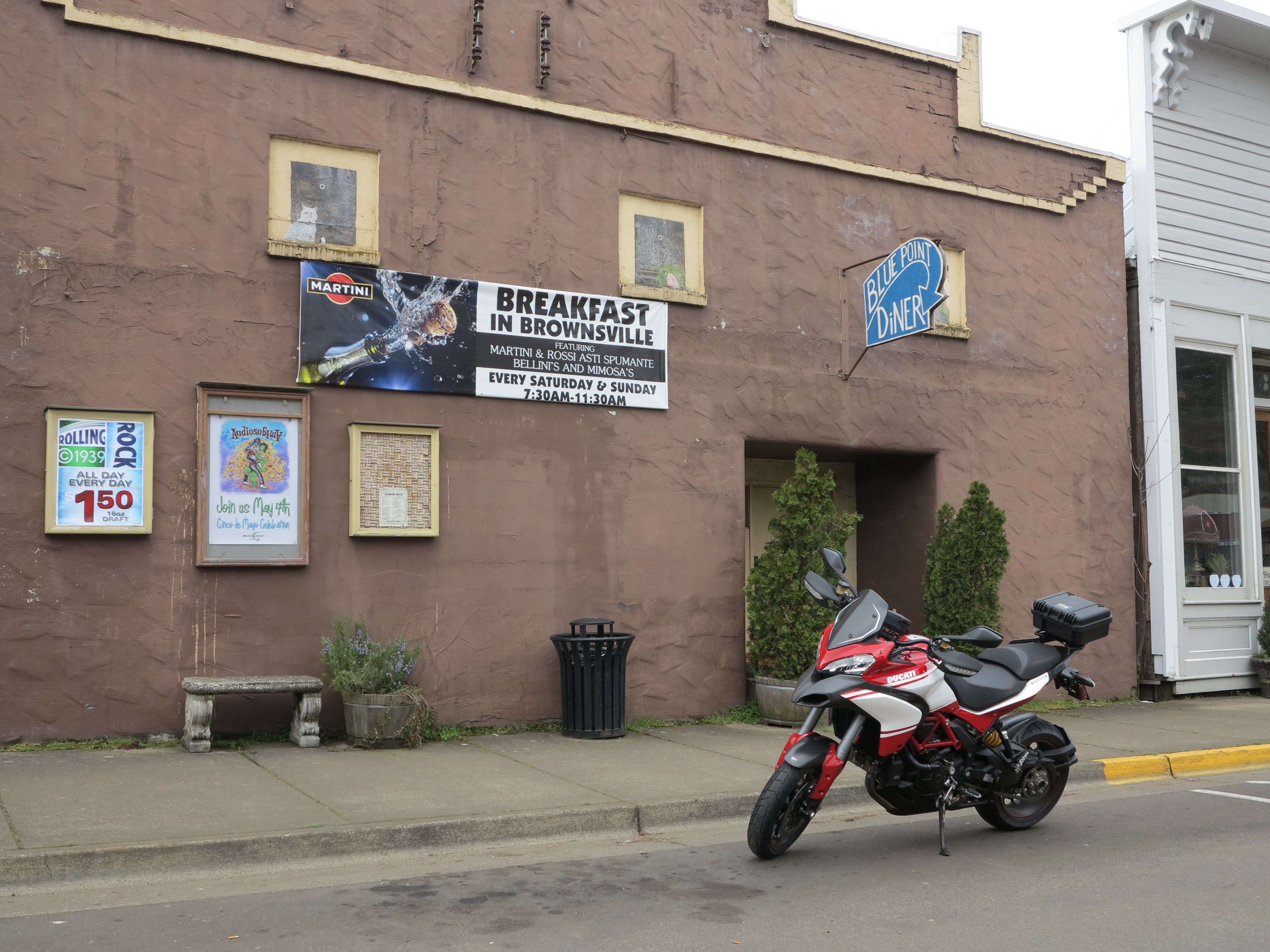
I’ve been to Alaska on work related trips, but I want to go back there on a motorcycle and ride it all the way to Dead Horse, at the end of the Dalton Highway and back. The tundra calls me as much as Patagonia does. As mentioned earlier, I like vast open spaces, there is something interesting about the solitude they represent, they trigger in me a good dose of respect to what is so much bigger than we are.

And at the same time, we are learning how fragile it all is. We start to see some changes, such as in areas close to Kotzebue in Alaska, more specifically I’m talking about the island and village of Shishmaref. I have not been to Shishmaref, but I was in Kotzebue, the central village of that area, and when there I had a chance to buy a mask carved in whale bone by an artist from Shishmaref. It shows sadness and it touches me with that.

Mask carved in whale bone by artist from village of Shishmaref, Alaska

Mask carved in whale bone by artist from village of Shishmaref, Alaska

Kotzebue is on a gravel spit in the Kotzebue sound, just north of the Arctic Circle. Very close, in Alaska’s scale of distances, to Shishmaref. Shishmaref is an Island which has

Shishmaref road before...

Shishmaref: front road before…

already been affected by global warming according to the National Oceanic and Atmospheric Administration (NOAA). The people from Kotzebue may not be too far behind if waters continue to rise and the protecting ice continues to melt and the ocean erodes their village away.

The people from Shishmaraf may possibly enter in the history books as the first ones to ask for financial help and assistance for re-location because of potential damage

... and after

… and after storm passes by

from global warming.

You and I may think that they should have not established their village in such an unstable and precarious location in the first place. And we would be right. But that is not what is relevant here.  What matters is that the fragility of their location and the impact they are facing serves as an indicator of things to come for others like us who are in locations where it will take longer to observe more direct consequences of the changes taking place now. Those people are our proverbial canary in the coal mine.

Local from Kotzebue and the late June melting ice. Kotzebue, Alaska, June 2007

Local from Kotzebue and the late June melting ice. Kotzebue, Alaska, June 2007

Another group that I visited and who are in a fragile situation are the people who live in Atolls, mostly they are in the south pacific. I was at the Republic of the Marshall Islands in November of 2012 and was amazed to witness just a few months ago what I had heard from other people’s accounts in the past: how many people live in a place that is so far away from continental land and are only on narrow strips of land and only a few feet above sea level, 6ft above sea level on average, in the middle of the vast Pacific Ocean.

Majuro Atoll: Lagoon on the left, open ocean on the right. Majuro, November 2012.

Majuro Atoll: Lagoon on the left, open ocean on the right. Majuro, November 2012.

I was in the Majuro Atoll, the capital of the Marshall Islands, where its narrow coral ring is interrupted by water and it is shaped like the letter U. From the top of one leg of the U to the end of the other leg, where the road ends, there are 36 miles of uninterrupted road. I drove all that distance, from one end, Rita, to the other, Point Laura. When looking from the airplane, you can see the strip of land going in that mix of water and sky, like a bridge to nowhere.

Majuro Atoll. Notice airport on the left. November, 2012

Majuro Atoll. Notice airport on the left. November, 2012

This nation is formed by a group of 24 Atolls, all of them (except for two islands) formed by coral reef rings that were formed around sinking volcanoes.

Borrowed from the Cyberspace

Schematics borrowed from the Cyberspace

It is a beautiful and unique place which is already experiencing the effects of the sea level rise.

Majuro Atoll. November, 2012

Majuro Atoll. November, 2012

People from the Marshall Islands told me of atolls where the sandy beach areas have already disappeared and the surf is now hitting the exposed roots of trees. On the picture below, it shows the end of of the left leg of that imaginary U that shapes Majuro Atoll (Point Laura). This is the widest portion of the entire atoll. I drove to that very end, where you see the tip of island (the low part, the vertex of the “V” shaped Point Laura on the picture), where you can see some sand, as if it has been pushed to the left by the water. That used to be a beach until some time last year. Although it shows still the color of sand, it is all under water now.  The water now hits the roots of trees, and some of these trees have already fallen.

Laura Point, Majuro. November 2012

Laura Point, Majuro. November 2012

It is just a question of time until some of these atolls will become uninhabitable.

Island in Majuro Atoll. November 2012

Island in Majuro Atoll. November 2012

It is just another canary in our coal mine.

Bus stop, donation from Japan. Majuro, November 2012

Bus stop, donation from Japan. Majuro, November 2012

In this debate about climate change I don’t think anyone really knows for sure whether the current warming we are experiencing is the result of human activity or whether it is part of the solar system’s cycles or something else. Independent of what is the real cause of the problem, we may be able to say two things: 1) Be it a short term, temporary and freak event of the last 100 years or a longer term thing, be it caused by human activities or not, what we know is that the climate is changing as observed by temperature rises; 2) Irrespective of having an impact on global warming or not, human activity and our current economic growth models are in fact unsustainable.

These are two problems, and some people claim it is one and the same. If they are not related, chances are we cannot tame problem 1. And problem 2 will only be resolved via a paradigm shift or some great technological leap. And if we solve problem 2, we may be able to solve problem 1, but only if they are related. Confusing? Of course.  And some people claim none of this is happening, of course.  There is a very small chance that they are right. Very small.

Federated States of Micronesia. November 2012

Federated States of Micronesia. November 2012

When discussing about all of this with friends at a bar, where all the great ideas are generated and revolutions are born, I tend to agree with the suggestion that living simply is a way to trigger important positive changes to our lives and to the world. In my own perspective, I agree, and I’m on board. As long as I can keep my motorcycles, that is. And since we are talking about exceptions, I want also to keep my computer, the smart phone, and my cameras of course, and the motorcycle GPS, notwithstanding that I want to keep flying across the globe to visit far-a-way places. Yes, everyone has always something they are not willing to let go. Living simply is one heck of a difficult thing to do. Aren’t psychotherapists called shrinks? We need environtherapists or something, then. People that will help us citizens of the world shrink our consumerist appetite.

Interesting stop sign. Kotzebue, Alaska. June 2007.

Interesting stop sign. Kotzebue, Alaska. June 2007.

Back on topic, do we all know how it was that everything started? This trend of lack of sustainability is nothing new. It started when we humans as in Homo sapiens sapiens, developed agriculture, perhaps the most important technological advancement, the mother of all technological advancements, and which occurred somewhere about 10,000 years ago, give or take, depending of whose paper you read. But if we had to do it all over again, I bet we would do it again that very same way. Who wouldn’t want to rest for a while and let domesticated nature, plants and animals, provide us with the food instead of having to wander all over gathering and hunting for it for 24 hours a day? That is, after all, human nature, we are ingenious animals, and that has been our species’ specialization, the result of our own evolution. Of course, we could have done it in some more sustainable ways, like some of our brothers still do today.

Gas Pump, Kotzebue, Alaska. June 2007.

Gas Pump, Kotzebue, Alaska. June 2007.

In that same vein, the same reason that brought us here may be the solution to all these problems: technological innovation. Yes, let’s think about it, wouldn’t it be a relief if we could find an easy way out via technological advancements, and without departing much from how we live our lives today we would make things right, at least in resolving problem 2 discussed above? That would be relief for us who knowingly live in the contradiction, even if such solution could be a fallacy in the long run.

What I like about 180° South is that they talk about all these issues but never bring up legislation as a way to control people’s actions, like some people promote today.  Those that promote legislation believe enforcement of strict rules to human activity will resolve the problems. To me that approach has shown failure many times over.  It goes the same way alcohol prohibition went, or drug control is going. In my view legislation and its enforcement cannot really control human behavior; they only create mistrust, polarization, even wars (as in “war on drugs”) and the professionalization of crime.

Instead, in the film they talk about the need for a paradigm shift. I see it as people evolving to exercise choice in a direction that is different than where we are going today, or how we’ve been doing for the last 10,000 years. I guess we have not really evolved since that time when we “conquered” nature via agriculture. We are due a next step in that evolution process, a conscious one this time.

Spirit Mask by Kotzebue artist (fossil ivory). Represents the fragile balance between human needs and what nature provides and Alaska Natives respect for nature.

Spirit Mask by Kotzebue artist (fossilized ivory, ballene, and crow feathers). Spirit Mask represents the fragile balance between human needs and what nature provides. It is about Alaska Natives’ respect for nature.

Although I wish every economist should swear to account for resource scarcity in their professional work, like medical doctors swear to practice medicine ethically and honestly in their Hippocratic Oath, I would like to think the definition of economics proposed by the AEA does not include the word “scarce” because they are assuming we will eventually know what is really a better choice on results utilization. And because of that, the concept of “scarcity” will be redundant or unnecessary.  If we evolve to that next step, it will be the paradigm shift mentioned on 180° South.

While that tipping moment doesn’t arrive, the time when we will all be happily living simply, or in which technology will save us from unsustainable practices (or some combination of both), we need to make the best of what we have, and protect our mother earth as much as we can. We need a great dose of common sense to make something good out of this.  This conversation brings me closer to my parents who live well, have had plenty of resources in their lives, but have always threaded lightly. It is just the way they are. They apply common sense and live simply, and are happy. I really admire them for that and I can’t wait for the next time I will visit them. Like my mother always says, happiness is always found in the most simple of things. I need to learn more from them and apply more common sense in my life.

Although I haven’t practiced economics professionally, it has always been an area of interest to me. But it is interesting how the film 180° South showed up on my screen exactly the day I was getting ownership of my new motorcycle and how it has taken me on this wide circle of thoughts. I’m obviously concerned about what happens to our environment, but selfishly I can’t wait for warmer and drier days when I will indulge in my motorcycle passion, riding this beautiful bike, and pretending the road is endless, like it says in this adhesive in its rear view mirror.  I will save it somewhere after I remove it from the bike.

Don't we all want it to be that way?

Don’t we all want it to be that way?

I look forward to days when I will evolve some more and will be acquiring more common sense and will learn to live more simply. While that time doesn’t arrive, and I don’t become a KLR rider (as in cheap but efficient, granola style motorcycling), I’m hoping for lots of rides with my new motorcycle…  But with lots of appreciation to our mother earth, as always.

We live in a beautiful part of this world and I plan to ride in this area, and hopefully beyond and as much as possible and document its beauty for all to see. I promise to tread as lightly as possible. I promise to think more on living as simply as possible. And to always carry with me the images of the people I met and who live in fragile areas of Alaska and the Marshall Islands and other geographic areas in more eminent danger from consequences of the warming. And I promise simple posts soon with pictures of my new motorcycle.

I’m lucky to live in a community where I can safely commute to work by bicycle for most of the year and I can walk to stores for my most basic grocery needs. And I can go to nice restaurants who only buy food from local producers and who produce them organically. I guess we are going somewhere already.

Posted in Film Reviews, The Book | Tagged , , , , , , | Leave a comment

The Ducati Streetfigher 848 and the Stockholm Syndrome

A look back at my 2012 Riding Season

 The 2012 riding season was an extraordinary riding season for me. I mostly rode a bike that is completely different than what I traditionally ride.  A bike that pushed my road riding boundaries, took me out of my comfort zone in many ways, and maybe it even conspired to put me in danger’s way every now and then. It sequestered my riding choices demanding my almost exclusive attention.

Blue skies and the Yellow Ducati. September 16, 2012

Blue skies and the Yellow Ducati. September 16, 2012

To put things in perspective, 2011 was the year of the Tiger, the Triumph Tiger, that is.  It had arrived by the beginning of the summer of 2011 in my garage. The Tiger is similar to all my other bikes in what concerns to the enduro style of riding, including that straight up riding position.  Just that it performed so much better on the road than all my previous bikes performed.  In terms of power and comfort there was no comparison between the Tiger and my other two bikes. Its touring capability was the reason I got the Tiger and it did not disappoint, it helped me appreciate what riding on paved roads could deliver and took me on longer and farther away rides in great comfort.  And I should add with great performance from the triple motor.

Tiger by the creek. Tipi Village, OR. November 26th, 2011

Tiger by the creek. Tipi Village, OR. November 26th, 2011

Although I really enjoy riding the Triumph, I wanted to explore yet a bit more of what pavement riding could bring.  That’s why in early May 2012 this naked sport bike showed up in my garage.  And very quickly it sequestered my 2012 riding season from its regular scene. At the same time the Ducati StreetFighter 848 came to my home, the BMW Dakar left for another home (I hope it has been treated well). In essence, except for being naked, everywhere else the Streetfighter is a different animal when compared to my other bikes.

Ducati 848 Streetfighter, May 16th, 2012

Ducati 848 Streetfighter, May 16th, 2012

 I had ridden several Ducatis before the Streetfighter.  Twice I rode the Multistrada 1200, a Monster 696 and a monster 1100 evo, and a Hypermotard 1100 evo sp. The Hypermotard, what a nice riding experience!

The Ducati Hypermotard. September 2011

The Ducati Hypermotard. September 2011

But I had never owned a Ducati.  Once you experience the Ducati, the V-twin feel, if you happen to like it you are done for it. On all of these Ducatis that I rode I felt there was a significant contrast between the attractive, even if awkward at times, Italian design and that rough on the edges, but powerful, V-twin motor. The contrast sets in when you push the start button and the rumble of the motor takes you somewhere else, possibly back to a past era, maybe that of a 1950’s Ferrari 250 Testa Rossa.

One of the first rides with the Ducati Streetfighter 848. May 16, 2012

One of the first rides with the Ducati Streetfighter 848. May 16, 2012

Whenever I thought about owning a Ducati I always thought about the Multistrada. But at this time I wanted a more street oriented bike, something with not much separating rider and road. My enduro bikes have tall forks with long suspension travel, tall handlebars, tall instrument clusters, windscreens; things that bring comfort to a rider but unfortunately it comes with a cost, it separates rider from the action, from the road feel.

The Ducati 848, May 16 2012

The Ducati 848, May 16 2012

I chose the beautiful Streetfighter 848 for the job. Except for the motor the SF 848 is the same bike as the SF 1098. Besides the lower displacement it also has suspension and brake components that do not quite match the 1098’s performance level.  In my opinion, however, the 848’s claimed 136hp is plenty of power for such a compact motorcycle.

The Ducati Streetfighter 848 on Highway 101, Oregon, September 16th, 2012

The Ducati Streetfighter 848 on Highway 101, Oregon, September 16th, 2012

This motor is a de-tuned version of the 848 race motor, not unlike what the 1,200cc TestaStretta motor in the Multistrada is from its parent 1198 race motor, making it a more tractable motor for the street.

The Streetfighter 848 on the Aufderheide Drive. September 9, 2012

The Streetfighter 848 on the Aufderheide Drive. September 9, 2012

The bike arrived at my house at the beginning of my riding season, in beautiful metallic yellow color. It looks great on photo and much better in person.

A nice shade of yellow on nice shades of green and blue. All in the family of colors.

A nice shade of yellow on nice shades of green and blue. All in the family of colors.

As I mentioned earlier, it is a joy to ride my Triumph Tiger, absolutely no questions about it. But since the yellow bike arrived my riding preferences were sequestered, the SF 848 demanded my attention almost exclusively.

Yellow-flowered road. July 8th 2012

Yellow-flowered road. July 8th 2012

The exceptions for riding the other bikes were very few.  It happened on the few times I went riding on dirt roads with my friends Doug and Riley when I took the most appropriate bike for those roads, the little Yamaha.

Somewhere north of Florence. April 7th, 2012

Somewhere north of Florence. April 7th, 2012

And the few times I took the Triumph were when I went on overnight trips and needed to bring camping gear with me. And one time when I went on an organized ride with the folks at the local Triumph shop.

The Triumph and the nice views. August 26th, 2012

The Triumph and the nice views. August 26th, 2012

Other than that, every weekend I went for a ride, yellow was my favorite color.

Primary Colors. Almost. September 8, 2012

Primary Colors. Almost. September 8, 2012

At first things were a bit awkward. I took it out for a spin towards the valley, not too far from home. Although its handlebars are not as low as in the SF1098, its position is forward and low enough, quite different than what I get on my enduro bikes.  My feet wanted to find the controls directly under my body, but they were farther behind and higher up.  The result is that my knees were bent on a narrower angle and my wrists had to deal with my upper body weight at slow speeds. On short rides, it is perfectly all right.

The 848 at the Briggs Mountain Rd. June 2, 2012

The 848 at the Briggs Mountain Rd. June 2, 2012

I did not realize, but eventually I got used to it. As I took it on longer rides, eventually my legs and arms gradually became more and more accustomed to the bike’s ergonomics, and eventually that more aggressive riding position felt more natural. And on the occasional times I took the other bikes out, it was shocking to realize how tall the handlebars on those bikes were. Even the Tiger, that I always felt its handlebars to be too low and far forward for an enduro machine, they felt upright enough after I accumulated riding miles on the Streetfighter.

Spring. June 2nd, 2012

Spring. June 2nd, 2012

Something else changed as well. As time passed my riding mode went from cautious and conservative to faster and aggressive. The machine was a transformer in its looks and in what it was doing to my riding style.  I would be riding along, enjoying the scenery, nice curves approaching ahead, and there are plenty of those here in Oregon, and I would crank up a notch, or two, and enjoy the curves in a way I had never experienced before.

The Streetfighter 848 on the Aufderheide Drive. September 9th, 2012

The Streetfighter 848 on the Aufderheide Drive. September 9th, 2012

This bike made me re-think riding. When I mentioned it pushed my riding boundaries, most of it was in terms of performance and comfort. In terms of performance, it naturally increased my cornering speed. I bought Keith Code’s Twist of the Wrist II and I could not put it down until I finished it. I have to say the bike and the book took me to another level.

Perfect curves. September 23rd, 2012

Perfect curves. September 23rd, 2012

In terms of comfort, no matter how well I adjusted to its riding position, I could tell it would never give me the long distance riding ability a touring bike gives. I know it can be done, and people ride sport bikes everywhere. People even take sport bikes on transcontinental rides! But those are likely exceptions. For me, it never felt adequate for long distances. But yet, I wanted to ride this bike, and only this bike time after time.

The beautiful Ducati Streetfighter 848. September 16th, 2012

The beautiful Ducati Streetfighter 848. September 16th, 2012

Something had to give. I fell on a pattern of rides with no more than 200 miles (like my Ocean loop or the Cascades loop). And still I would arrive home more tired than what the 200 miles of riding should have represented.  But no matter how tired I felt on Monday, by Tuesday I was already planning my next weekend’s ride, and when Sunday arrived, yellow was the color of choice.

The Ducati at that same location, July 4th, 2012.

The Ducati at the McKenzie Pass, July 4th, 2012.

This bike became my favorite bike. When riding at slow speeds I would raise the visor to better listen to that motor and appreciate it when it sounded its crispiest at about 4,500 when cruising in second gear going through a small town.

The Ducati and the Heceta Lighthouse on the background. August 19th, 2012

The Ducati and the Heceta Lighthouse on the background. August 19th, 2012

It also sounded great at 6,000 rpm, but it felt its greatest at 7,000 to 8,000 rpm in its sweet spot. I think the best experiences with this bike were when I would be on second or third gear, on the range between 6,000 and 9,000 rpm, on long sweeping corners and I would slightly roll off the throttle on approach to a curve and then partially roll on the to settle as I leaned it into the curve, and then rolling more after the apex, and I would glance at the dashboard in anticipation of DTC get into action, the three red flashing lights indicating traction control had been activated. Than I would slow down, go up to fourth gear or fifth and cruise until the next set of curves, go back down to 2nd or 3rd and repeat the action. Those were the best moments with this bike, and that is what I believe this bike is at its best. Not on city streets, not on touring rides. It is about aggressive riding on the twisties.

The Ducati Streetfighter is looking great! Mary's Peak, May 19, 2012

The Ducati Streetfighter is looking great! Mary’s Peak, May 19, 2012

All of that is really great. But yet I wanted more. I wanted to have that V-twin, but I did not want to get restricted by comfort (or lack thereof) that would limit the distance I wanted to ride on a certain weekend. I did not want to get to my garage and feel that my preference for that bike determined where I would go for a ride.

Nice way to show the tank's angular shapes. May 19th, 2012

Nice way to show the tank’s angular shapes. May 19th, 2012

Therefore, as the season progressed and the more I wanted to ride the Ducati, the more I felt the need to go back to the drawing board and re-examine my bikes and my riding choices.  My questions were simple:  what riding I want to do and what three motorcycles would be a best match to accomplish that riding.  If I could afford four motorcycles it would be simple, I would simply add something else to the mix.  But three bikes is already an extravaganza, so I should limit it to that and re-think my riding priorities.

Sun on the background and fill flash brings the color to life. May 19th, 2012

Sun on the background and fill flash brings the yellow color to life. May 19th, 2012

I definitely want to continue riding on gravel and dirt roads, that’s the terrain where I started riding, that’s where I’m mostly at home.  Oregon offers so many possibilities. There are so many dirt and gravel roads where the little WR250R Yamaha is an ideal motorcycle. You can’t beat a light weigh, well suspended motorcycle on that type of terrain. Therefore, the WR250R is a keeper. It could be eventually upgraded to a 450, but that is another story.

The WR250R in the Steens Mountain area. September 2011.

The WR250R in the Steens Mountain area. September 2011.

But there are also some rides in Oregon which include good portions of pavement mixed with gravel roads where the Tiger would be a better fit than the WR, when carrying tent and supplies on self-supported long rides. I’ve been dreaming about places such as Alaska or neighboring states, or even the Baja of Mexico where the Tiger would definitely be a better fit than the WR. The Triumph could eventually be exchanged by something else on that size with that similar dual purpose capability.  There are options out there but for now it is a keeper.

The Triumph and the Three Sisters. Just outside Sisters, Oregon, September 2nd, 2012

The Triumph and the Three Sisters. Just outside Sisters, Oregon, September 2nd, 2012

And then there are the short and long distance rides strictly on pavement, from day trips on my ocean and mountain loops to long distance, multi-day trips. Sure, the Triumph can perform double duty and be great on those rides. As a matter of fact, the Triumph could be my only bike. If there will ever be the need to downsize, that’s probably the bike (or the bike’s size and style) that I will keep.

The Tiger sees the Crater Lake for the first time. September 2nd, 2012

The Tiger sees the Crater Lake for the first time. September 2nd, 2012

But there is something that the Streetfighter brought to the equation:  the on road performance, the being at home on the road, that fast turn in, the sport bike feel for the road. I need, well… No, I want something else for the road.

The Ducati on the Aufderheide Dr, just below the Cougar Dam.

The Ducati on the Aufderheide Dr, just below the Cougar Dam.

Therefore, by the end of September I had made my mind and by October, on a gray day, with very mixed emotions I went on my last ride with the yellow Ducati.

Last ride of the year, so far. October 2012

My last ride on the Ducati Streetfighter 848. October 2012

The beautiful yellow Ducati, the one that taught me so much about riding, the one that expanded my horizons and so quickly became my favorite bike, went away. No matter what bike it is, the one thing that I dislike the most is to let them go.

The last ride on the 848. October, 2012

The last ride on the 848. October, 2012

But it needed to be done.  In part this was about regaining my riding options and where, somewhat in jest, the Stockholm Syndrome comes to play.  Every now and then the term “Stockholm Syndrome” lands in a conversation.  If you are not of the generation that witnessed the actions that eventually coined this term, or have not googled it when you heard it for the first time, the term Stockholm Syndrome was coined in the early 70’s to describe the reactions of four bank employees to their captors. These four people were held for several days by bank robbers who threatened their lives but also showed them kindness. What was surprising to all who witnessed the events is that the four hostages strongly resisted the government’s efforts to rescue them and actually defended their captors.

Last ride in the Ducati 848. October 2012

Last ride on the Ducati 848. October 2012

As experts on these matters understood better what happened with the four hostages the term was further defined.  Someone can “get” Stockholm Syndrome if the following conditions are met:

  • Perceived threat to survival and the belief that one’s captor is willing to act on that threat
  • The captive’s perception of small kindnesses from the captor within a context of terror
  • Isolation from perspectives other than those of the captor
  • Perceived inability to escape.

Well, my experience with the Streetfighter matches those conditions. Every time I went on a ride it only felt into place when the riding was more aggressive, a clear threat to my survival. But the thrill was great; undoubtedly it gave me great satisfaction while pushing the envelope of my riding ability and riding comfort. Each time I went to the garage, the only color I saw was yellow and all I wanted to do was to ride the yellow machine even when the next day I would feel tired for it. And it sequestered my riding modes making me hostage of the 200 mile loops that matched this bike’s best aptitude.

Last ride in the 848. October 2012

Last ride in the 848. October 2012

Kidding aside, I made my mind about the changes and hopefully I will be able to complete the process in the next few weeks. Although it doesn’t look like I’m a patient person, or that I plan things well, I believe I am and I do. The reality of the matter is that before I purchased the Streetfighter I had originally planned to stay with it for about two years only and then I would re-evaluate the situation already with thoughts of a change or an upgrade.

I’m just implementing the plan, albeit a year before the original plan. Changes in the Ducati line up helped anticipate the change. And since I would not be riding it in the winter, and an opportunity for a new home for the bike appeared, it went away in October 2012. I’m looking forward to my 2013 riding season, hoping to have a more balanced approach to my riding. In the end, it will be what it will be, and I can only hope it will be as much fun as it was last year.

I will not miss the riding position, although that is what brought me closer to the road. I will not miss the dashboard with very limited information, and which is situated too far down, much below the rider’s line of sight.  It makes for checking the “vitals” too much of a distraction from the road.

Information Cluster of the 848. October 2012.

Information Cluster of the 848. October 2012.

I will miss that direct connection to the road. I will miss its beauty.  I will miss its compact size. I will miss its aggressive stance. I will miss its color. I will miss its riding character. I enjoyed this partnership, the 2,851 miles (4,590 km) of riding we had together!

A good luck charm that goes with the bike. May 2012

A good luck charm that goes with the bike. May 2012

Good bye Streetfighter 848.  Hello…

Note: I’m not the first person to relate a vehicle to the Stockholm Syndrome. The other reference to such connection, that I came across, was from Richard Hammond of Top Gear fame. He was describing the feeling he got about a Lamborghini during a Top Gear show in 2009 or 2010. He actually mentioned it as the Helsinki Syndrome, but we all know he meant Sweden and not Finland.

Posted in Bike Reviews, Random Thoughts, The Book | Tagged , , | 17 Comments

Testing the 2013 Ducati Multistrada (and how it compares to the 2010-12 Multistrada)

The weekend before last I had the privilege of riding, back to back, two great motorcycles: the 2010 Multistrada and the brand new 2013 Multistrada.  After a short three years in production we have here a rather long list of changes in the 2013 model.

The 2013 Multistrada (Silver) and the 2010 Multistrada (Red)

Can you spot the differences? The 2013 Multistrada (Silver) and the 2010 Multistrada (Red)

The motor and the suspension are where the key changes were made, I would call one evolutionary, the other revolutionary. So, what are these changes and how do they translate into the riding experience? Is it an improvement? Would these changes go as far as making you call the 2010-12 models “old school” bikes (not that there is anything wrong with that)? So let’s find out. To do it properly, I asked the great folks at European Motorcycles of Western Oregon (thanks Scott and Madelyn) whether I could have both motorcycles available for a test ride. When they graciously gave me an okay I invited my friend Doug to join me in the effort. Effort? Ha! That was some fun!

Looking back to 2010

It was love at first sight when I first laid my eyes on the much anticipated 1200 Multistrada back in 2010. Once it showed up at the European Motorcycles of Western Oregon I took the 2010 Multistrada S (Sport) for a test ride and I was immediately impressed by its power, loved the ergonomics, how the bike feels light, the oh-so-sweet fast turn in, and the Ducati 1200 cc L-twin motor experience.  That motor… you twist the throttle and on the blink of an eye you are on the next zip code. If your arms did not fall off their sockets, there is. Because you are doing all of that while riding on a very comfortable, and even plush, I would venture saying, upright touring / enduro / motard riding position. I couldn’t find a way to describe that riding experience with the Multistrada, but the word “visceral” was what came to mind at that time.

The Ducati Multistrada 1200. September 3rd, 2011

The Ducati Multistrada 1200. September 3rd, 2011

The motor on this bike has a successful racing pedigree, based on the 1198 Superbike motor, from where it was tuned down for a street application, and Ducati called it the 11 degrees Testastretta, referring to the narrower valve overlap as compared to the 30-something degrees on the original 1198 motor. Making such motors rideable on the street and also have them meet fuel emissions is not an easy task. The result of this first incarnation of the TestaStretta was that it has all the power you may want but it runs lean hence poorly (surges) at anything less than around 3 to 4 thousand rpm at constant throttle position. It actually doesn’t feel really good until you get past the 5,500 rpm.

Ducatisti around the world proudly justify this as par for the course in the forums, “that’s what gives it character” they say. But in reality many of these same owners work on the few available fixes, not perfect solutions and sometimes quite expensive, but in the end it shows great improvement. Although I like the rough on the edges contrast you experience between that wild motor and the overall refined design concept of the 4 in 1 bike, it was not quite what I was looking for on a motorcycle. I would had preferred another Jekyll and Hyde proposition: A motor subtle and smooth for the “touring” mode,  but which is capable of showing its wild character upon a “sport” setting request! And that would make the bike’s 4 modes in 1 concept more realistic as well, in my opinion.

2010 Multistrada, Photo from September 2011

2010 Multistrada, Photo from September 2011

I had a chance to ride that very same bike again in September of 2011. Now the bike had some 2,000 miles on the clock, the motor was broken in and some tune work had been done to it and it felt substantially better on the low range.  I was still unconvinced, though. After all, it had Urban and Touring modes, right? Shouldn’t these two modes give you a more refined riding experience? In reality I had a feeling I was the only one complaining because this bike was pretty much hitting the top end of the popularity charts. The sales figures were the prove of its  success. That wild character was the postcard of this bike, Sport mode was champion!

The Four bikes in one concept: Four riding modes from a push of a button.

The Four bikes in one concept: Four riding modes from a push of a button on the 2010 model.

Admittedly, this bike had a lot more to offer than what could be hindered by my humble impressions of a lumpy motor on partial throttle. Back in 2010 the 1200 Multistrada was a trend setter and it still is today. The idea of a sports bike motor on an enduro style body, offering plenty of comfort for touring, with four riding modes ranging from enduro to urban to touring to sport was new back then. Somehow it is still new today! The Multistrada brought a new perspective to the adventure and sport-touring bikes segment with the electronically controlled suspension setup based on top-of-the-line Ohlins suspension systems which was and still is a major hit for performance riding. Other manufacturers are only now arriving at what Ducati has had for three years already. Like Audi, their new partner, once used in their adverts, much before the start of their joint venture last year: “you lead or you get out of the way.” Who could have imagined Audi and Ducati together back then, right? But that is another story.

Ohlins, Baby!

Ohlins, Baby! Offered on 2010-12 model S and Touring!

The story of three years on the market.

So three years later and now with the benefit of the story cumulative sales data can tell, we can say that the gutsy move played by Ducati with this bike paid off.  This motorcycle impacted the Adventure segment and pretty much impacted Ducati itself. The average Multistrada buyer is 45 years old. And for about 80% of the owners, the Multistrada was their first Ducati. Ben Cope at Visordown puts it well:

Ducati has sold 20,500 Multistrada 1200s since its launch in 2010 and it surprised me to see that, for 80% of buyers, this was their first Ducati. They ride, on average, 50% more than the typical Ducati owner (no jokes, please) and the stat that stands out most is that the previous bike MTS1200 owners came from is equally split between sportsbikes, naked bikes and adventure bikes.

This motorcycle conquered slices in the sales pie of the adventure, sport and naked bikes segments. Prove that the 4 in 1  concept worked, and more than that, it offered an alternative that was nonexistent until then in its merge of comfort ergonomics with a sport performance. This bike makes its own segment and its uniqueness remains. Furthermore, this bike became an introduction to Ducati to many riders around the world. Success nonetheless. When I visited the Ducati factory and museum in 2011 they proudly talked about the Multistrada as their best seller bike at that time. While there I had a chance to meet Lidia, the Multistrada that went around the world in a promotion stunt which was proudly displayed in its own room in the museum. But I digress. Again.

Lidia, the multistrada that went around the world with Paolo Pirozzi. Ducati Museum, Borgo Panigale, Bologna, Italy. October 26th.

Lidia, the multistrada that went around the world with Paolo Pirozzi in 2010. Ducati Museum, Borgo Panigale, Bologna, Italy. October 26th, 2011.

So why change, you may ask?

In soccer we often say we don’t change the roster of players nor the game strategy when the team is on a winning streak. But of course, there is much more to that on the motorcycle world. I see two reasons for change that make sense to me. One is Ducati’s official story. Ducati claims the changes implemented in the 2013 model are a result of their consultation to customers and from data gathering of riders’ opinions on motorcycle forums. I wasn’t alone on my complaints after all! The bottom line was to make the Multistrada a motorcycle with a stronger touring capability and fix a few niggling issues here and there. This could serve two objectives: consolidate their newly acquired customer base by offering an upgrade and improved product; and conquering yet more new customers by offering a better touring product which taps into a larger more mature slice of the market. Ducati’s move with this bike in its 2013 fashion could be to assume a more mainstream position by offering a de facto touring machine. But which still had that wicked sport mode! They wouldn’t want to lose that edge, right?

On the other hand, we can also speculate how Ducati wants to keep this bike at the trend setter position it started in 2010. Other manufacturers are catching up to Ducati’s challenge and are offering motorcycles with riding modes and electronically controlled suspension systems not unlike what Ducati has been offering on this bike since 2010. And not only that, they are also offering semi-active suspension systems on 2013 models. Two examples are the 2013 BMW R1200 GS and the 2013 Aprilia Caponord. And there is more: I’ve heard a rumor that one major and traditional manufacturer of large adventure motorcycles of the 1200 cc variety (which I will keep nameless here because it is a rumor, despite the fact that rumors always have a hint of truth…) wanted to emulate some of the Ducati feel on their heavily revised 2013 model. Too much of a hint? Anyway, you lead or get out of the way, right? Ducati is again taking chances with this bike, introducing changes including the new semi-active suspension technology to the motorcycle market.

2010 Multistrada. Photo of September 2011

2010 Multistrada. Photo of September 2011

Evolutionary, you said?

So where is this long list of changes? Although these bikes look about the same, Ducati has touched just about every system on this bike. They kept the four riding modes (Enduro, Urban, Touring and Sport) but outside of that it seems everything else was fair game. Some of these changes are here:

  • LED headlights for low beam. Besides being brighter and more visible to traffic, its lower power consumption allows for low and high beams to be on at the same time, improving illumination overall. High beams remain the same as previous models.
  • Upgraded ABS brakes with three levels of interference including levels of front and back linked actuation, which changes depending on the riding modes (latest version of Bosch’s 9ME ABS system).
  • Upgrade to the 8 level Ducati traction control (DTC) sporting smoother interference with torque reduction of up to 60 per cent now controlled by retarding the ignition, and the fuel injection being interrupted only for greater levels than that.
  • New windshield with better wind protection and which allows one hand operation, so you can move it up or down on the go.
  • Other cosmetic changes, like wheels, the stickers are gone in place of high relieve plastic, slight changes to the shape of the headlight, the seats, and perhaps other things that I have missed.

There is a shuffle on the models available: A base (no semi-active suspension) continues to be available, and the Touring model is also available, the S model disappears and in its place you get only the Pikes Peak version. And a Gran Turismo model appears.

Touring, Pikes Peak and GranTurismo

Touring, Pikes Peak and GranTurismo

This one really shows the new direction towards a more touring appeal. The bike comes in only a graphite color, with a few accessories that make it more geared for touring (higher screen, different seat, fog lights, engine protection bars, and tires more geared for touring than sports performance).

2013 Multistrada 1200 Granturismo. Photo form Ducati press release.

2013 Multistrada 1200 Granturismo. Photo form Ducati press release.

But the two main areas of change as mentioned earlier are in the motor and in the suspension. I recommend you check “Ash On Bikes” for Kevin Ash’s excellent comprehensive technical review of the specific changes to the motor and suspension, including Ducati’s diagrams explaining in detail the changes. It is worth a look, I guarantee you that.

But to summarize, these changes make a lot of sense to me, they say it is smoother at the partial open throttle range. It has a 5% increase in torque and up to a 10% reduction on fuel consumption. With its Dual Spark (DS) plugs per cylinder, angle of fuel injection more directly across the intake duct, and an auxiliary air injection, you can call it an evolutionary change. Ducati calls this new motor the Testastretta 11 degrees DS.

And the revolutionary change is on the suspension. Ohlins electronically controlled suspension is out, Sachs semi-active suspension is in. It is the Skyhook semi-active suspension, Ducati calls it DSS. This type of suspension has been in the auto industry for several years already. Ferrari and Maseratti are great examples, but it has become more prevalent on other top tier car manufacturers as well. Semi-active suspension allows for on-the-fly, fraction-of-second changes to compression and damping that are based on several parameters (speed of travel, throttle position, brake actuation, measurements of front and rear wheel travel if I haven’t forgotten something). The objective of this suspension is to maximize wheel contact with the pavement while maintaining the chassis as stable as possible. In theory it improves traction while also improving rider comfort. Again, I recommend you check Kevin Ash’s review on the “Ash on Bikes” site linked above.

The Ride

You must be thinking too much talk and it is not on the riding experience. So here we go. We got a scheduled date for the ride and I counted the days waiting for it to arrive. The day it was scheduled, a Saturday morning, Doug and I met for coffee early before getting to the EMCWOR. Doug shows up on the 850 Moto Guzzi Eldorado. I show up on my Triumph Tiger 800 XC. I already know it is a problem selecting a bike to go for a Ducati Multistrada test ride because chances are your motorcycle will feel underpowered when you get back to it after the test ride. You are better off driving a car to the test ride, so you avoid the inevitable comparisons. Follow my advice or you risk buying a new bike!

The Eldorado and the Tiger

The Eldorado and the Tiger

Having Doug join me on the test ride would allow us to have both bikes out at the same time allowing back to back comparisons and an opportunity for a photo shoot.  But most importantly I would have someone with whom I could exchange notes along the way, and not just someone, but a guy who knows about motorcycles. I could write a few pages here to describe the portion that I know of Doug’s Curriculum Vitae on motorcycle matters.  But let’s just summarize here that Doug is a motorcycle enthusiast with experience on the race track and great overall knowledge on several aspects of motorcycles and motorcycling in general. And I should add that I learn about riding and about motorcycles every single time I go on a ride with him. I was really glad he was available and willing to join me on this ride.  Of course, you should know there was no arm twisting here, it was not difficult at all to get him to join me on this ride.

EMCWOR provided us with their new 2013 demo bike and a 2010 that has been an executive demo at the shop, my friend of the previous two test rides, now with about 4,700 miles on the clock, with brand new tires. The bikes were ready to go when we showed up at the shop at about 10:00am give or take.

Bikes ready to go at the European Motorcycles of Western Oregon

Bikes ready to go at the European Motorcycles of Western Oregon

If you haven’t ridden a Multistrada yet, you should know these bikes require instructions regarding the operations of their several systems. It is pretty much intuitive, but it had been a long time since the last time I rode the 2010. And the 2013 has a few important changes and added features that we wanted to know. Below you can see the default set up for sport mode, DTC at level 4 (just below medium interference level, 8 being highest) and ABS at level 2 (less aggressive with independent actuation of front and rear). On Touring, ABS is defaulted to level 1 indicating front and back braking is linked when operated by the handle bar lever. On Enduro, Level 3, you can get rear wheel lock up, if I remember correctly, the order of levels could be inverted and the defaults could be different.  What is important is that you can customize each of the riding modes the way you like it. So you can have the 150hp map (touring or sport) with a different set of ABS, suspension damping/compression and DTC that is different than the default. And it will stay there until you change it again or bring it back to default.

The 2013's more informative dashbboard

The 2013’s more informative dashboard

I asked to ride the 2010 first. I was wondering about what does “evolutionary” meant, so going from the 2010 to the 2013 would tell me the story, if there was a story to be told. The outside temperature was 42 degrees and both bikes showed the ice warning symbol on the dash. I climbed on board of the bike I already know relatively well. I was surprised to realize the 2010 was even smoother than I remember it was last time I rode it in September 2011. I was following Doug going west on 11th at the 35 mph traffic and the bike was doing fine at partial throttle on second gear.  I was immediately comfortable with the bike’s ergos. I’m 5’10” and this bike fits me like a glove. A bit taller than my Triumph Tiger 800 XC when I have the Tiger’s seat on its lower position, shorter than the Tiger with the Tiger’s seat on its highest position. But it feels laterally lighter than the Tiger when stopped, which is important when only the ball of one of my feet reaches the ground. Handlebars reach is spot on! Perfect distance seat to pegs. Very comfortable indeed.

We took off towards the south hills of Eugene.  When we hit the open road we let the bikes show a bit of what they are all about but as soon as we hit the hills we were engulfed in a thick fog. Roads were wet. I slowed down.

Fog so thick you could cut it with a knife

Fog so thick you could cut it with a knife

We went towards Crow, OR, to show the bikes to a riding friend of ours and make some time waiting for the fog to lift some. But he was not home, so we took the opportunity to talk about the bikes so far and examine some of the differences about the bikes. When we stopped and helmets were off, first thing Doug said was: “I like this bike!” On one of the intersections, half way there, I had helped Doug change his bike’s mode from Touring to Sport. I think that’s what did it for him!

And about the windshields, can you spot the differences?

2013 Windshield is taller, wider, and is shaped differently.

2013 Windshield is taller, wider, and is shaped differently.

Besides being taller, wider and shaped differently, the operation can be made by a one-hand-move, on the go. It is quieter than the previous model. But it is not quiet. And for me it works better on the low position. On the high position if I lower my upper body to a position that actually makes it uncomfortable to be riding at any distance, but it makes it really quiet. I wonder if the windscreen of the Granturismo model, which is taller will offer less wind noise for long distance traveling.

There is a slight change on the shape of the headlights. Can you tell? On the new model the top of the headlight cuts towards the front and center of the fairing on a more straight line.  Looks less like it is surprised like the previous model and more like it is determined.  You can also see the new windscreen is bolted with four attachment points, so they are not interchangeable with the previous model (three bolts).

A more straight line on top of the headlight makes it look more determined.

A more straight line on top of the headlight makes it look more determined.

The fairing on the front, on that area from the headlights to the dashboard, has a different angle when it connects to the black plastic on the dash. I only noticed that now that I was paying more attention to the photos. Looks better integrated with the dashboard. The upper part of the fairing as well, it has a new indentation where it connects to the wider wind screen. Very small changes that require one to be paying close attention to notice.

We got back on the bikes, I was still on the red 2010 bike.  We went towards the King Estate Winery, it is always a great setting for photographs. And there is a great set of curves with very rough surface on the way to the winery.  The Ohlins suspended bike took it well. I felt some jarring on the handlebars, the bike pitched some, but it was solid. Once at the winery we stopped for more photographs at their entrance road.

The 2013 and the 2010 Ducati Multistrada 1200 S at the King Estate Winery

The 2013 and the 2010 Ducati Multistrada 1200 S at the King Estate Winery

The rider’s seat on the new bike is a bit longer.  That was Ducati responding to some taller riders complaining they felt cramped on the seat.  To me it was okay for regular touring, unless on situations when I needed to move around and then I would hit the lip to the passenger seat. I think this change was actually already incorporated on the 2012 model. Another small change is the stitching on the new seat. Looks really nice.

Rider's seat is longer on new model

Rider’s seat is longer on new model

The high relieve “Ducati” emblem on the side of the tank in the 2013.

The new Ducati emblem in high relieve plastic

The new Ducati emblem in high relieve plastic

I like it better as an adhesive under the clearcoat.

Adhesive under clearcoat on previous models

Adhesive under clearcoat on previous models

We climbed back on the bikes and this time I took the 2013 for the first time. WOW!!! What a difference on the motor. First thing I noticed was when I just blipped the throttle. The motor of this brand new bike seemed surprisingly rev happy. I put first gear and it launched smoothly… it was very, very smooth. And it pulled firm as if the 5% increase in torque was a lot more than that. I would have to say the changes to the motor can be evolutionary on paper, revolutionary on feel!

But anyway, it was a short trip to the top of the hill and we parked the bikes again for another photo shoot. Check the headlights. The LED lights are bright.  I think they should be more noticeable on the road when facing oncoming traffic, for example, a good thing. I’m looking forward to see what happens at night, with the driving lights and the high beams turned on at the same time, which can be done due to low power draw of the LEDs.

LED lights on the 2013

LED lights on the 2013

One thing to be missed on the new bike is the Ohlins bling and its golden fork legs. And its performance fame. The Sachs shocks are dark grey, do not photograph well but look better in person. There is no brand or logos or anything identifying what it is, just plain matte grey fork legs and matte black wheel axle clamp. That is something interesting as Sachs has been providing performance products for some of the Dakar vehicles. Could be because Ducati bought the rights for the Skyhook concept, which has been terminology used on the field of semi-automatic suspensions for several years already but no one working on it had claimed proprietary rights for the word.  By the way, Ohlins has developed their own semi-automatic suspension for motorcycles, called the Mechatronic (= mechanic + electronic?). They plan to eventually offer it as a retrofit model for motorcycles. Think about the possibilities here.

We jumped back on the bikes. I’m again on the 2013, I put it back to Touring  mode, and we hit the road back to Eugene. I noticed that when just cruising I could ride on the lower part of the fat area of the torque one gear taller than what the motor tells me to do on the red bike. Despite how smooth the 2010 felt when I first started riding it earlier in the day, it still has issues. It is never completely round, except when at about 5,500 rpm and above. And it felt more clearly so when I jumped on the 2013 and its motor felt so much more drivable. It was just unbelievable. Yes, I know, what should a Ducati be all about, right? Where is that rough on the edges experience? Well, I think Ducati is offering a different product here, changing the priorities on this bike, but without compromising its original performance.

2013 and 2010 Multistradas: two great motorcycles.

2013 and 2010 Multistradas: two great motorcycles.

We continued back to Eugene and we hit the area of the road with the tight curves with rough surface. I was anticipating some level of smoothness and was not disappointed. The feeling I got is that it softened the edges of the road imperfections. At some point Doug had mentioned that he purposefully changed his line on a couple of curves, to see how the semi-active suspension worked on the 2013 and was surprised on how neutral the bike felt at all times. Some journalists indicated the bike does not inspire confidence, giving less feel to the rider. I did not ride to a point where that was ever an issue. Doug did not experience that either, quite the opposite, it felt always very composed. Maybe this could be an issue on the track.

For now I liked the simple fact that it was solid and went over the rough surfaces so well. I then moved the bike back to sport mode and got that aggressive throttle response. So it is there, the performance is there. But more the way I like it. A touring bike with a sports motor on tap. That’s the Jackyll and Hyde I was looking for. Thank you Ducati for listening to me (even if it was through other people who thought the same way I did).

Which one is the best?

Which one is the best?

At some point Doug mentioned: “if I was buying one these two bikes, I would buy the silver one. The red one seems old school.” And I remembered one article I had just read on the July 2012 Motorcyclist magazine about the Ducati 750 SS Imola. That’s the bike that put Ducati on the map, 41 years ago. Imola 200 in 1972 was their first win. And Ducati was only on their second year of production of the V-Twin motors, up until then they only had the big singles. Paul Smart was the Ducati rider who won that race. You should know he was not too keen about riding that bike at first. “They felt pretty awful to ride, and slow too. There was loads of torque, but it seemed to fire every other lamp post” he said.  But when he checked his time sheets on practice, he realized he was riding something really special, he was going a lot faster than he perceived it was. Well, I don’t know if Doug was thinking this far back when he mentioned “old school” in reference to a 2010 Multistrada. But that’s how I feel about that motor on the 2010-2012 bikes. There is something raw and rough on the edges about it. That way it is old school. It is deceivingly fast, but it also demands you to work on it as you ride tighter curves, for example, and anytime you let revs fall below 5,500 rpm. We got back to the shop and parked the bikes upfront.

Bikes parked in front of the shop

Bikes parked in front of the shop

Overall I have to say that I was ecstatic with the new bike. The DSS suspension is fine. It actually feels more evolutionary than what its revolutionary design represents. After all, this is a completely new and radical approach to how compression and damping operates. But you only notice it, at least on sport mode, when you hit rough surfaces. Other than that, it feels very composed and un-intrusive. You wouldn’t know it was there until you hit the extremes. And then you would feel what it was meant to do.  I would like to try a softer setting to see how it responds to the rough surfaces. Must be even smoother.

The motor, on the other hand, that was a complete departure from the previous model’s experience.  I enjoyed the extra torque experience and thought about Paul Smart’s quote on the 750 SS and thought what would he say about this bike. It is still deceivingly fast, or faster, but it now fires on every lamp post. It clearly shows it is a V-twin, no questions about that so that part of the Ducati identify of the last 40 years is preserved very well. But it feels more compact, it actually reminded me of the Streetfighter 848 motor, which is something that I really like. As a matter of fact, on sport mode it reminded me of the 848 in terms of feel, responsiveness, sound, but with longer legs and so much more refined on the low range. The only fault is that it is a bit quieter, or it sounds “lighter”, at least that’s what I perceived. But that can be changed with a slip on, if you want it louder. Or a full aftermarket exhaust system. I would not go that far, though. How much more power and sound would one want? I know I should not have asked this question.

Soon after we parked the bikes Scott and the guys from the shop came to greet us upfront and to know our thoughts about the new bike. Doug and I were both enthusiastic about the new Bike. But I was really impressed with Doug’s excitement about the new bike. After all, Doug rides many old school bikes. Real old school ones like his 1970-something Moto Guzzi 850 Eldorado. And on our bar conversations, when we talk bikes, he is always the first to show skepticism towards new electronic technology on the bikes. But surprisingly he liked the Skyhook semi-active suspension (DSS). And he also liked the revised motor and felt the red bike required more rider’s work and input during a ride.  Which can be a good thing. Or not.

When we were walking back to our bikes I mentioned to Doug: “Now we will feel the real difference.” He replied: “I’m the one who will really feel the difference,” as he mounted his 850 Eldorado. The Tiger felt soft, sluggish and heavy. And the Tiger is an awesome bike!

2013 or 2010-12?

2013 or 2010-12?

Would I buy one of these bikes?  The 2013 is really appealing to me. I think Ducati has produced a motorcycle that has a more clear touring capability, without dismissing the sport performance. I did not try urban or enduro, but with the touring and sport modes I can more clearly see the distinctions between the two modes. The semi-active suspension is an improvement, evolutionary in feel. Overall it is a more refined motorcycle.

For the people who appreciate that old school feel, there are plenty of brand new 2012 bikes still available.  An Ohlins bike may become a coveted item. They are not really old school, as they obviously come packed-full of technology. At the shop here in town they have a brand new 2012 on the floor that you can get with some Ducati factory incentives. So if you are interested in that 2012 that is on the floor, in a nice titanium color, stop by at the European Motorcycles of Western Oregon and talk to Scott or Mickey. And there is a brand new silver 2013 on the floor as well (besides the demo bike I rode). And maybe there is a special one to arrive at some point in the future with my name on it.

Now, listen to me: if you don’t want to buy one of these bikes don’t take them for a test ride, especially the new one! And don’t say you were not warned!

Posted in Bike Reviews | Tagged , , , , | 75 Comments