Our group of riding friends here in Eugene started talking about a trip to the High Desert this spring. What about an extended weekend stay at the Diamond Hotel in June? This conversation was not about a motorcycle trip. But in my single-minded way of thinking, if it is about going to the Steens then it is a motorcycle trip. What else is there to do in the Steens, I jokingly asked them?
If it is about going to the Steens, then it is a motorcycle trip.
I’ve been wondering what the Tiger could do in those high desert open roads I like so much. I visualized all the dirt roads I already know, roads with which I’ve gotten familiar since 2006 when I went to the Steens for the first time with the BMW F650 Dakar. And after that with the Yamaha WR250R a few times. These bikes, especially the WR250R, make riding in that area second nature, it’s a point-and-shoot motorcycle. Knowing those roads well I know where potential challenging points for the heavier Tiger are, riding this bike on those roads would raise my riding level. So it was with trepidation that I loaded my gear on the Tiger and took it with me on this trip.
Will the Tiger and I make it there and back? The answer is unequivocally yes! More than that, I was impressed with this bike. There are some shortfalls about this bike when it comes to riding on dirt, but overall it positively surprised me. In the three posts I will write about this trip I will describe in detail and show videos to demonstrate how well this bike performed on this real adventure trip. It includes an enduro/rally type of performance with this bike in my favorite roads at the Lone Mountain Loop. Well, uh, not an enduro nor rally, really… but I put this bike into high gear and it responded well to the challenge on dirt and gravel roads. I will also cover some maintenance steps for this bike after such a dusty ride.
At Doug’s house, ready to go!
As I had suspected from the initial conversations about this trip, only Doug was up to ride to the Steens with me, and even Doug was not completely in for this motorcycle trip, I suppose. But he made it. All others went by car. I loaded my gear on the bike Thursday evening and early on a Friday morning I rode the bike to Doug’s house for a 7 am departure. Doug rode his KTM 950. These two bikes are reasonably compatible.
Doug and his KTM
I had originally thought about taking as much dirt and gravel roads as possible from Bend all the way to the Steens. This being a three-day trip, however, one day to get there, one day staying there, and one day to come back, and not knowing how much effort I would have to invest in managing to keep this bike upright, I decided to take the shortest paved route to Paisley and keep dirt exclusively to those fun roads starting right out of Paisley. Also impacting this decision is that the Diamond Hotel serves dinner at about 6pm. If you miss dinner you will be sorry. And hungry. We did not want that, and we wanted to be there early so we would have time for a cold beer before dinner. Luxuries, you know. So we rode to Paisley via 58 to 97 to 31.
We stopped for fuel in Crescent, but I decided to hold off and wait to fuel in Paisley. Let’s see if this Tiger can really do more than 200 miles with a tank of gasoline in real adventure riding situations. Although, it should be known, full disclosure here, I was not carrying tent, sleeping bag and other camping paraphernalia that all adds weight.
KTM gets fuel in Crescent, the Tiger bets on waiting until Paisley… Will it survive 200 miles on one tank of gasoline?
From Crescent we took 97 north for a short distance to the beginning of Hwy 31 and then continued the southeast track towards Paisley. As soon as we got to Hwy 31 I looked in the rear view mirror and saw Mt Bachelor and a corner of one of the Sisters. So I had a chance to get my three Sisters’ blessings, as is customary for me when starting motorcycle trips to East Oregon.
Mt Bachelor as viewed from Hwy 31, close to Hwy 97.
The day was picture perfect. We carried on steadily and only made a quick stop as we approached Summer Lake.
Summer Lake
We eventually rode by the lake, which is mostly dry, and arrived in Paisley at 11:00am, on schedule. The Tiger had covered 212 miles and the computer indicated I still had 19 miles to go before running dry. It was close, but it gives me the assurance this bike can safely cover 200 miles before I need to stop for fuel. This included a very brisk climb of the Cascades following an inspired Doug, or should I call him Valentino Rossi on a dual sport, it was hard to keep up with him. Even with that, the bike would have done an indicated 231 miles before it would run out of fuel.
To me 200 miles is just perfect. More than that and you are always carrying unnecessary extra weight and/or bulk. If I know I will cover an area with more than 200 miles without gas stations – these areas are very rare, mind you – I will prepare for that by strapping an auxiliary tank which easily extends the bike’s range for what would be needed. On my three years of ownership pf this bike I’ve never faced a situation where I was riding it and there was no gas station for 200 miles on any direction. And 175-200 miles is just about the time for me to stop for a quick rest anyway. You can tell I do not understand the fixation some “adventure” riders have with large motorcycle tanks. Must be something Freud would explain, perhaps.
Non-ethanol fuel in Paisley
From Paisley the most direct route to Frenchglen is about 130 miles of gravel and dirt roads. If, to be on the safe side, you decide to top your tank off in Plush, you will add some 20+ miles to the route. We thought a stop in Plush would be good for lunch and gas. And a stop in Plush always adds interesting twists to travel in that region, and this time was not an exception.
This road goes by several names (it is a mix of roads, actually). It starts in Paisley as Red House Lane.
We had made a good time to Paisley, we were on schedule, but now is where the challenges start. My fears and apprehensions were quickly dismissed, however. As soon as I hit gravel and dirt, even with the loaded bike, I could see the bike felt composed, no worries at all. I did not turn ABS off, by the way. The ideal set up would be to turn ABS off only for the rear brake. But this is not a capability this bike offers. More sophisticated systems on newer bikes such as the KTM 1190 Adventure, the water-cooled BMW R1200GS, or even my Ducati, have ABS systems designed for off pavement riding.
I’m not sure how much disabling ABS only for the rear brake would translate into an improvement but I would rather be able to lock my rear wheel when I want or feel a need. The front ABS on this bike worked very well, I used the front brake several times, including at speed (60mph+) on dirt/gravel, with no fear of lock up and it really works in significantly slowing the motorcycle down. This was in circumstances where the rear brake was rendered useless with ABS, by the way. But I doubt it would improve performance without ABS, I would suppose. But I still would like the ability to lock the rear wheel up on command.
Anyway, back to the trip, it was great to be riding this road and I was happy to have taken this bike when I realized how well it coped with gravel, dirt and even more challenging rutted conditions as the pic above shows, with the dried up mud tracks. Now, when this road is wet, you will not see me riding the Tiger on this road.
Helmet Cam Photo of the Road
At some point we spotted antelopes. A group of three crossed the road ahead of me and this is a photo (below) of the last one of this group – they have a funny way of running, different than deer, but seem smarter than deer, or more skittish perhaps, when it comes to crossing the road. We eventually ran into more antelope at the Hart Mountain Refuge.
Antelope crossing the road ahead: Would a tiger hunt antelope in the wild?
The bike was doing so well on this road that I started to roll on the throttle to see how far it would let me push it. It turns out it lets you take it very far, this is quite a domesticated beast. It growls under command, but if not, it will just traverse all sorts of terrain purring with ease. Impressive machine for its size. I’m left wondering about the F800GS, must be even better, perhaps. Take a look at the video below, I apologize for the wind noise, as the camera was backwards. But it gives you the experience of riding this beast at speed on a gravel road.
Hogback road was a different story, though. Some areas of hard gravel were making things quite interesting.
Hogback Road. June 6, 2014
At the first sections of Hogback Rd, just east of 395, it had small gravel on top of hard compacted soil. Slippery, but you know where you stand, or roll, at all times. But later, as we approached the turn off to Plush, we encountered deeper gravel which brought head shakes on both of our bikes. At one point both of us thought we had flat front tires. My bike actually started an almost tank slapper at one point, as the handle bars at one point veered violently to the right. Some level of head shake was always there at 50-60 mph. Slow down and you get that flat front tire feel. What’s worse? Slow down and fear losing momentum or go fast and face the head shakes?
This happens often on my WR250R, on similar circumstances, but I just ignore it. But with this bike I was not ignoring this thing. I tried everything to cope with it: relaxing my arms, standing up, speeding up, slowing down. Everything helps a little. The best approach to calm her down was to let go of the handlebars, but then I could not operate the throttle, obviously. The second best was to sit as far back as possible, on top of my Giant Loop bag in my case, keep arms relaxed and then carry a good speed on top of that. You want to let it shake a bit, but not transfer that motion to the rest of the bike. If you tense up, your arms and body transfer the motion to the rest of the bike and the head shake can easily turn into a tank slapper. And when that happens it becomes a likely buy-buy sunny-side-up scenario.
Hogback Road: it doesn’t look like much, but this is deep gravel.
I did not play with the bike’s settings (what is available on this bike is pre-load and compression damping on the rear shock) to see if I could improve its composure. I just lived with it, kept my body relaxed and maintained speeds on the high 70’s or more. It worked. And it was fun. But if I was having this issues, Doug was feeling miserable.
Doug stopped to check air pressure of front tire. Was it flat? It felt like flat.
Later, much later, on the way back to Eugene, he found out his forks had built up so much pressure that when he released the air valves the bike dropped almost two inches. This was possibly what was building up to his problem, why his bike was really struggling on deep gravel. Anyway, we made it safely to Paisley.
Paisley Gas Station, Restaurant, Grocery Store, Hangout…
We topped off our tanks after the station’s owner (or manager?) was hinting about Frenchglen’s gas station’s reliability issues: “If he is there” or “if they have gas”, he said, warning us to not count on finding gas in the Frenchglen Mercantile. Yes, I’ve been there and they once had a sign saying: “back in 1 hour”. And they didn’t take credit cards either. But we could also get gas in Diamond, from the hotel staff. Or Fields. Anyway, we topped our bikes’ tanks off to be on the safe side. Reasonable planning is another item on the list of reasons to not need to have a “tanker” bike.
But first and foremost, we took care of our bellies. By this time I was starving.
The Cheeseburger was actually pretty good (and it is larger than it appears).
Doug gets started on a conversation with a local. It turns out he has a gemstone claim in the area. He proudly showed us photos of a recent blast he detonated in his claim. The explosion creates a large pile of loose dirt he sifts through for gems. That was quite the conversation, part of the Plush experience, I suppose.
Fuel and conversation at Paisley
We met other locals, or imported, newbie locals, like two friendly Mexican brothers. We left Plush and found our way to the Hart Mountain Rd.
Confluence of roads at the Hart Mountain Refuge
And my first view of the Steens on this trip (below). Just a smudge of snow, it seems from the distance. Will the Steens loop be open?
The Steens, some 60 miles (100km) away.
This road was also covered in fresh gravel. I had to ride on the yellow band to the right, on the edge of the road, for more stability, otherwise it was doing the same thing as we got on Hogback Rd., but it was lighter and easier to manage here.
Frenchglen Rd.
As we got closer to the Steens, the road got better but you still had to pick a line as free of gravel as possible. Again, the faster I went, the better the bike felt. By comparison, my Yamaha 250 does shake a bit too, but it is much less pronounced.
Almost home-free. I can feel the taste of a cold beer!
Closer yet.
Are we there yet?
We topped off our tanks in Frenchglen, so here is an update on their gas reliability issues. They have a new attendant at the Frenchglen Mercantile, and he seems to match the store. And now the store takes credit cards (the attendant used his I-phone to process it). Who knows who will be there next time, but things looked good this time.
Fuel in Frenchglen, June 2014.
The inside of the store is always the same. It is good to have certain things not change. For a change.
The store continues the same, probably not too different what it looked like when it opened 88 years ago, in 1926.
Diamond is another 30 miles up the road. We made it there by 4pm, with time to spare to unload the bikes, learn about the vicious and relentless mosquitoes, and appreciate a very cold beer while enjoying the view of the bikes, from behind a screened mosquito free porch, of course. I was really glad about this bike’s performance, that evening I was like a kid with a new toy. Well, it is a re-discovered toy. And I am a kid. A big, old, and forever a kid.
Bikes parked in front of the Diamond Hotel
Others did not arrive until later, when it was almost time for dinner. After dinner they were talking about next day activities: hiking, bicycling, or bird watching? Right. I was thinking differently. I had my mind set but some things are better dealt with and mentioned on the next day, after a good rest. I was so tired, I slept well.
The next post will be a report on what I did the next day, and it was one of the best riding experiences of my life! Stay tuned.
It seems spring has come and is gone already. Either that or time flies when you are busy riding, busy at work, busy researching for blog posts, and also spending some time abroad in this mix. But I’ve managed to put more than 2,000 miles between the Triumph and the Ducati this year already! The Yamaha has not been touched yet, though. Will it ever?
The Triumph gains space in my riding time – Easter Sunday Ride – 4/20/2014
I’ve spent more time with the Triumph Tiger this year than the last two years, when I was obfuscated by the Ducati fever. But things are settling down now, and I had a chance to re-discover the qualities of the 800XC on road and off-pavement. That doesn’t mean that I have lost my passion for riding the Ducati, that seems impossible to be extinguished.
Short tour to Cottage Grove and Wine Country. May 3rd, 2014
Riding the Ducati is always something special. There is something about the sound and the vibrations from that V-Twin. And of course, the performance, which is night and day when compared to the Triumph.
The Ducati at the Aufderheide rd., May 25, 2014
It’s a funky looking bike. Shaped from a mix of motard, touring, and enduro styles. But it works best as a sport-touring bike. And when you don’t push it hard it can deliver an astonishing fuel economy for the performance vehicle that it is. For example, on a recent trip to Auderhaude Rd and then up the Cascades to Sisters, I filled the tank in Sisters. On my way back home, the bike delivered an average consumption of 53.3 mpg, at an average of 59 mph, from Sisters back home. Yes, it was downhill. Still, better than a Prius, which I consider the benchmark for fuel consumption.
Environmentally friendly performance motorcycle? The rose bushes in my back yard were in full bloom! May 25th, 2014
The Ducati can actually deliver better fuel economy than the Triumph Tiger, at same level of riding speeds.
But the Triumph is a much more relaxed motorcycle. It is the easiest motorcycle to ride, from all motorcycles I’ve had so far. Acceleration, braking, clutch and transmission, everything is smooth and gradual.
Alpine Road on my way to the Coast. June 1st, 2014
Its biggest downfall is the windscreen. It really needs to be changed or tweaked or something, and I don’t know why I haven’t done something about it yet. It generates loud buffeting at any speed above 45 mph.
I took it on June 1st to the Cycle Parts’ Ona Beach lunch. Thanks, Rod, the hamburger was so good I had no chance but get on the line again for more! While there, someone with a Yellow Ducati SF848 showed up. Good to refresh my memories about that bike.
Excellent attendance at Cycle Parts’ Ona Beach lunch – a total of 68 motorcycles/riders were there. Including someone with a Yellow SF848
The newest bike there was a KTM Super Duke 1290. This thing looks and sounds serious.
KTM SuperDuke 1290
KTM is finding their way into the street bike market. They even modified their big enduros giving them more street flavor with their 1190 Adventure bikes. Now they are taking the SuperDuke to a new performance level. What’s next? I bet they will have something to take them back to their main vocation… what about a mid-size V-Twin rally type, real enduro bike? They would not vacate the spot they left behind after closing the 950/990 Adventure line.
With these thoughts in mind I went back home from that trip to Ona Beach and stopped at the Heceta Lighthouse, it’s always there, like an old friend.
The Tiger and the Heceta Lighthouse.
That’s it for now.
Coming soon: The Tiger’s impressive and aggressive performance on dirt on a trip to the Steens. On the other side of the equation there were mosquitoes and grass seeds (allergies!) as well.
Coming Soon! An Impressive performance by the Triumph Tiger, as well as a major shortfall.
Has the Triumph managed to push the Yamaha away from the shed? Stay Tuned!
I was in Brazil a few of weeks ago. This trip gave me a chance to learn what soccer fans will experience when they will be in Brazil in a few days from now, when the beautiful game will be played under the FIFA World Cup organization. I could still see World Cup related construction while I was in Brazil, and that was three weeks before the start of the Cup. The local media was speculating that the 12 stadiums to be used during the Cup were likely not going to be completely finished by the time the games started. But that is far from the main problem. I learned about the Brazilian people’s grim mood toward hosting the World Cup. Some are protesting about the exorbitant expenses involved in building stadiums and infrastructure. Others are simply embarrassed that Brazil is not completely ready for the cup. Others aim their complaints toward FIFA and their high standards and requirements. From these issues we may learn what are possible game changers in how World Cups will be played in the future, especially in the criteria for selecting the locations to host this most important cup of the most popular sport on earth.
When in South Africa the FIFA official ball was called the Jabulani. For Brazil, it is called Brazuca.
My adventure, like that of American tourists going to Brazil, started when I had to face the bureaucracy at the Brazilian Consulate in San Francisco. In my case I had to renew my Brazilian passport and I had to be onsite for that (if you do it via mail a Brazilian passport will only be valid for three years). I chose a Wednesday in mid April to go to San Francisco to do this job, booked a flight leaving at 5:30 am from Eugene arriving in San Francisco at 7:20am, returning to Eugene the same day.
The Official Brazuca by Adidas.
I arrived at the consulate at about 8am, the consulate opened at 9am and I was number 15 on the line. But soon there were some more than 200 people there, all American tourists lining up to get their travel visa to be in Brazil for the Cup.
While waiting for services I had a chance to talk to several tourists. They told me consulates across the United States were struggling to arrange appointments for the required visa interviews due to high volume of visa requests and/or lack of staff at the consulates. At that point in April, interviews were being scheduled for June, meaning many people who started the process at that time would not get their visas in time for the world cup. To resolve this situation the Brazilian Consulates dedicated Wednesdays for processing visas without appointments, on a first-come-first-served basis.
That’s Brazil: it gives you the impression things are a mess, and they potentially are. But in the end it all comes together although sometimes with delays and adaptations to the process. One could hope the same goes for the FIFA World Cup in Brazil!
At the consulate, just before windows opened
With my brand new passport in hands I got on my United flight to Porto Alegre, my final destination in Brazil, and one of the 12 cities hosting games for the world cup. My flight went to São Paulo first where I connected with the domestic carrier TAM which took me to Porto Alegre.
Arriving in São Paulo, May 10th, 2014
Arriving in São Paulo is quite the experience. If you have never been there before you will be amazed by the sea of residential high-rises going into the horizon. Makes for a densely populated area. Traffic jams can be incredible. It is not as bad on the other 11 towns hosting games, just because they are not quite as large as São Paulo. But you can count on traffic being an issue everywhere in Brazil. To solve potential traffic problems in these 12 cities, Brazilian national and local governments have decreed optional holidays for most government workers on the days when games will be played, in the hopes it will reduce traffic congestion in these towns.
Sea of buildings in sesidential areas. Almost everyone lives in apartment buildings
The Guarulhos (GRU) International Airport in São Paulo will play a key role taking people to the different cities where the games will be played. It is Brazil’s main air transportation hub.
Guarulhos Main Terminal
GRU was still under renovation when I was there in November last year. And it was not operational yet three weeks ago. My flight taxied to a point on the tarmac and stopped far from a gate. Passengers were transported to the main terminal by bus.
New terminal in GRU airport under construction in November 2013
The construction of the new terminal was going to be completed by May 25th, just a few weeks before the main influx of tourists starts. This should resolve the problem of not enough gates for planes at this airport.
New Terminal at Garulhos Airport, almost ready on May 10th, supposed to have been functional by May 25th
Construction at Porto Alegre’s airport, for example, which included the extension of its single runway, never left the planning stages after much talk and discussion about removing the families in the houses which are illegally built, mind you, at the end of the current runway. And then there was the installation of Instrument Landing Systems (ILS) in Porto Alegre which were delayed.
Porto Alegre Airport (Salgado Filho) closed due to fog, two days before world cup starts(Photo from 6/10/2014 – Photo Agencia RBS)
Porto Alegre’s airport is frequently immersed on a thick fog during the winter days, and when that happens, it closes. And winter weather is just around the corner, when the cup is about to start. The ILS was installed a couple of weeks ago in Porto Alegre, but due to specific red tape and technical issues yet to be resolved with ANAC (Brazilian equivalent of the FAA) the equipment is not yet operational. Hopefully it will be fully operational and preventing flight cancellations when the first of the five games will be played in Porto Alegre on a few days from now, in June 15th.
Typical fog at Porto Alegre’s Airport (Salgado Filho). June 2014 – Photo: Ronaldo Bernardi / Agencia RBS
On the other hand, other services were already operational both in São Paulo’s and in Porto Alegre’s airports. One of the annoying issues I’ve experienced in the past on my connecting flights in Brazilian airports was the lack of internet access for non-residents. There are a few pay-by-the-hour wireless services available at the airports, but they are expensive and require a convoluted payment process to obtain access, something only residents can unravel, if you have the right card, that is. But now you get free wireless in São Paulo’s Guarulhos (GRU) and in Porto Alegre’s Salgado Filho (POA) airports. I hope this service will continue after the World Cup is over.
Free wireless in Guarulhos (GRU) at last! And hopefully service will continue after the cup as well! May 2014
I was in São Paulo for a few hours to connect from the United flight to the TAM flight to Porto Alegre. An interesting touch for the cup, TAM’s traditional red carpet service has been changed to a soccer pitch themed green carpet.
TAM’s soccer pitch green carpet
One more thing before I take you to Porto Alegre: I saw this Gol plane at a gate (photo bellow), painted with the colors of the Brazilian national soccer team, to celebrate the team’s Confederations’ Cup win of last year.
Livery of a Brazilian airlines (Gol) plane celebrating Brazil’s win on the Confederations Cup of last year.
The flight to Porto Alegre was uneventful and I’m glad it lasts just a bit more than an hour from São Paulo. Mainly because the seats on TAM planes (but perhaps also other Brazilian airliners?) are really tight. No leg room even for someone like me, of average height (5’10” with 30.5 inseam)!
Minimal leg room, TAM’s Airbus 320 (from my visit to Brazil in November 2013)
By the way, the guy on a grey suite a few rows ahead of me is Paulo Paixão, the director for physical development of the players of the Brazilian National soccer team. He has worked with Felipão (Big Phil) since the time Felipão coached Grêmio, my soccer team, and Paulo lives in Porto Alegre. He must be a very busy man these final days before the cup, getting the players ready for the first game.
Porto Alegre is located on a confluence of several rivers, building to a large mass of water which eventually becomes the Lagoa dos Patos (Patos Lake), and from there this water connects to the south Atlantic Ocean down south close to the border between Brazil and Uruguay.
Arriving in Porto Alegre, May 10th, 2014
Another view of Porto Alegre during approach for landing.
From my visit to Brazil in November 2013
Porto Alegre will host five games during the cup (four in the phase of groups).
France vs. Honduras, Jun 15, 2014
Australia vs. Netherlands, Jun 18, 2014
South Korea vs. Algeria, Jun 22, 2014
Nigeria vs. Argentina, Jun 25, 2014
1st of group G vs. 2nd of group H, Jun 30, 2014
All these games will be played in Sport Club Internacional’s stadium, called the Beira Rio. The stadium, which went through a massive renovation to comply to FIFA’s standards, was not completed yet when I was there.
Beira Rio Stadium, still under construction, Poerto Alegre, May 16th, 2014
To me this stadium looks like a red and white circus tent. Just let’s hope it doesn’t become a clowns’ event during the cup. After the cup, well, I don’t mind if it becomes a real circus full of clowns – after all, this stadium belongs to Internacional, the archenemy of my soccer team, Grêmio Football Porto Alegre. Both teams are based on Porto Alegre.
By the way, Grêmio has a brand new stadium, built to FIFA’s standards. It is larger and accommodates a few thousand more spectators than Beira Rio. Its construction started after Beira Rio was chosen by FIFA as the stadium for Porto Alegre’s matches. Grêmio’s Arena was built with private moneys, and it has been concluded and has been fully operational for more than a year already.
Gremio’s Arena. May 10th, 2014
Grêmio’s Arena is probably the only FIFA standards soccer stadium in Brazil today that is not under some form of construction. Even the stadium where the inaugural match will take place, in São Paulo on June 12, two days from now, is not completely ready. Grêmio’s arena will not be used for official FIFA World Cup matches, it will only be used as a practice pitch for the national teams playing in Porto Alegre during the cup.
While I was in Porto Alegre, as is my tradition, I made sure I went to Grêmio’s Arena to see my soccer team play. And I was not disappointed when Grêmio beat Fluminense 1-nil.
Grêmio 1 x 0 Fluminense, May 18th, 2014
That was a long detour from the main point of this post, I get carried away when I talk about my Porto Alegre, my home town. The bottom line is that Brazil is not completely ready for the FIFA World Cup which will start when Brazil and Croatia play the inaugural match on June 12th, in São Paulo. By the look of things, construction in several stadiums needed to be halted, or was completed one way or another. And even if stadiums get finished, Brazilian news indicate surrounding areas will remain under construction, including roadways, parking structures, and several other aspects of human mobility around the various stadiums.
The announcement, in 2007
The problems with Brazil hosting the FIFA World Cup, the most prestigious sports event in the world, are not restricted to delayed construction issues. The problems started in 2007 when Brazil was announced the host for the 2014 World Cup.
First of all, there was no consensus among Brazilians whether hosting this event was a good idea or not. Most Brazilians, it turns out, knowing the expenses involved in getting their country ready for such an event, were against the idea of Brazil hosting the cup. And today, the percent of Brazilians dissatisfied with the idea of hosting the cup has reached an all time high of about 70% according to a recent poll. At times, this dissatisfaction has been demonstrated with quite an amount of aggression by segments of the population.
Brazilians demonstrate against the cup – burning the Brazilian Flag
Hosting a FIFA event, or the Olympic Games for that matter, is about elevating the prestige of a country, or city, it also is about self promotion of politicians involved in the process. Very rarely it is a sound financial investment. Look at the Winter Games of 2022. No cities are lining up for a bid to host these games, especially after Sochi’s experience. All because events such as these require massive investments. I believe this is how the 2014 World Cup will be the game changer for FIFA, and maybe for the Olympic Committee as well, considering Rio 2016 is only two years away, and the same issues being discussed for the World Cup in Brazil also apply to Rio de Janeiro and its hosting of the Olympic Games in 2016.
“We want Hospitals with FIFA Standards”
So what is the background on the specifics of Brazil? First of all, Lula (Luiz Ignacio Lula da Silva) was President of Brazil in 2007 when Brazil bid to host the 2014 FIFA World Cup. His presidency was marred by corruption scandals and expensive populist policies generating large domestic spending and debt. But the world economy was growing at a fast pace during those days and Brazil was rated, together with Russia, India and China as the motors of the world economic growth. The BRIC countries. Brazil’s boom growth was closely linked to China’s growth. Brazil’s growth was mostly based on agriculture commodity sales to hungry Chinese, and minerals and steel products to a growing Chinese industry.
Of the BRIC countries, only China was the actual motor of world’s economic growth, as it turned out. Eventually that growth tapered off, as a domino effect starting with the real estate bubble in the United States and what followed as a consequence with the world economy. By that time, Brazil had already committed to hosting the cup, there was no going back. But not only that, FIFA had requested 8-10 stadiums for the cup. Brazil offered 12. Why? You have to ask that question to President Lula. But what most Brazilians seem to indicate is that it was for his and his party’s political gain, investing in regions where soccer is seldom played, but where the President and his party needed to gather support, these Brazilians say.
But the times changed, and with the economic downturn, what seemed like a bad idea became a tragic decision, and it would have to be shouldered by many Brazilians and their tax money. And likely this has turned into a political loss to Lula’s party on the upcoming presidential elections (November 2014). It has been a large investment, with federal funds that many Brazilians claim could have been invested on more important initiatives such as health and education. If Lula had stayed with the 8 stadiums FIFA required and the problems would have been somewhat more contained. But he was riding the wave of success, had political cache to spare, so he signed something even then he could possibly not deliver without sacrificing some popular programs. Four extra stadiums is quite an investment. Especially when some of these stadiums are likely to never fill up to capacity, perhaps not even during this World Cup.
As a result, seven years later, and a troubled Brazilian economy, there has been a lot of push back from the Brazilian people on matters associated with Brazil hosting the cup. When I was in Brazil media channels were reporting worker groups and unions threatening strikes during the cup, including public transportation workers, and even airline and airport ground crews. Negotiations haven taken place, and with that more problems have been pushed under the proverbial rug for an economy showing the stress of inflation and with the Federal Government’s weakened political leverage to adopt necessary austere measures. These austere measures, by the way, are necessary and will not be brought up until after the cup. Dilma Rousseff, the current president and successor of Lula has the work cut out for her. And then there are the November elections for president. When the cup is over, and the election campaign should be in full swing by July, we will learn more about the Brazilian economic reality.
Protests on the Test Game of the São Paulo Stadium, where the inaugural game will be played, on June 12
Something else, I was for example amazed that local stores and businesses were not building the world cup into their marketing campaigns as they’ve always done in the past. No green and yellow windows at stores on the malls. The push back from the Brazilian people is so intense, it seems, business fear being associated with the cup.
On the other side of the argument, there were Government campaigns being aired on the media, at prime time, specifically targeting to influence the hearts and minds of the Brazilian people. The gist of the campaign was to suggest the future success of Brazil would be hinging on a successful hosting of the World Cup. And that is true, I would argue this is a reasonable argument at this point. So, the narrator, as the video shows beautiful manicured images of the stadiums, hotels, airports, read something like this: “let’s pitch in for a good effort and make this the cup of all cups. Let’s make it happen. Now is the time to be nice with the tourists, make it a pleasant experience for all, show the world we can deliver.”
Brazilians asking tourists do not come to the Wrld Cup
Also, three weeks ago Dilma Rousseff (same political party as that of Lula) invited the most prominent and influential Brazilian journalists to a dinner event in Brasilia. During the event it is believed she argued that now was the time for them to stop criticizing the World Cup, it is time to use their influence to prevent a larger embarrassment. She probably asked the journalists to stop instigating the public against the Cup and also against the government.
One of a series of graffitti with World Cup themes – always criticizing hosting the cup. Food or fancy soccer stadiums?
It should be noted that in the presidential elections this coming November, Dilma, who is in her first term, is likely a candidate for the next round this November. Her popularity is at its lowest, though. And the World Cup becomes from something that was in its inception to boost her re-election chances to something that is likely to undermine her chances. And that of her party as well. There is a lot at stake here, hinging on the success of the world cup.
Therefore, what is the potential game changer? What are we learning from the Brazilian experience with hosting the World Cup so far?
We learned that hosting a FIFA’s World Cup is not necessarily an emerging country’s sound financial and political investment. That’s something that we actually learned from South Africa in 2010. But by then it was already too late for Brazil. But it may not be too late for future cups and other emerging countries that may be a candidate to host the cup several years from now. Most importantly, FIFA should stay away from countries where decisions to host the cup are politically motivated, and which require massive infrastructure investments to meet FIFA’s requirements.
It is a lot safer for FIFA to seek developed and politically mature countries, where the existing infrastructure is sufficient to host the cup and the population is in favor of hosting the event. Or perhaps FIFA should seek rich and well established dictatorships where political issues will not emerge. By the way, where is the next cup?
The same should apply to the Olympic Games, except that these are scaled down to cities. Rio 2016 is probably under a lot of scrutiny right at this time. There have been rumors, likely unfounded, that London, the most recent Olympic Games host where most structures should still in place, would be ready to take over should Rio fails. But more interesting is how cities are no lining up to host the 2022 Winter Games, after they learn the expense Sochi went through to prepare for and host the games, and how it still was below acceptable standards. A perception that probably did not boost that city’s tourism industry after the games.
Having said all of this, I sincerely wish the 214 World Cup in Brazil is a tremendous success. But I also wish that lessons are learned by all: the Brazilian people, the Brazilian government, and FIFA. There may be more to this than I really know, so please accept my writings as, well, thoughts…
To divert from all of this negativity, here is a nice video of Porto Alegre, prepared based on FIFA standards (let’s interject humor). There is something good coming out of this: by promoting my lovely home town into a potential world recognized town. The video makes it look better than it is. Maybe. I’m biased though, as I really like this town.
Finally, in Brazil there is a popular expression that is often mentioned when things work out well after they’ve been in a precarious situation, or to explain why Brazil is spared of earthquakes, active volcanoes, typhoons, hurricanes and other natural disasters. People say “God is Brazilian”. I was listening to a Brazilian radio station the other day, and someone was being interviewed about the cup and this person said: “Let’s hope God is really Brazilian and the cup will be fine.”
Yes, let’s hope for that!
I wish a successful world cup, safe for all spectators, Brazilians and foreigners alike. And may the best team win!
[Note: This post was originally published on May 13th 2014. Check the updates added to the end of this post as new information about this bike has become available – Including the most important update, a year later on May 12th, 2015, when Honda finally and officially announces thenew Africa Twin – follow the link to see Honda’s confirmation, the Africa Twin is back]
Background [as posted on May 13, 2014]
Produced between 1988 and 2003, the Honda Africa Twin acquired fame as a version of the bike that won the Paris-Dakar four times (1986-89). Four consecutive times, that is. No small feat. For some reason this bike was never sold in the United States. But perhaps now, if the rumored new Africa Twin becomes a reality, it will.
For a couple of months already there has been a wave of rumors about Honda bringing this bike back to the market. Mainstream motorcycle sites have been feeding these rumors, covering stories based on a set of specs they claim to have been sourced from Honda insiders. And these journalists have sketched their view of these bikes. Some depict a bike based on Honda’s entries in the Paris-Dakar from the past (1980’s), others from bikes from the present entries (2014). And these journalists consider the new Africa Twin a done deal. The Africa Twin is back, they say.
One of the images that have been sketched by motorcycle magazines for the new Africa Twin
They also say it is imminent, that this bike will be revealed as soon as the 2104 Intermot (Cologne) and 2014 EICMA (Milan) shows this coming fall! And it would hit the market as early as the Spring of 2015. If this is true, this bike must be in an advanced stage of design at this point, with prototypes being ridden many miles in many conditions to collect data on its various systems, and it should be very close to production at this point. No spy photos have been displayed yet, as far as I know.
Rumor or reality? I cautiously ponder. I will entertain the possibility that these rumors have some truth to them given the amount of information circulating on online publications. If it turns out that this is only a rumor, well, then this post will serve as a review of the adventure market.
The Original! Honda Africa Twin XRV650
Background
The origins of the Africa Twin motorcycle are in its name. Honda is not a company that takes racing lightly – when they decide to enter a race you expect them to produce a competitive machine, be it for Formula 1, motocross or motorcycle GP. The story of the Africa Twin followed this pattern when 26 years ago Honda produced a machine for the Paris-Dakar race.
The Paris-Dakar was the race where a win would put a motorcycle model in great position in the growing Enduro market of the 80’s. It was the win on Sunday and sell on Monday deal, except that it was a once a year race, and in its first years it carried on its back the creation of a new market segment in the motorcycle industry. Winning it during those days probably meant more than today, when now bikes in the Dakar race have a 450cc size limitation for motors. These 450cc bikes of today are not in a popular or growing segment of the market.
Along the years, while the Dakar race has been downsizing motor displacement from 700-800ccs to 450cc for the race bikes, consumers have been going the other direction, buying bikes with larger motors, effectively moving away from the original enduro idea and targeting the adventure portion of this segment. Aside from KTM and Suzuki, no manufacturer sells a 400-450cc street legal adventure bike in the U.S. market. But there are eight manufacturers selling 1200cc motorcycles, almost all of them claiming some direct ancestry with the original Paris-Dakar winners. And only few multi-cylinder bikes are available in the 650-800cc range today.
Honda’s official entry for the Paris-Dakar race in those days was the NXR750. This machine won the 1986, 1987, and then with the NXR800, Honda won the 1988 and 1989 races. Four consecutive wins!
The Honda NXR 750
The Africa Twin, the bike sold to the public, was a derivative of the NXR750. It was tuned down to a 650 motor, but still a V-Twin, the XRV650 Africa Twin.
Is there a gap in the adventure motorcycle market today?
The adventure market is a growing segment of the motorcycle industry. And twin and triple cylinder bikes are what sells the most. There are plenty of single-cylinder adventure motorcycles out there. People talk about Suzuki’s DR650 as the perfect machine – still air cooled, it is simple, strong but light enough to do the job. And there are others, including BMW’s G650GS line, and the ubiquitous Kawasaki KLR 650.
But many riders want a multi-cylinder bike. It seems most want large displacement bikes, hence the 1200 cc portion of this segment being where most manufacturers have a product. There is no gap at that larger level of the adventure market: from the KTM 1190 Adventure R to the Ducati Multistrada and Aprilia Caponord, you run a complete gradient of bikes from dirt to street, or from enduro to sport/touring, under the adventure umbrella.
But there are riders who wish there would be smaller bikes, bikes as light as single cylinder bikes, but bikes that would do a better job than single cylinder bikes for adventure riding and round-the-world dreamed rides. From my riding experience, twin cylinder bikes are simply more fun to ride than single cylinder bikes, so in my humble view yes, that would be a good idea if such a multi-cylinder machine can be made without too much added weight when compared to middle-weight (650cc) single cylinders.
Is it possible to build such a bike? We have a few mid-size multi-cylinder adventure bikes in the market: the BMW F800GS, the Triumph 800XC, the Suzuki V-Strom DL650, and until recently the KTM 990 Adventure, and there are others. But they are definitely heavier than a single cylinder bike, and they are also more complicated and more problem prone than those tried and true thumpers (single cylinder bikes).
When the rumored specs about the new Africa Twin started circulating, they indicated this new Honda would possibly be that light weight, mid-size, multi-cylinder machine with good dirt manners, capable of 200+ miles with one tank, and with enough frame strength to carry camping gear. The perfect formula that would fill this gap in the adventure market.
Except that these rumored specs point to a bigger motor and more power than one could have imagined possible for the 440lbs package being rumored for this bike. And that’s where one could start doubting the story. Is it wishful thinking from these journalists and enthusiasts what is actually shaping this wave of rumors?
On the other hand, there is the group of riders who likes larger and more street oriented bikes and wants a bike that will travel some 300 miles on one tank of gas. They can’t complain if their machine weighs about 600lbs. This group envisions this new Honda as yet another “GS killer”. Something Yamaha’s 1200 Super-Ténéré failed to accomplish, for example. Something KTM is after with their 1190 Adventure series.
I doubt this new Honda will be in this group of larger bikes. First because Honda already has a bike for that portion of the market (the Honda Cross-tourer, although it is not sold in the US). And second because, if the rumor of 440 lbs is correct, this new bike will be about 100lbs lighter than those large bikes.
Time will tell whether this bike will be made or not and what will it be about. But for now, let’s talk some more about these rumors.
The specs being rumored for this bike
Journalists claim the rumor mill started when in the Summer of 2013 a journalist got a hold of Honda’s renewal of the patent and trademark for the “Africa Twin” name in the United States market. Honda never sold this bike here, but it holds a patent and trademark on this bike’s name. So it may mean nothing special to renew its trademark.
But could it had been a real move? It triggered journalists to investigate it and apparently someone (or more than one person) from Honda leaked information. Remember, this is a legendary bike, rumors about its revival and related stories are worth the ink spilled on magazines’ pages. It sells magazines when an imagined Africa Twin is sketched and displayed on the cover of a publication headlined with visionary specs and technology that most of us dream to ride one day.
From the perspective of the manufacturer, such rumors are often done on purpose, as a strategy for certain products where leaking just enough information will trigger an informal marketing of or research for a product. It seems to be working for this bike, if that is the case. Based on what was leaked, journalists are speculating two different possible looks for the bike, I will discuss those two version next. But first, here are the rumored Specs for the New Africa Twin:
200kg / 440lbs (fueled) // 180kg / 396lbs (dry)
20L / 5.3 gallon fuel capacity
Parallel twin engine, 1000cc
100hp
250mm / 9.8in suspension
21” front / 17” rear
Offroad-designed ABS brakes
Offroad-designed traction control
In my view these specs look more like wishful thinking. Is this possible? As an example, the 471 cc Honda CBX500 is rated at 430lbs ready to ride. This 1,000cc bike is rumored to weight only 10lbs more than the CB500X. This new bike would be some 85 lbs lighter than BMW’s R1200GS, 32 lbs lighter than the F800GS. I’m skeptical about these values, but I admit, I wish it to be true. Who wouldn’t?
Motorcycle weight is a funny thing. All manufacturers, and the bike owners (go figure), claim their bike is lighter than it actually is. So please read these weights knowing they are likely approximations of the true weight for these bikes.
Two Visions
Given these specs, two groups of speculations have described this bike in two different ways: a) Motorrad (and Moto.It) have sketched the more dirt-looking bike, which looks like a scaled up version of the CRF450 Rally machine of present Dakar races and to be called the CRF1000 Africa Twin; and b) MCN, claiming more recent and more “official” information, depicts a bike looking very similar to the original machine, including the dual round headlights and the gold rims, trademarks of the Africa Twin.
In both cases the motor is a parallel twin of 1,000cc’s or thereabouts, a departure from the V-twin of the original bike. The parallel twin being suggested is not a motor currently in production, by the way. And if it is an all new motor, this bike is likely to be part of a family of motorcycles, as is usually the case for such investment. I can see at least three bikes from this motor: a dirt/enduro version, an adventure/road version, and perhaps a naked bike to go head to head with Yamaha’s MT-o7 (Fz-07) and MT-09/(FZ-09), for example. Plenty of excitement to be brought to this market, uh? Let’s hope so.
The Dirt Version (scaled up version of the CRF450 Rally)
At some point last year an interview with Katsumi Yamazaki, Honda’s project leader of Team HRC (funny, his last time seems to be a hybrid between Yamaha and Kawasaki, connected by the “Z” of Suzuki, all while working for Honda), surfaced on the internet. On that interview Mr. Yamazaki hinted at the development of a version of Honda’s rally bike to be built for consumers. People fixated on this statement from his interview:
It may be expensive, but riders with more money to spend will be able to purchase a bike with the same specs as our rally machine. That is why we have designed each part to be replaceable. My idea is to offer a cheaper base machine and optional high performance parts for riders who want high performance.
2014 Honda CRF 450 Rally
The reality of his statement was that this 450 cc race bike, besides Honda Team riders, was also meant for privateers, the racers who buy production versions of a team bike. It was, after all, not meant to be a street legal bike for you and me to enjoy on our dirt adventures. Again, this is one difference between Paris-Dakar races of the past and present. In the past, the public in general would have access to a machine similar (albeit de-tuned) to the one being raced, such were the Africa Twin and the BMW Paris-Dakar bikes. Today there are no street legal versions of the Honda CRF 450 Rally machines.
When Africa Twin rumors started, it was not too difficult for someone at Moto.It to imagine it as a CRF 1000 with the Africa Twin name. Motorrad also claiming inside information, and the idea of a scaled up version from the CRF450 Rally bike, sketched this vision for the Africa twin on a Motorrad magazine.
Will this be the 2015 CRF1000 Africa Twin?
On the graph below, generated by Motorrad Magazine, Motorrad journalists place this new bike with a primary aptitude for the dirt, perhaps filling the void left by KTM’s departure of this corner of the adventure gradient, when it ended production of its 990 Adventure and replaced it with the 1190 Adventure and Adventure R models, a more street oriented motorcycle even in its R version.
This is Motorrad’s interpretation of the Adventure Market gradient between dirt (Gelande) and street (Strasse). And where they place the speculated Africa Twin
Motorrad sees this bike as better geared for the dirt than all the large bikes but also better on dirt in comparison to smaller displacement bikes such as the BMW F800GS and the Triumph Tiger 800XC, and even the Yamaha XTZ 660 Tenere. But not as hard core as the KTM 690 Enduro R, which would be expected, considering the KTM is not quite an adventure bike. Exactly where I envision the gap in the market.
“In Moto”, an Italian publication believes this is the route for this bike as well. They also envision a bike looking similar to the CRF450 Rally, with a clear dirt vocation if based on these looks (below), and with the HRC colors. Their sketch shows a set of lights behind a glass area similar in shape to the lights of the CB500X and NC750X bikes, but with a more vertical, rally-like screen.
In Moto Version
“In Moto” complements this rendering by saying: “Here it is! Light, powerful but without exaggeration. After so many rumors, finally it is real. It’s a bike of dreams.”
In my opinion, these drawings look great, but they look great for a thumper. I would prefer a more sedate look for a 1000cc bike that will cost north of $13K. But I won’t complain too much about it, if this is what it will look like.
The Nostalgia Version
On the other camp, MCN projects a very different bike. MCN claims their rendering of the bike includes more updated information from Honda and it was “computer generated.” MCN’s computer must have a touch of nostalgia, because the resulting rendering makes it difficult to distinguish the new bike from the original bike, including the HRC colors.
MCN’s rendition of the New Africa Twin. Can you spot the differences from this to the original?
Below is the original, posted again for comparison purposes.
The Original Honda Africa Twin XRV650
MCN claims their view is not from guess work, but based on actual information they received from Honda insiders, where they claim a more realistic play of the name Africa Twin on the bike, including the styling based on the original bike.
MCN also mentioned this bike will come in two versions. A 21 inch front wheel version aimed at more serious dirt riding and a 19 in front wheel version for road oriented riding, but still capable of dirt riding. The dirt version would come with a raised fender or beak, to better traverse muddy terrains while the road version would come with a low fender, styled more similarly to the original bike. These two types of versions mimic what we have seen on the F800GS (with the F700GS for road), the Tiger 800XC (with the Tiger 800 “roadie”), and the KTM 1190 Adventure R (with the 1190 Adventure “standard”). It makes sense, and corroborates with creating a family of bikes as discussed earlier.
MCN claims Honda insiders indicated the new bike would have the dual round headlights similar to the original. MCN believes it will have the HRC color scheme without the HRC logos. And that the bike would come with the gold rims of the original bike and a twin-spar aluminum frame, similar to that on the 450 Rally machine. Such a frame would be light and strong.
MCN generated their own graph to depict where this bike would be placed in the adventure market. By the way, where is BMW’s F800GS on this graph?
MCN’s view of the bike and the adventure market
MCN’s perspective places this bike in the middle of the road, less dirt biased than the KTM 1190 R, the BMW R1200GS Adventure and the Yamaha Ténéré. Really? And the BMW Adventure, the tanker bike at well north of 500 lbs, is it a better off road machine than the regular, lighter BMW GS? Really? Considering MCN did not include the F800GS and that they named the KTM 1190R as a KTM 1290R, this graph was possibly published without a revision. At least that is what I think, otherwise I have no idea what they are talking about when they refer to “off road”.
Bottom line, MCN envisions a heavier bike, less dirt ready, even on their anticipated dirty, 21-inch front wheel version, perhaps. Or were they thinking about the road version of the Africa twin when they drafted the graph? But since they claim to have the insider information, let’s wait and see.
My Own Vision and Projections
I wish Honda would release a new Africa Twin with the V-twin motor. But a parallel twin is a more efficient motor, a 270 degree crank will make it feel and ride similar to a V-win. A parallel twin will provide a more compact package, lighter and easier to place in the design, with easier cooling systems to organize. I will go with the compromise, if the overall package is good.
If the specs being discussed on the internet are anything to go by, I do believe this bike will be interesting: about 30 lbs lighter than both the F800GS and the Triumph Tiger 800XC, and with better character for off road, it will be just what I’ve been looking for. I would go for the more dirt oriented version of this bike.
But why would Honda try to build bikes with a serious off-road bias? This is a very small portion of the market. I know I’m a potential buyer. But who are the others? Will it be worth making this bike even if it is only one of a family of three other bikes?
I decided to generate my own graph (see below) to describe my vision of the adventure market. I depict KTM motorcycles always on the dirt side of the equation when compared to similar motorcycles. KTM’s are endeared by moto journalists but KTM’s do not sell as well as BMW’s. Although it seems the new KTM 1190 Adventure has been selling well, and has become a point of entry for motorcyclists into the orange “coolaid” program. In that case it proves KTM right for moving to a more “civilian” portion of the market, the 1200 cc Holly Grail, and moving away from the niche market where the 990 adventure resided. Therefore, my skepticism about Honda building such a bike. Perhaps MCN is right, after all, it is a more street oriented bike. But one can wish for that light bike, with proper dirt manners, right?
In my vision, at 440lbs wet, this bike in its 21 inch front wheel version, the more dirt oriented version, will fit the gap in the market. It will be a better off road bike than all the 1200cc bikes, and better than the 800cc bikes. Based on the technology/specs being rumored for this bike, only bikes lighter than this new Honda will do a better job off road, when taking in consideration the suspension travel speculated for this new machine. Considering the criteria below, my view is not too far from that of Motorrad. But differs from how MCN interprets off-road motorcycles.
Another Gap in the Market
If the new Africa Twin turns out to be just another street bike in adventure clothing, as predicted by MCN, then the gap remains. Without other options in the multi-cylinder market, there’s the CB500X, in a rally version. There are no multi-cylinder bikes around 500cc in the adventure market here in the United States. Except if you build one yourself, such as what Honda’s Thai chapter of the HRC has done.
Honda CB500X modified for off road
This Rally bike was built out of a CB500X bike and entered in a cross-challenge rally in Thailand, about this time last year. It has generated a flurry of inquiries from riders. Even the technician who made these changes in these bikes graced the ADVRider CB500X thread with his presence, explaining the changes to the bike in about 8 or 9 posts. Yes, a few riders see this gap on the adventure market and would like to have a lighter multi-cylinder adventure bike.
Why haven’t others thought about a small displacement twin cylinder bike before? For the same reason the 1,200 cc adventure market is crowded today. Most people are interested in a road mannered bike with adventure styling. And it is likely where the manufacturers get the most return per unit produced.
Thai HRC team’s CB500X Rally, with 19 and 21 in front wheel versions
If the modified Honda CB500X retains anything close to the 430 lbs of the original CB500X then they are great adventure motorcycles: Light, hopefully Honda durable, smooth, just enough power (less than 50HP) to go the distance. With radical changes to suspension they should be good for loads of fun on dirt roads. With less than 50 HP it doesn’t need traction control. And there is the extra fun one gets from building their own bike.
At about 60-70 mpg and a 4.2 gallon tank this bike will go 250-300 miles with one tank of gas. This travel distance between refills comes without the penalty of the weight and bulk of a large gas tank or gasoline jugs strapped to the bike. And further more, these bikes would be the under-dog on the adventure world, when compared to other multi-cylinder bikes. I would rather be riding a smaller bike than larger and heavier machines when going off road.
Final Thoughts
Let’s see what Honda will bring (or not) to the market under its Africa Twin trade mark. Will it be as light as the CB500X Rally bikes? Will it be a paradigm shift in the moto-world? Will it be a new motor and frame technology for a new batch of light weight motorcycles? Will Honda bring a KTM-like bike, but one that starts and runs well at all times?
On the other hand, will Yamaha build an adventure bike out of its MT-07 parallel twin motor? Rumors about an XTZ700 Ténéré have surfaced. That sure would be a light and fun motorcycle with the aptitude to go off road. Overall, it would be good if manufacturers concentrated more attention to the mid-size portion of this market, and that such bikes become viable offers.
Time will tell, and this story telling time should arrive soon. Since you’ve read this post all the way to this point here, let me reward you with something more reassuring about the Africa Twin: a video from an interview with Dave Hancock. Who is Dave Hancock? On the words of a Canada MotoGuide article signed by Costa Mouzouris, this is Dave Hancock:
[Dave Hancock] is an unassuming English chap of diminutive stature, with a slender build and closely cropped grey hair. He’s an engaging conversationalist and speaks with a smile, and could easily pass for your high school shop teacher.
But a shop teacher he’s not; Hancock is the head of product planning and business development at Honda Motor Europe. If you ride a late-model Honda, you owe him a debt of gratitude. Simply put, if he doesn’t sign off on a new design, it won’t go into production.
That is, if an Africa Twin is to ever come to production, Dave Hancock is the one to sign the deal. I’m no Honda whisperer, as my writing on the Africa Twin clearly denotes, but Mr. Hancock’s reaction when the Moto.It journalist asked about the Africa Twin (at minute 10:30 of the video below) tells the story (this video is from EICMA 2013).
You should notice that Mr. Hancock brings up his notion of the new VFR80, how and why they designed the new bike as an evolution of the old one, because of its strong following. The passion of the old owners for the bike, as demonstrated by how old owners have maintained their old bikes. This provides merit to MCN’s view that the new Africa Twin will be based on the old Africa Twin. If for anything, the Africa Twin has as much if not more of a passionate following than the VFR.
Anyway, you reach your own conclusions. I’ve reached mine and for me it is just a question of what it looks like: will it have more of a dirt focus, a street focus or two versions? And when will we see it for the first time? And will Honda let me test ride it?
5/17/2014 UPDATE
On 5/16/2014, VisorDown published updates on Honda’s patent application. Their text reads:
A BIG-capacity retro-style adventure bike has been revealed in Honda patent applications. The drawings appear to show a road-biased adventure bike, with a round headlight, hand guards and traditional mirrors and clocks. The wheels are wire-spoke while the exhaust is set high, suggesting off-road pretensions. The application points to the engine being a 1000cc parallel twin.
Read more in this VisorDown link, it includes two drawings indicating the location of key components of the motorcycle, such as air box, exhaust position, and what appears to be a parallel twin motor.
VisorDown refers to it as a Retro-Style adventure bike. Which could corroborate with MCN’s view as shown by their drawing of the bike, which looks very much like the original. Which may reflect the road/travel version of the bike, while the Moto.it and Motorrad version reflect the dirt version of the bike, with the 21 inch front wheel.
5/18/2014 UPDATE
A motorcycle forum participant reported a chance encounter with a journalist on a recent motorcycle trip to Morocco. The Journalist claims to have been part of a group of few journalists who have ridden a prototype of the new Africa Twin. This journalist is claimed to have said he was impressed with the motorcycle’s performance.
5/21/2014 UPDATE Indefinitely Wild (Gizmodo) had a post by Wes Siler filed to “Two Wheels Bad” about the new Africa Twin. It includes bits of communication claimed to be from a Honda insider with updated information on the Africa Twin. Some quotes from this claimed to be Honda insider indicates he is not working on the New Africa Twin project:
The first round of prototype bikes are built and the second iteration are being put together now. By the looks of it, it won’t be released as a 2015 model.
The above information agrees with the circumstances provided in the 5/18/2014 update, where a journalist claims to have ridden a prototype.
It’s aimed squarely at the KTM 990 Adventure […] Rim sizes are 21-inch (front) and 17-inch (rear). Spoked wheels and no-[fooling]-around tires as stock.
This goes together with the information and the images Moto.It, In Moto, and Motorrad have put forth about this bike and the information they claim to have received from their Honda insider. It goes together with Motorrad’s Graph (and my own graph) where this bike is assumed to be a dirt biased adventure motorcycle, a more “rally” less “touring” adventure bike. Not after the R1200GS as MCN claims. Although in my opinion a more street version will also be offered.
That is, this bike will probably bridge the 650 singles and the large 1200’s better than the F800GS and Tiger 800XC managed to do in terms of a dirt orientation. Which was the KTM990’s appeal. And that’s how Motorrad has described this bike. And that’s what I would personally like to see. Imagine a KTM with a world wide dealership network and Honda-like reliability.
ABS, Traction Control, Supermoto Mode, the works.
This Honda insider also claims the bike will come with an electronics package. Supermoto mode? Probably meaning you can also push it hard on the streets? Perhaps it is aimed at a younger crowd? Or is it that this package will actually offer the three versions I described earlier: a naked, a rally/adventure, and a touring/adventure version.
Based on the last quote of the article this Honda insider appears not only not to be on the New Africa Twin project, but perhaps he is not a Honda employee at all. But he/she has had exposure to the project.
Based on what I’ve seen, it’ll look like a cross between the CRF250L and a Tiger 800. I’ll be honest, this Africa Twin is probably the first bike from Honda I’ll seriously consider buying.
Something in between my WR250R and my Tiger 800XC is exactly what I’ve been looking for in the adventure market. Something that does not exist, and I was thinking the CB500X Rally version would be it for me. But this new bike may be it, especially if the weight is really the 440lbs being claimed. Still, this seems to be the twin-cylinder bike that is designed to first tackle dirt roads, but also does well on paved roads, not the other way around, like the F800GS, the 800XC, and I don’t need to mention the 1200 class of bikes. Something that I and many others have been waiting to see.
6/11/2014 UPDATE
Our friends at Indefinitely Wild/Gizmodo continue to bring interesting information about this bike. Now it is being rumored as a 2016 model.
The key issue on this update is about the airbox design that was recently patented by Honda. What this new design does is that the airbox can sit outside of the frame. Usually a motorcycle air box is in the middle of the frame, just below the tank and above the throttle bodies. What Honda is proposing is a set of two air boxes one on each side of the bike at tank height and a bit forward. Air goes to the motor via tubes from the bottom of the boxes to the top of the two throttle bodies (parallel twin motor).
This may streamline the motorcycle if it reduces the width of the tank and it may also lower the center of gravity. It allows the tank to occupy the space where traditionally the airbox sits.
One more thing to consider about the speculated location of the air: ease of maintenance. If you are serious about riding off road, you know the drill, there are about 20-30 fasteners to be removed to get to the filter, including removing the tank on most bikes. This Honda would make such maintenance easy.
This last update also indicates the tank is not going to be larger than 5 gallons. And that this bike is really being designed for dirt. If so, kudos to Honda! It just may revolutionize this market of street bikes disguised as adventure bikes. Honda seems to be designing an actual rally bike!
6/16/2014 UPDATE
Yet, another rendition of the speculated Honda.
French Magazine Moto Journal also joined the speculation front on the new Africa Twin, and have come up with their own rendition on this speculated bike.
Their version seems like a copy of the Moto.It’s version, except the French plastered the headlight, windscreen and the bash plate from the KTM Adventure 1190 on it.
It wins the prize for which is the ugliest version so far, in my opinion.
But other than that, it is one more publication building on the rumors being spread. I did not have access to the content of the article.
…
7/14/2014 Update
After the Germans and Italians, and the British and the French, now is the time of the Spaniards to come up with their own concept of the new Africa Twin.
EnduroPro Magazine’s rendition of the New Africa Twin
The EnduroPro article did not add anything to what we already covered in this post. They hold more of the MCN’s view which states this bike will compete with the BMW R1200GS. Their rendering is strange. Although their text reflects the notion of the parallel twin (and they say the decision to move to a parallel twin instead of a V-2 is a cost issue, while we say it is a weight, and design/application issue), their rendering depicts a wide motor, that is not quite a VFR motor (Honda’s V-4), but it is definitely not a parallel twin. The plastics on their rendering are a mix of the Italian take (Moto.It) of the New Africa Twin and the English’s (MCN) view.
…
Our view remains that Honda will produce this bike, perhaps it will be later than expected, and that it will have at least a version that will be more dirt oriented, meaning, it will not necessarily be a BMWR1200GS look-a-like such as was the case for the Super Ténéré, but more of a rally bike. Perhaps it will be an improvement to what the BMW HP2 and KTM 950SE bikes represented. Or what the F800GS and Tiger 800XC never were. We are waiting.
If you want to vote in which rendition of the new Africa Twin you like best (or you think is more realistic or likely to be the real thing), go here.
9/5/2014 Update
Will it finally be unveiled, and will this reveal take place five days from today? A tease on Honda’s German site, the home country of Intermot (2014 Intermot starts on October 1st in Cologne), shows an illustration of a magician in the process of revealing a motorcycle.
The caption on the illustration says:
WorldPremiereon September 10th! Weshowa new formofadventure. Whoever you are, wherever you are: Get readyfora motorcycle thatwill allowyou a whole newexperience. Theexperience of being ableat any timeto break out oftheeveryday. Do not miss outwhen the curtainfalls.
Well, this is just a drawing, and it is not a real motorcycle on the illustration. That is: it’s not it, even if it’s meant to be it. We will wait another five days to know what this new motorcycle is. Will it be the new Africa Twin or something else? And if so, will it be the Africa Twin we hope it to be? We offer more questions than answers for now…
In terms of it being something else, one of the possibilities is that Honda could be bringing back its Elsinore name, and it could be of 500cc instead of 1,000cc. For more information on a possible Elsinore variation to the Africa Twin, check our Elsinore or Africa Twin post.
4/30/2015 Update
On the Episode 4 of the series of videos of Honda’s marketing campaign for the True Adventure motorcycle, Honda’s head of product development, Dave Hancock, describe his take after testing the motorcycle. He said:
Yesterday we tested the adventure bike that is going to change the face of the adventure world forever.
We believe he is referring to Honda’s Dual Clutch Transmission (DCT) on this bike among the many other patents files by Honda for the specific motorcycle. Patents for changes to traditional designs, such as the air filters divided into two components, flanking the tank. The list is long. The DCT application to an Adventure bike, however, could be on top of the list.
5/2/2015 Update
We believe this much anticipated Honda Adventure motorcycle will be displayed to the public again very soon, as an updated version from the one presented at the 2014 EICMA show. It will have incorporated the improvements noted on the Episode 4 video. It is getting closer to the final production model!
5/12/2015 Update
Here it is, the official announcement from Honda on the new Africa Twin.
I moved to Eugene in November 2005. After several years without riding, in March of 2006 I once again acquired a motorcycle. It was a BMW Dakar and with it I started riding again. New to the area, riding was a way for me learn about this beautiful state and it expanded my social network. I met local riders and great friendships evolved from there.
Back to a few weekends ago, Sunday April 13th was a sunny day, and just before 9am I got a text from Doug confirming a ride we had talked about the evening before: “we’ll meet at 10:00am at the Hideaway Bakery” the text said. It was going to be a group of people, some of them it has been a couple of years since the last time we rode together. I was looking forward to this ride. I got the Tiger ready for the job, “it will be a relaxed ride”, I told myself, “with a possible gravel excursion”, I projected, “the Tiger is the best bike for the job”, I concluded.
The Tiger is ready to go
I went to the usual non-ethanol gas station on the corner of Hwy 99 and Irving Rd to top the tank off. From there I got on Hwy 99 east to meet those guys at the Hideaway Bakery, on East Amazon. When I was about to reach the corner of 99 and Roosevelt the light turned to red. On the right sidewalk a lady in a white dress had probably pressed the pedestrian button, she started her way across 99.
And right there I witnessed an accident, just as I was waiting for the light to turn green. It was something that could had been a lot more tragic then it ended up being. A dump truck filled with gravel was coming down the bridge (bridge over the train tracks) on 99, opposite from the direction I was coming from. I’m stopped at the light on the first row, so I have a great view of the road ahead and spotted the truck coming down 99, in which appeared to me to be higher speed than normal, considering there was a red light and cars were stopped on the corner with Roosevelt. So I paid close attention to the truck. The driver gets on the turn-right-only lane to Roosevelt, where there were no cars stopped waiting to turn right, it is a 90 degrees turn, if not less. With that speed now I knew the truck was not going to make it.
The truck started the turn, its bed started flexing, then the truck was on two wheels, then the truck was upside down and stopped, on the middle of Roosevelt Road, wheels up, motor over-revving and spewing black smoke before expiring. All of this happened in about 5 seconds from the time I spotted the truck, to the time it was upside down. But I remember the accident as if it were in slow motion. Luckily all of this happened before the lady in the white dress had reached that very lane as she was crossing 99 towards that direction!
Dump truck over-turned on the corner of Roosevelt and Hwy 99. Roosevelt is straight ahead, 99 goes left to right on this photo.
By the time it was all done and dust had settled, the light turned green for me so I moved my bike to the other side of Roosevelt from where I took these photos. Luckily for the driver, he did not hit anyone or any car. See the lady with the white dress in the middle of the island? As I mentioned before, she was just about to cross the last portion of 99, exactly where the truck went by on two wheels, on a red light for him, green light for her.
As if coming out of nowhere, three guys rushed to the scene and arrived at the truck’s cab just about the same time to rescue the driver who was trapped inside the truck. In seconds they had the driver out, who walked away, apparently unscathed, and before I could get the bike to the other side. It was all that quick. One of our traits is to help out our brothers.
The lady in the white dress, lucky that she did not walk faster or the truck would have hit her
The lady in the white dress can only be thankful for the circumstances. You can see the trail of spilled gravel starting on the sidewalk, by her right foot. It was spilled when the truck drove on two wheels trying to make the 90 degrees curve to enter Roosevelt, right in front of her, right where in a few seconds more she would have stepped on the road to cross the last portion of Hwy 99.
Situation all FUBAR now under control
The guy with the white shirt under a tree towards the left, on the picture above, is probably making the 911 call, the driver seems OK, the situation appears under control, there is nothing I could do to assist anyone on the scene. I got back on the bike and continued on 99 towards 7th Ave and from there to Pearl St to get to my meeting with the gang.
My speculation is that the truck’s brakes failed, as the driver obviously was not able to slow down, and turning on Roosevelt was his way to avoid hitting the cars stopped at the red light. Turning there would probably work also to perhaps scrape some speed and maybe save the situation completely if he had made the corner. Luckily a bigger tragedy did not materialize. There were no cars and no one on the way, the truck’s path was clear.
As I left the scene, the lady on the white dress was still there, standing on the same spot, staring at the over-turned truck as if she were frozen. I can’t imagine her thoughts and sentiments from being so close to becoming a fatal victim of this accident. What if she had eye contact with the driver in the couple of seconds he drove by her on two wheels, not more than 3 feet away from her, and spilling gravel over her feet. If so, driver and lady probably both know what each other went through in that momentary lapse of time.
I got to the Hideaway Bakery with these thoughts meandering about in my mind. I’m not one to take anything for granted and things like these only augment my perspective on life. I was more than ever looking forward to a relaxed riding pace. Which was not to be, later I would find out. But let’s go one step at a time.
My friends were peacefully and joyfully having breakfast, sitting outside, it was one of those days that give you an idea about what summer feels like. They had a cup of coffee the way I like and a scone waiting for me: have I told you how nice these guys are? I parked my bike and joined the crowd. Kyle was not there yet, he was coming from Corvallis, where he works at the Del Alma restaurant (Side note: we went there last Thursday, very interesting Latin-European fusion cuisine, I enjoyed the leg of lamb on a bed of soft polenta).
left to right, and clockwise: Kyle, Lew, Doug, Annie, Janet, and Ken.
I met these guys several years back. I met Doug and Kyle in 2008 at a BMW Discovery Rally, and through them I met Annie, then Ken. There are others missing here, but this is, give or take, a core group.
I’m very respectful of these guys, even if by now I’ve ridden for many years with them, I’m still the new guy of the bunch. Exponents on this group, on the fast side of riding there is Lew. He is not a frequent rider with this group, although they have a riding history with him. I had never ridden with him before, but his fame preceded him — whenever people talked about him it was to describe how fast and intense his riding is.
Enjoying a sunny Sunday – all Sundays should be sunny, it is in the name. Or every sunny day should be a Sunday.
Another exponent on this group is Kyle, the youngest of the crowd. He rides like a motorcycle riding textbook should read: his riding is impeccable, his reading of curves as shown by his speed, approach, turn in, and perfect arching line towards the apex is spot on time after time. Very consistent, he is smooth and fast. He always keeps a reserve spot for emergencies on his riding – that is, never to the limit. He is someone good to follow and to use for pace. It is a lesson in riding each time I follow him.
After we got done with eating and talking, it was time to get up and ride. I went to the restroom and when I was back outside they were huddled around the bikes, making decisions about where to go. I was only going to follow, had a full tank of gas, I did not bother knowing where were going. It was all about enjoying the ride and trusting they were making a good decision. Janet was driving so she went home from there.
Motors coming to life, Lew went first, followed by Ken, and I followed the two of them. Behind me Annie, then Doug. Kyle was last. We took off on Dillard Rd towards Hwy 99. Lew disappeared ahead, and I kept up with Ken and we opened up a gap to Annie and the others. Then Ken slowed down, played with the fuel petcock on his bike and stopped at the intersection with 99 to let us know he was running out of gas. Lew waited up ahead on the road, he was already on 99 for a while. And that became the theme for this ride: Lew would jump ahead, then would wait at some place until others would catch up.
We stopped for gas in Cottage Grove and from there we took one of Doug’s favorite roads, the Cottage-Grove to Lorraine Highway.
Gasoline in Cottage Grove, April 13th, 2014
Lew took off again, and this time I followed him. It was obvious I was not going to keep up with his speed, and I did not bother. But then I looked in the mirror and Doug has caught up with me, I wave him past me.
There is something animal in all of us, in the wild sense of the word, and it comes out one way or another. Well… we are animals! Somewhere in our DNA there are genes from days when we depended on excellent hunting skills, not unlike other top of the chain animals, which were key to our survival at some point. The inherent capacity to observe movement from the corner of our eyes is one of them and the chase instinct is another one of these true animal instincts that are very much still intact in our being today. Although we use these instincts most for sports today, it is proof that we were and we still are hunters if not also gatherers.
Back to the story, as soon as Doug went past by me a chase started. That’s where my relaxing ride ended, and a more primitive kind of fun ensued. Doug was chasing Lew, and it contaminated me, after all, we are the kind of predators who hunted in packs. Soon we hit the small pass and the tight curves started Doug got more distance from me, although he could not totally disappear from my view. I could see him when the road would open on longer sweepers. And once we started the way down on the other side, every now and then I could still see Lew way ahead, then Doug. Lew was on a KLR. Doug was on his KTM Adventure 950, and I’m in my Tiger 800XC.
The 800 triple was at various times on the 7-8,000 RPM territory, on 2nd and 3rd gear. The bike has a close-ratio gear box, so changing gear at higher RPM sounds like you never moved up to the next gear — let’s say a change at 9,000 RPM and the motor comes back screaming at 7,000 RPM on the next gear up and soon it needs a new up change again.
In theory and in practice I had the best bike for these roads among these three guys. But I could not keep up with them. Rider skill, “cullones”, or degree of sanity (or lack of sanity), prevailed. As the tight curves ended and the road regained more sets of sweeping curves and finally straightened up closer to Lorraine I got close to Doug and Lew. We stopped in Lorraine and soon the rest of the group caught up with us.
Hanging out in Lorraine, April 13th, 2014
Ken was complaining the tires on his legendary Bumble-Bee R100GS were past their prime, Ken was done for the day. We had plans for dinner later at Doug and Annie’s house that evening and they had to set things up, so from there Doug, Annie and Ken took off towards Eugene. Lew, Kyle and I would continue on Wolf Creek Rd.
We said our goodbyes and Lew took off at speed yet again, Kyle looked at me waiting whether I wanted to go after Lew, but I declined. I used Kyle as my pace setter. We kept up with Lew until we reached the single lane Siuslaw River Rd.
Upside Down Map of the Area
From there Kyle slowed down, and I just settled down as well, following Kyle and enjoying a riding lesson. We regained sanity and enjoyed the ride at a spirited but much safer pace. Lew waited for us at the intersections and we went this way towards Whitaker Creek rd, where we made a pit stop before getting on 126.
Kyle and his BMW R1200GS at Siuslaw River Rd
From 126 we made a left on Poodle Creek road, to Sheffler, to Buttler, to Territorial, to Clear Lake Rd. From there Lew went his own way, towards somewhere around Junction City, I believe.
And from there I went to my house, Kyle followed me there before going to Doug’s house.
About 130 miles (207 Km)
Over dinner we all regrouped, others who did not go for the ride joined as well and tall stories followed around the pit fire.
Dinner then talking around the fire pit
By this time the morning accident I had witnessed was forgotten. It turned out to be a perfect day for riding, it was great to had it started with breakfast and end with dinner. We were all there, safe and sound. I confess I was riding faster than I had planned to ride at the beginning of the day, but I never got on a “oh sh!t” moment, never crossed any double yellow line, never hit the rev-limiter on the bike. I can say I kept it sufficiently sane, which is how I like it.
On the other hand, I don’t think I’ve ever pushed this bike this fast before. At times I wished I was riding the Ducati, but most of the time I was happy I took the Tiger instead. The Ducati would be too much of an unfair advantage for one thing, but for another, it would get rid of any resemblance of excuse I could still have for not keeping up with them. The Tiger already offered no excuses as it were.
The Tiger is back home safe and sound, after a nice bonding experience!
In the end, looking in perspective, taking the Tiger for this spin was a great decision. Pushing it to its higher notes was a great bonding experience with this bike. This bike still retains some of the most fundamental analog functions that make what I now call a neo-classic motorcycle, a dying breed. That is, besides ABS and fuel injection it does not have the other features most top end motorcycles today have like traction control, riding modes, and electronically actuated suspension systems. Although I like these features, it is nice to have a motorcycle that still keeps you somewhat honest. I will be riding more of this bike.
It was Saturday, it was a beautiful spring day around these parts of the world, and the European Motorcycles of Western Oregon (EMCWOR) had a 2014 BMW R1200GS demo hanging out in front of the store. I had some time to kill while my Multistrada was being worked on the shop last Saturday, no need to twist my arm… I will take the BMW out for a spin.
2014 BMW R1200GS
The quality of the fit and finish remains the same with BMW motorcycles. The overall design and the ergonomics of the motorcycle shows the project team paid close attention to who adventure riders are and how this bike was going to be used. Well, they’ve been doing this for more than 30 years, they know who we are. They invented this segment of the motorcycle industry.
I had ridden the 2013 water-cooled model last year (see 2013 R1200GS report here), but that bike was a base model. This 2014 model had the fixings. I was especially looking forward to trying the Dynamic Electronic Suspension Adjustment (Dynamic ESA).
Riding Modes button: Dynamic, Road, Rain and Enduro
Dynamic ESA is not unlike what is available in the 2013-14 Ducati Multistrada and called Ducati Skyhook Suspension (DSS). Although there are differences on the way these two applications work on the BMW and the Ducati. More on that later.
Sachs semi-active suspension, BMW calls it Dynamic ESA
Besides the riding modes, this bike had heated grips, cruise control, the ability to turn ABS off with a switch (instead of a convoluted menu driven process like in my Triumph Tiger), and a wheel-shaped control that operates the GPS. The bike comes set up for a GPS (Navigator IV base). It also has an ESA suspension adjustment (normal, soft, hard).
ESA adjustment, cruise control, ABS switch, the wheel which controls the GPS, and the trip and info menu operation
This bike was equipped with the Garmin Navigator IV (Navigator V should already be available for sale). The position of the GPS is great in terms of eye-sight. It probably could be set up a bit higher up for me; as it was, it partially covered the tachometer. This bike comes with the spoke wheels option, a great asset for riding on rough roads.
GPS set up from BMW, with lockable base
With these specs this 2014 BMW water-cooled came from the factory set up for what we call adventure riding. From show room floor to your dreamed adventure ride, nothing else needs to be done. That’s one of the reasons this bike remains top of the heap on the adventure corner. Another reason being how it performs on whatever terrain you define as adventure riding. And in the unlike scenario something goes wrong with the bike, you have BMW service and support basically on all corners of the world, including an unrivaled 3-year warranty.
But not everything is perfect… you have to get used to that beak. If Bauhaus applies, form follows function, there must be a reason for this odd shape, right? Or not. I have not discovered that yet.
The beak.
And if you read my review of the 2013, there is the side stand issue. It hinges from farther ahead on the bike when compared to my other bikes. I have to make a conscious decision to move my foot forward to find the tab to deploy it each time I park the bike. But maybe all 1200GS bikes were like that?
The side stand attaches to the bike further ahead than other bikes
But it is all out of sight, out of mind when you get the bike going, you don’t see the beak, you don’t need the side stand. The red 2013 I tested last year was brand new. This white 2014 already had 750 miles on the clock when I took it out for a spin. This may explain why the motor of the 2014 felt more willing to rev than the 2013, although the 2013 was already an improvement over the 2012 and 2011 models I tested. First thing you notice is the typical BMW boxer exhaust note, but on these water-cooled bikes it sounds angry, goes well with the motor’s revised stance.
Nice exhaust note!
Once in motion I immediately started playing with the settings. I settled with Dynamic for the ride mode (options are Dynamic, Road, Rain and Enduro — this model could be set with Enduro-Pro as well). And the suspension was set to normal (choices are Hard, Normal or Soft), with the pre-load at “rider without luggage” (other options are rider with passenger and/or luggage). Settings can be changed using a couple of buttons in a very intuitive way. And you can change settings on the go, I closed the throttle, with the clutch in, and changed settings. The riding mode takes a few seconds to take effect, and it is all very clearly displayed.
Setting riding mode and suspension action: dynamic mode, suspension set to normal, pre-load set to rider without luggage
On “Dynamic” mode the bike felt engaging, something I didn’t quite experience with the base model. The motor revved smoothly with a touch of aggressiveness. Not a Ducati, of course, but it is plenty good, it never felt underpowered when I called it to action. And like my previous ride with the 2013, it settles on a very nice touring mode at 4K RPM at 70MPH. At that combo you can cruise in comfort all day long. And from there the bike still has enough torque to accelerate without the need of a downshift.
Plenty of power and disposition to make things happen in the twisties
It is in the “Dynamic” mode that the bike feels more aggressive, and in that mode the fueling shows a bit of an on/off edge when coming off a start. Good for when you want to push it hard, but when coming to town or you’re tired and just want to take it easy, change it to “Rain” mode. In rain mode it is less engaging, in a Mr. Hyde and Dr. Jakyll way, the bike assumed a more compliant role, riding becomes effortless. I did not try the “Road” and the “Enduro” modes. But I can see use for the Rain mode, similar to my Urban mode in the Ducati.
Great bike from all angles. If you don’t stare at the beak, that is.
The bike felt always ready for action, it was a willing partner to whatever you throw at it, it seemed. A true rider’s motorcycle, or a comfortable and compliant tourer, it depends on your mood or with whom you’re riding. Unfortunately, once again I did not try it off pavement. But there is nothing there to make me think it would not work well on dirt and gravel roads.
Overall, the bike felt really planted on the road and on all types of curves and pavement irregularities. The main change in the 2014 was the addition of a steering damper. I never felt the 2013 needed it, but I only rode it for 50 miles. There were reports where people noticed a head shake with the previous bike. In any case, if there was any issue there, the 2014’s steering damper should have solved it.
Steering Damper is standard equipment on 2014 models
Overall, I liked the bike with the semi-active suspension better than the “analog” base model I rode last year. I like technology, I enjoy the benefits of electronic assistance, so you should know there is a personal bias here. Both BMW and Ducati use Sachs technology for their semi-active suspension. However, the Dynamic ESA in the BMW felt softer than its DSS application on the Multistrada. It could be that the BMW is geared more for comfort on its three modes (Soft, Normal, and Hard) while Ducati may have dialed their application to a more sport oriented mode. Maybe there was more to the BMW settings then what I explored, perhaps I missed a few settings. Maybe I should take it for another spin. Yes, I need to do that. Maybe the shop should let me try it on a gravel road too. Right.
I forgot to mention earlier: this bike comes with LED headlight lights.
Having said that, the BMW felt solid at all times, and in my opinion, the Dynamic ESA felt more solid than the “analog” suspended base model I tested last year. I did not feel the Dynamic ESA was lacking anything compared to the Ducati DSS, and I actually wish the DSS had a setting where the suspension felt more comfortable and compliant on its softest setting for when I’m just touring. Overall, both BMW’s Dynamic ESA and Ducati’s DSS, in my opinion, are the way to go for large displacement motorcycles. For me, there is no looking back to analog suspension on these big bikes. Even KTM has joined this crowd!
Looks good in front of the Starbucks or a Winery in the valley or on a dirt road somewhere.
Talking about KTM, I’ve been trying to schedule a test ride on the 1190 Adventure. First the local dealer told me I needed a chaperone rider, and since they didn’t have the staff to do that, I could not ride it at that time. Strike 1. Then I checked with them and they say they sold their demo. Strike 2. I saw an Orange 1190 Adventure on the floor but it is not a demo and their demo allocation is done for this year. Strike 3. This situation reminds me of the Long Way Round when Charlie wanted a KTM, but KTM did not trust they would make it to Siberia, or the Road of Bones, and cancelled the offer to let them ride the 950 Adventure bikes for which Charlie lusted so much. BMW had been approached before by the duo and BMW knew they were second option, but no problems, they gave them the bikes and well… the rest is history. Which, as history itself tells us, it tends to repeat itself. What?
So… would I buy it?
The question is: would I buy the BMW? Like I said before when I tested the 2013 bike — if I were down to have only one bike, this bike would be a top contender for the job. I can say this with more conviction today than a couple of years ago with respect to the 1200GS: I really like the revised character of the boxer motor associated with the water-cooled changes; the Dynamic ESA hit the spot for me; and although it is fun to customize a bike for your travel needs, the BMW R1200GS remains one of the few bikes ready to ride, from the showroom to your dreamed journey to the end of the world without basically adding any accessory.
In the last several months I attended work related meetings in Washington DC, Atlanta, Chicago, Philadelphia, and Portland.
Washington DC, March 2013
In all of them I made use of their public transportation system. Using those systems was convenient to me in terms of taking me where I needed to go, it was efficient in terms of how fast it took me to where I needed to go, systems were sufficiently clean, and they were also inexpensive when compared to the alternatives.
Washington, DC, March 2013
In some cases, like in Chicago, when I first was introduced to its train system several years ago, I was actually in a cab going from downtown to the airport and traffic was at a standstill just outside downtown. I asked the driver how long it would take to get to O’Hare (ORD) and his answer was about 90 minutes. It would mean I would miss my flight. So he drove me to the next train station and probably less than 30 minutes later I was safely at the airline’s desk at the airport. And at a fraction of what the cab ride would have cost me. I never looked back.
Chicago, March 2013
A couple of weeks ago I was in Philadelphia, participating at a conference in Philadelphia’s convention center. Hotels in the vicinity of the convention center had no vacancy or were rather expensive. I had no problems selecting a hotel by the Philadelphia airport. To be honest with you, I did not research whether there was public transportation from the airport to downtown Philadelphia. I just booked the hotel and hoped for the best.
Marriott Hotel at the PHL April 2014
I was pleasantly surprised by Philadelphia’s public transportation. From my hotel room at the PHL I walked probably no more than 5 minutes and I was at the train station where trains departed every half hour to the city center. Trains departed at the :12 and :42 of every hour. Everyday I timed my trip from my hotel room to the station so I did not wait more than 5 minutes to get on the train. I picked the 6:42am train and at 7:10am I was in the city center.
Arriving in downtown Philadelphia
Perfect! But not only that, when exiting the train at the East Market station, it dropped me right by the Reading Station Market.
Reading Station, Philadelphia, April 2014
Where I could have a nice breakfast before attending the meetings.
Reading Station Market, Philadelphia, April 2014
Or I could walk directly from the East Market train station right into the Convention Center.
From the East Market station to the Convention Center
At the end of the day, I would find my way back to the East Market station. And I would be back in my hotel room some 25 minutes later, and at a $12 round trip.
East Market Station
During the years I lived in Columbus, from 1987 to 2005, I witnessed the growth of a town driven by a perfectly designed system of highways. Not unlike some other mid-western towns, this system of highways was a great example of the “if you build it they will come” growth model. In the specific case of Columbus, it determined the car-dependent suburban sprawling to be the rational and efficient way for the city to grow.
It has been 7 years since I last was in Columbus. During my time there, its wide spread geography and its well designed systems of freeways worked well for me. Besides the morning or evening rush hour, the rest of the time traffic flowed relatively well around its system of freeways. I have to say I made great use of the freeways in Columbus, favoring them over the back roads and shortcuts through the city. But while in Columbus, I also got in the City and Regional Planning master’s degree program at the Ohio State University. So I had no choice but to learn a few things about urban planning and design. At the same time I knew the highway system in Columbus worked well, I also knew, should the city grow as expected, eventually his system would not only collapse, but it would offer no alternatives for viable public transportation.
Just recently I visited the Central Ohio Transportation Authority (COTA) site to see how things were going over in Columbus and took a look at their projected traffic and transportation alternatives. Traffic has become a problem and is projected to become worse as population growth in the metropolitan area is projected to remain decentralized and spread throughout the suburban areas. There are no visible transportation corridors now. Nor in the future according to this projection, where pockets of growth, in red, are spread almost evenly throughout the mapped area.
COTA Study: Projection of Population Growth in Columbus Metropolitan Area through 2035
That means, its original plan is working well to maintain the automobile as the main transportation mode. But that’s also when the urban area’s sprawled nature is likely to become a problem. That will be the time when building more freeway lanes, if that was possible, will no longer be a solution. And because the sprawled urban area does not provide the economies of scale, the corridors of transportation that would favor trains or light rail, besides cars crawling on freeways, the only viable alternative is a bus system, which is more flexible and not as dependent from the economies of scale provided by well defined population corridors.
COTA Study: Bus Routes in Columbus, past trends and projection
And with this projected population growth, COTA’s solution for Columbus is the Bus Rapid System (BRT), which is not expected to be in place until 2016. And it is projected to operate with only one line. BRT is something from which Eugene already benefits. Controversial as it may be for the business community (some business possibly won’t benefit from it and will incur costs from its development), the current BRT line here in Eugene (called the EmX – connecting downtown Eugene to downtown Springfield) has positively impacted public mobility between Eugene and Springfield. And it could actually have been one of the factors in the process of revitalization of downtown Springfield.
The point remains that a large urban area like the one in Columbus, with 2 million people in its metropolitan area, about 10 times the population of the Eugene/Springfield area, has become a victim of its well executed suburban-focused growth plan. It worked too well. But now what?
Meanwhile I will continue to use public transportation, whenever it is available. When growing up in Porto Alegre (Brazil) I despised it – despite the fact that BRT was available in my home town in the 80’s, making public transportation rather more efficient than car transportation (more on this on another post, when I will discuss the phasing out of electric street cars in Porto Alegre in 1970).
Although I saw benefits of public transportation as a graduate student at the City and Regional Planning program, I stayed away from public transportation as much as possible. Be it from the global warming perspective, or simply from the cost savings it promoted when I used it in my recent work travels, I have to say I now finally appreciate and enjoy the benefits of public transportation.
Not much. Except that it is often where my friends find rental houses for the weekends when we get together on the coast.
Lincoln City, March 2014
I had this trip marked on my calendar long time ago. When was it going to happen again? Those dates arrived in a hurry – I was coming back from Massachusetts Friday afternoon, and the original plan was to get home, unpack one bag and then pack another, and head to Lincoln City and there still Friday evening.
View of Manhattan on flight from DC to Hartford, CT, Marc 2014
But I had caught a cold in Massachusetts and I was still on the mend so I thought about giving up on the idea of going to the coast and stay at home and rest. But the weekend was clearly a Spring weekend, very sunny to the point I had not seen yet this year around here. And the Ducati was calling my name.
The blue skies and the Ducati
I managed to go, and I’m glad I did. But instead of sticking to the Friday afternoon plan for the trip, I decided to take my time to rest and recover and go Saturday afternoon. Saturday morning I woke up feeling better and even gathered enough energy to do some house work. Or at least I got started on it.
Saw dust, finishing the arbor on top of the front gate
Eventually I organized the bike for the trip. Put the panniers on it, which were still with dirt from my trip to the California Sierras last June, the last and only time I had these guys on the bike, I believe, besides when I got it home from the dealer the first time. The bike just doesn’t look the same with them. I like it when it is light and streamlined, like so many other things in life.
Making eye contact with black Angus cattle. Uncomfortable. When will they rebel?
It was well past 2pm when I go on the road. I started by going north through the Willamette valley and I would then cross over the Coastal range at some point. I was surprised by how cold it felt while riding. Maybe it was my cold lingering, negating its demise. But in fact, it was chilly out there, despite being sunny, and probably my lingering cold had something to do with it as well.
Black Angus young bulls.
I topped the tank off in Philomath and got on 20 towards the coast, the shortest route from there to my destination. The plan was to get to Lincoln City at around beer time.
Non-ethanol gasoline is your bike’s friend
Before getting to 101 where I would encounter the traffic of Newport, Depot Bay and Lincoln City itself before I would get to the house, the clever GPS suggested I took 229, going north just after passing by Toledo a few miles from Newport. I expanded the view on the GPS and noticed how the road connected to 101 right on top of Lincoln City, and how it had many curves. Why not?
229, connecting Toledo to Lincoln City
It turned out to be quite a nice road, going by Siletz, no traffic and plenty of nice curves here and there. How long has it been since I last said what a nice motorcycle this Ducati is?
The Ducati on 229
I got to the beach house at a good time, and it seemed any time was a good time as all who were there were having a great time. Coincidentally the house was just 200 yards or so from another house we had rented a couple of years ago. I parked the bike on the gravel driveway and could see the bike straight from above, from a balcony on the third floor where the kitchen and the living room were. Nice view of the bike, weird house. But such set ups are not uncommon on the coast, where they often design houses taking into account where you spend the most time to be where you have the best views of the ocean. Hence the bedrooms on the first and second floors, and the kitchen and living room on the third floor.
Seeing the bike from above
Soon I was enjoying barbecued oysters and beer, a nice appetizer.
Oysters and Beer
At some point a couple was driving by the road in front of the house on a Jaguar sedan and waved and shouted something at us with smiling, friendly faces. We talked to them and learned they had rented this house for this coming June. They were going to get married in this house, could they take a look at the house? But of course, come in! They came up, got a tour of the house, gave us business cards and a promise of half rental price on a condo they own in Cabo San Lucas. Well, what about a week in Cabo San Lucas in the winter? Great place to go riding. And to top it off they took our picture!
21 people, 5 different countries, an Ohio connection
As you can see, it was quite a group of people. Some were there just for the day. The core of them I’ve met 20+ years ago in Columbus, OH. I think all of them in this picture had a connection with Columbus, either they were born there, or went to the Ohio State University, like was my case. Others are their children! None on this crowd lives in Columbus anymore, but Columbus is our connecting point. And eight of us (seven on this picture) moved from Ohio to Oregon in 2005. An exodus of biblical proportions, almost to Oklahoma standards. There you go, the three O states in a couple of sentences that almost made sense.
Since we are talking about Ohio, here is my move in 2005. Everything I owned in one truck and one trailer.
This trip had a special meaning to me. Just this last couple of weeks my office received notification that we will be consolidating our efforts. Instead of the current setup that we have six offices spread around the country, we will have only one office, starting at some point this fall. Who knows where I will end up after all is said and done. I already have some options in draft mode to stay in the region. Change can be good, but I hope I don’t need to move. Bottom line, these are stressful times for me and my colleagues, and also for my clients across the region. So it was good to see some old friends from my Ohio connection at this time. It could be that in the future I will be part of the annual visitors group, coming to the Oregon coast once a year for these reunions with the core people who lived Ohio in 2005.
Soon dinner happened. I’m not sure how it came together, it was a real mess int he kitchen. I found a plate, silverware, found some food and found a corner of the room, as far from the chaos as I could be, and enjoyed my dinner in as much peace and quiet as I could get.
Something got cooked
Then there was the sunset. I could not zoom the electric post out of the picture to only have the sun on the frame without getting the roof of a house to the left. So I decided to work with the post.
The sunset and the electric post
Eventually I went downstairs and placed a tarp on top of the bike.
I think I need to get a real bike cover
Some of my friends have long forgotten about old cars and their need to use keys to unlock doors. What an ancient concept when you unlock keys with remote controls, right? Well, my Ducati does not even have an ignition lock, just a button and a proximity “key”. So what happened is that one of the guys borrowed Chris’ keys to go to the Suburban and pick something that was in the Suburban and well… to make this story really short, he broke the ignition key on the passenger’s door lock. Now they were talking about going to a hardware store and wiring a “start” button on the dash with the ignition wires and all sorts of contraptions to solve the missing/broken ignition key. I suggested we remove the broken key from the lock and make a copy of the ignition key. What a brilliant idea! Successive groups of guys (I was in one of these groups, of course) with flash lights went to the Suburban to “fix” it, and at some point I mentioned we should do that when we were all sobered up and caffeinated in the morning. No, one last group had to go there to fix it now. In the end they managed to push what was left of the key further inside the core.
Morning at roads end, Lincoln City
But in the morning, 90 dollars and 10 minutes later, the broken part of the key was out of the lock and a locksmith had a new key made, actually not one, but two keys, since before that Chris had only one ignition key. The guy said he would show up at 10:30am, he was there at 10:24!
Minute three of the process, broken key had been removed from the lock
Of course, we gathered around the van and asked stupid questions about his job, his prices, and his business ethics. After all, he had the tools and know how to open any lock he wanted. He simply sad he was out of the AAA circuit, where 24/7 was the way to go. He now picks clients how he picks locks.
Around minute 9, second key being finalized
This Suburban, you should note, was on my first trip to the Steens, when the Suburban still belonged to Sierk, and Sierk & his wife, and Chris and a few others brought the beer, my tent, and food on my first adventure into the high desert of Oregon. All I did was ride my motorcycle there. Now the Suburban is burning one distributor after another, and short of spending big dollars to diagnose the problem to find the solution, it will be sold. A “new,” as in about 10 years old or so, Suburban will be the replacement.
The Suburban at the Alvord desert/lake. June 2006
Once the Suburban’s broken key was resolved, kitchen cleaned, the cars loaded, it was still morning and the party was over. They were going to hang out at the beach for a little while with the kids, I wanted to be on my own. I had a lot on my mind and decided to just ride back home via 101, following the procession of cars and RVs. Not a time to be on the moment, just a time to be with my thoughts, and following cars gives you just that opportunity. But I did made some of my typical stops and some different ones this time. A different one was Depoe Bay, world’s smallest harbor.
Depoe Bay, March 2014
It really is a small harbor. This is it.
The harbor.
And the real challenge is the connection between the harbor and the ocean. Boats have to go through a channel between walls of rocks, not on a straight line, with waves at the ocean side to make things interesting. Must be quite the experience.
The channel
Lots of whale watching and fishing boats come and go full with tourists and paying fishermen on weekends, maybe on week days as well.
Whale watching tours
I was about to leave when I saw two boats approaching. I had to wait and see the action.
Boats approaching the channel to the harbor
The boats stay at the entrance of the channel, I guess the captain examines the wave action, makes calculations of some sort, wait for the right time to enter the channel. Once they commit, they have no choice but got for it. And they go at speed on the first section, where waves pose a challenge, waves could easily throw a boat on the rocks.
Going fast!
By this time a crowd had gathered to see the action. Boat passengers celebrate the passage and wave at the crowds. Protagonists and witnesses interact. Entertainment for all.
Boat watching.
The next boat took a while to commit for the passage. They sure need a radio to know if no one is coming from the other end. The boat was bobbing up and down, waiting. I can only assume if someone has a tendency to be sea-sick, stay away from these trips. This waiting time, with the boat being tossed by waves, this bobbing must be the ultimatum for a food reversal process. Eventually they made it.
Second boat makes it to the channel.
Once they clear the first few yards, then it is all good. Tacklebuster makes it into the harbor.
It’s all good.
And that was it. And that was Depoe Bay.
101 goes through Depoe Bay
Time to get back on the road.
The Ducati patiently waiting
I continued south, made a stop in Yachats.
Yachats and the Tsunami Warning
This time I did not go to Ona. I did not go to any restaurant, actually. I just wanted to go home, finish my arbor project, and fire the grill. It would be a first barbecue this year. But I first had to make a stop in Mapleton. This time I did a longer loop, and despite topping it off in Philomath I did not have enough gas to go home. Also, I had the bags on the bike they add to the wind drag. But it did 46 mpg and after it was all done, I realized I still had one gallon left in the tank. Yes, I could possibly had made it to the gas station close to my house, but at the expense of not having fun on 36. I’m glad I filled it up.
At the Mapleton gas station.
Now it was time for me to forget the uncertainties of work and concentrate on my riding. Time to be in the moment, the true motorcycle therapy. And fun I had, I was home in no time. Because I had that extra fun on the twisties she made only about 44 mpg on the last leg. The bike crossed the 5,000 miles mark right at the fun spot of my way back home. That made me happy.
5,000 miles and counting.
Total for the weekend 280 miles, 450 Kms.
280 miles.
And I still arrived in time to complete my homework.
Homework completed!
And another chapter on the Ducati adventure has been written.
Time for the bike to rest
Maybe I should move to some place sunnier and warmer… and with different roads. Maybe I can manage to stay here. Time will tell. Until then, I will enjoy my stay here as much as is possible.
The weekend before last I ran into my friend Ricardo and his wife at a local grocery store. I had not seen him for a while, as we usually see each other on the soccer pitch and both of us are out on injuries for quite a while. Getting old sucks. Anyway, I got an invitation for dinner from them, and then Ricardo and I talked about riding. And we made it happen. Yesterday Doug and Ricardo showed up at my house and we went for a ride.
Setting up for a ride. Saturday, March 15th
We stopped at the gas station with the non-ethanol pump on 99 and Irving and there was a long line for that good pump. It was the beginning of a nice weekend and people were getting the good gasoline for their toys or for the small motors of machines involved in yard work. Soon it will be warm enough that boaters will be lining up for the good gas as well.
We took 36 to Territorial, to Monroe, and from Monroe we took Alpine road all the way to Alsea. At some point on Alpine road Ricardo thought his front tire needed air, so we stopped at the gas station in Alsea.
Checking air pressure on front tire of the Super Duke.
Tire air pressure was okay. We think it probably was the Alpine road pulling its tricks. Despite the appearance of being clean, it is a seldom used road, I would say it is not the best surface for traction may give that wondering feel upfront. All was good, we carried on to the coast via 36.
Alsea Mercantile, in Alsea, of course.
We hit the coast and made a left on 101 and went straight to Yachats. This time I suggested we went elsewhere other than Ona for lunch. But Doug and Ricardo were set on Ona. Fine with me.
The three bikes at Ona’s parking area
Doug ordered the two-eggs with bacon and the server told Ricardo and I, both of us ordered the Manila Clam chowder, that we would be envious of Doug’s order. And she was right, it was quite a plate, the bacon looked really fresh. It looked really good even when the Manila Clam chowder with a couple of slices of freshly baked bread is a great choice.
During one of my loops I went next door to Ona, to this joint (photo below) for a greasy burger. Perfect for a cold day and it matches better a biker atmosphere. But they took a long time to serve and the food at Ona is far better.
The “joint” next door
This time there was no rain at this part of the loop, just a heavy ocean mist, enough to require wiping the visor regularly. We stopped for one quick photo shoot of the ocean.
The forever eroding Oregon coast
Just a minute and we got back on our bikes and got on our way to Florence.
Nicest bike I’ve ever had…
From Florence we took 126 to Mapleton for a shot of non-ethanol gas. Well, they needed it, not my Ducati. They did not look too happy when I bragged about my bike’s computer indicating I had another 100 miles to go before the bike would need a fill up. I’ll be more subtle next time. Maybe not.
The KTMs need a refill. The Ducati looks from the distance.
We said our goodbyes here. Twenty or so miles down the road the two of them would take the cut-off from 36 to Noti and cross 126 towards Territorial and get to the south Eugene area where they both live. I would stay on 36 and beyond to Prairie Rd, it is almost a straight shot all the way to my house, on the wrong side of the tracks. But we rode together all the way to their turn off point and it was quite fun following them. I was really glad I was riding the Ducati, each time I get more comfortable on this bike, trust it more, use it better. I just don’t like the switchbacks and very tight corners with it. But 2nd or 3rd gear, low-to-mid speed corners it shines. I’m not even mentioning the long and sweeping corners on 4th gear at 5,5K rpm as you open it up at the apex in that sweet spot of the motor. No words to describe the feel, the sound, the experience the machine generates.
I stopped at the Chevron on 99 and Irving and filled it up, it took 4 gallons to fill the tank. That means the bike made almost 50 mpg. The bike practically had 1 gallon left in the tank, which would be good for another 50 miles or so. 250 miles between fill-ups is not out of question for this bike. More distance is certainly possible from a full tank if taking it easy.
Back were I started: 4 gallons for the loop
A few more miles and I was back home, it was another great day for a ride. About 200 miles completed (the GPS showed 191 miles as it was turned off for a few miles when one of the connectors came lose).
About 200 miles for the day
I did this entire loop on Urban mode, with 150 High. I usually do it on Touring or Sport mode, both on 150 high, but with a bit harder suspension setting, especially on Sport mode. I had not slept very well the night before, so I was looking for comfort and not performance. I don’t know what else to say, except that this is an amazing motorcycle. I’m already looking forward to the next time I will take it out for a ride.
Sunday morning the sun was out early. Doug would be joining me on my first Pacific Ocean loop of 2014. The Ducati is ready!
Ducati getting ready for first ride of the year
Because one of my neighbors’ cats picked the Ducati as a territory marker (he has done it twice – forcing me to wash the bike each time to get rid of the stench and to protect the bike from corrosion) I now have to set the bike up inside the garage, closing the door when I’m not there because he shows up out of nowhere to do his deed. I’m researching (google, of course) ways to prevent that behavior, but I already learned it is a difficult and practically impossible task.
I’m thinking a battery operated low voltage electric fence, like the ones used with cattle, at the right height around the bike should do it without hurting the cat. Maybe it is too much work. What about pine-sol or citric oil on the ground by the garage door or around the bike when it is outside? I’ve also heard that once a marking spot is established, cats never let go of them, and other cats start using that spot as well. Rest assured I’m not going to go as far as this guy on the video below went to stop cats from marking on his car. It is worth a watch! (no cats were “damaged” in this “humane” process, I believe).
Cats aside, the day was promising, weather forecast mentioned a dry Sunday in the area and coast. Doug showed up and we took the bikes to the gas station to top them off with non-ethanol gas. My plan is to ride enough miles to use most of the gasoline in the tank and then get a full tank of new, fresh, non-ethanol gasoline. Two things I noticed on the bike, after being in storage for four months. First was the start button getting stuck on the depressed position. To bring it back I had to remove the gloves and dig it back by its edges manually. Ducati has sent me a new button, but it has since been back to normal operation by itself so I won’t install the new one.
Start button getting stuck on the “pushed” position.
The second thing was condensation on the main dash area.
Condensation on the main dash board
It went away at some point during the day (here it was already going away, only around the RPM numbers between the 2K and 9.5K numbers). But it came back on the next ride (yesterday) and also went away during the ride. I’m not too concerned about it, soon it will be dry enough that it won’t be there again. But it worries me if that will happen every winter, as I fear eventually it will damage the dashboard.
On the way to the top of Mary’s Peak
From the gas station we rode 99 north towards 34 and from 34 we went west towards Alsea. It was not raining, but most roads were wet in forested areas. We made a detour to Mary’s Peak and the road had probably just been opened for the season. It was covered by a real mess of branches, leaves, gravel and water. Closer to the top, there were patches of snow to make things yet more interesting.
Areas with last signs of snow closer to the top of Mary’s Peak
Doug climbed that mountain like a maniac. By the time I got to the parking area at the end of the road, his bike’s motor had probably cooled down already. I don’t know how he manages to ride so fast on treacherous pavement conditions but then slows down on dirt roads. He probably thinks the same about me, but on reverse, how do I ride faster then him om dirt and chicken out on pavement under certain surface conditions.
Doug ogling at my bike
The views were really clear. Sisters and Mount Bachelor at the Cascades.
First blessing of the season from my three sisters
It was cold up there, just above freezing. We went down the mountain, towards Alsea.
Going down from Mary’s Peak
Doug suggested we had a cup of coffee at Deb’s Cafe in Alsea. Good idea to warm up our hands on a hot coffee cup and stay indoors for a little while. I had started with minimum heat on my hand grips, by the time we stopped at Deb’s Cafe at had it on medium. On my way back from the coast I had it on maximum.
A coffee stop at Deb’s Cafe
We met two fishermen at the cafe, working their way to get steel head trouts. Once they heard about my connections with Brazil they wanted to know about fishing over there. I recommended Argentina to the south, instead, for fly fishing. They talked about expeditions in the tributaries of the Amazon river, a completely different experience than fly fishing in southern Argentina. I’ve never been to the Amazon region in Brazil except for an airplane fuel stop once, and it was at night.
We continued our journey towards the coast and eventually found our way to Yachats.
Yachats
We had lunch at the Ona restaurant, where else. When we left the restaurant we encountered persistent rain. Great weather forecast, where is the “promised” dry Sunday?
Persistent rain.
Nothing to do but carry on. We made a stop at the Heceta light. Now it is the “getting wet” type of rain as it is really coming down. And Doug pointed out to me that he does ride in the rain (a remark from my comments on two of our last Steens adventures). Well, he really doesn’t like riding in the rain on dirt roads. And you know, between you and me, he is right.
Anyway, he has been hinting that he wants to ride my Ducati and complaints I’m not letting him ride it.
Not this time.
My answer:
He already rode one bike exactly like mine when we tested the Multistradas 2010 and 2013 back to back in February 2013 (it was reported here) so why bother riding it again?
If he buys the KTM 1190 (which he talked about in the past weeks and now he dismisses it) I will gladly exchange bikes with him for at least one entire leg of one of these rides. That would be a fair exchange wouldn’t it?
Anyway, there we were, the wet bike and the Heceta Lighthouse.
The Bike and the Lighthouse
And it was nice to see it working on low visibility, how lighthouses are designed to operate.
Heceta Lighthouse in Action
We continued south under steady rain to Florence and from there we went east to Mapleton where we stopped for “clear” gas as some people call the non-ethanol gas.
Clear, non-ethanol,gas in Mapleton
Soon we were on 36 for the home stretch. The further from the Ocean we got the less rain we encountered. I got back home at about 5 pm I believe.
229 miles.
It was great to be back on the saddle. The bike performed really well.
Back Home
This ride took place in February 2014, and it was a great reminder for why I got this bike in the first place. This ride was long overdue, since, except for the few miles the day before, I had not ridden since October 2013, which makes about 4 months without riding this winter! Well, at least I’ve been riding my bicycle to and from work.
Next will be the ride I did yesterday, with Doug and Ricardo. Same loop.


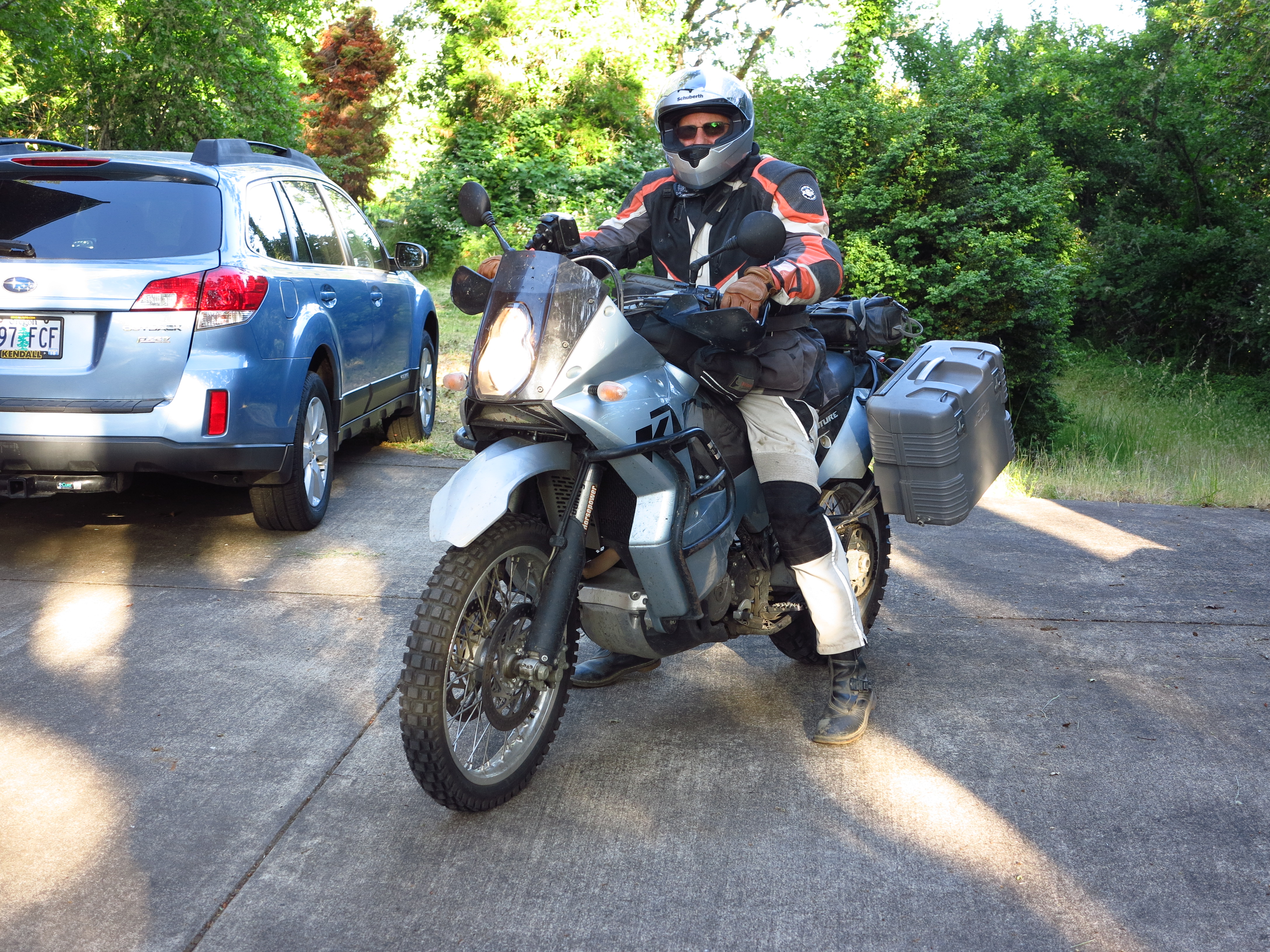
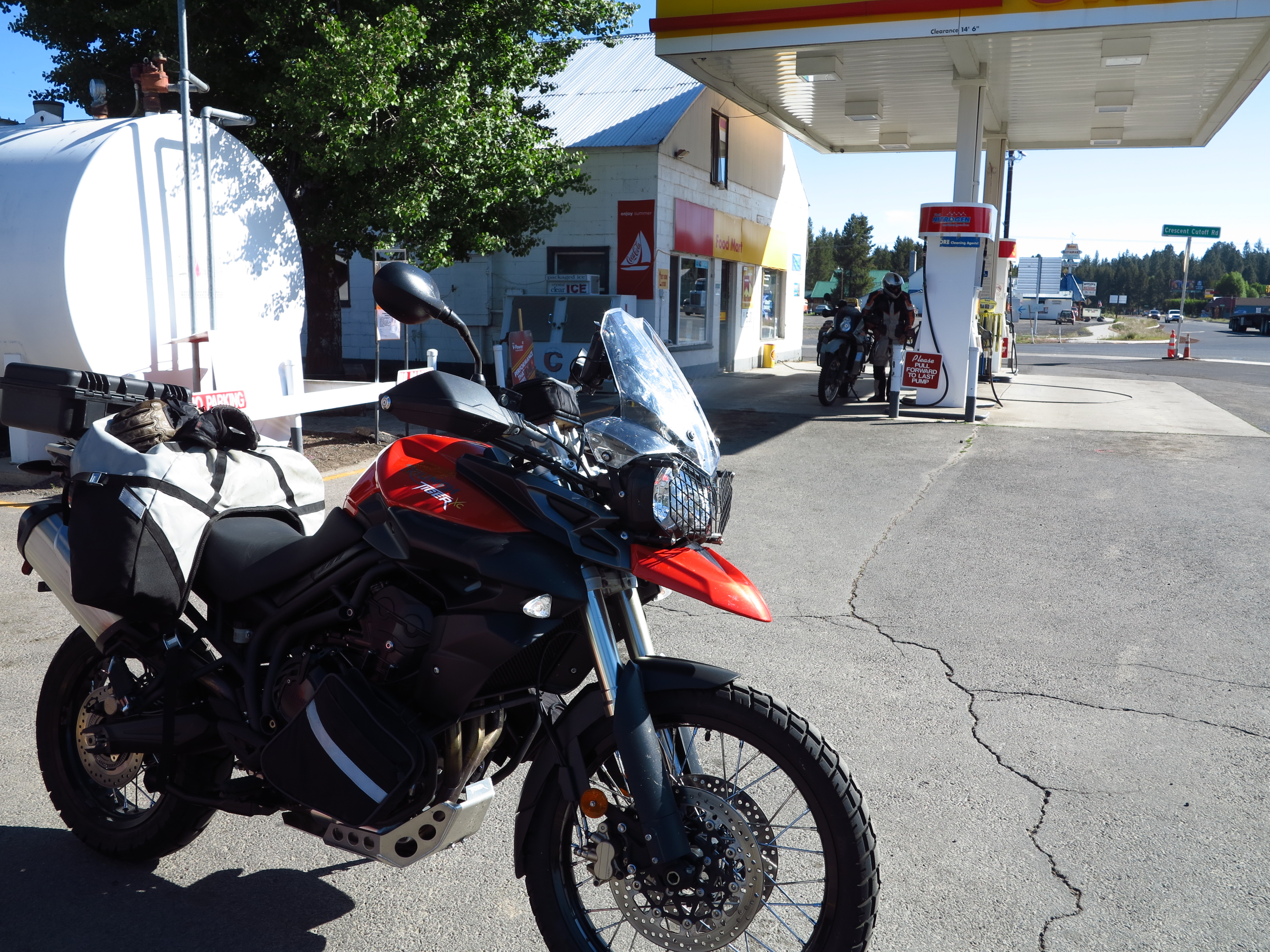
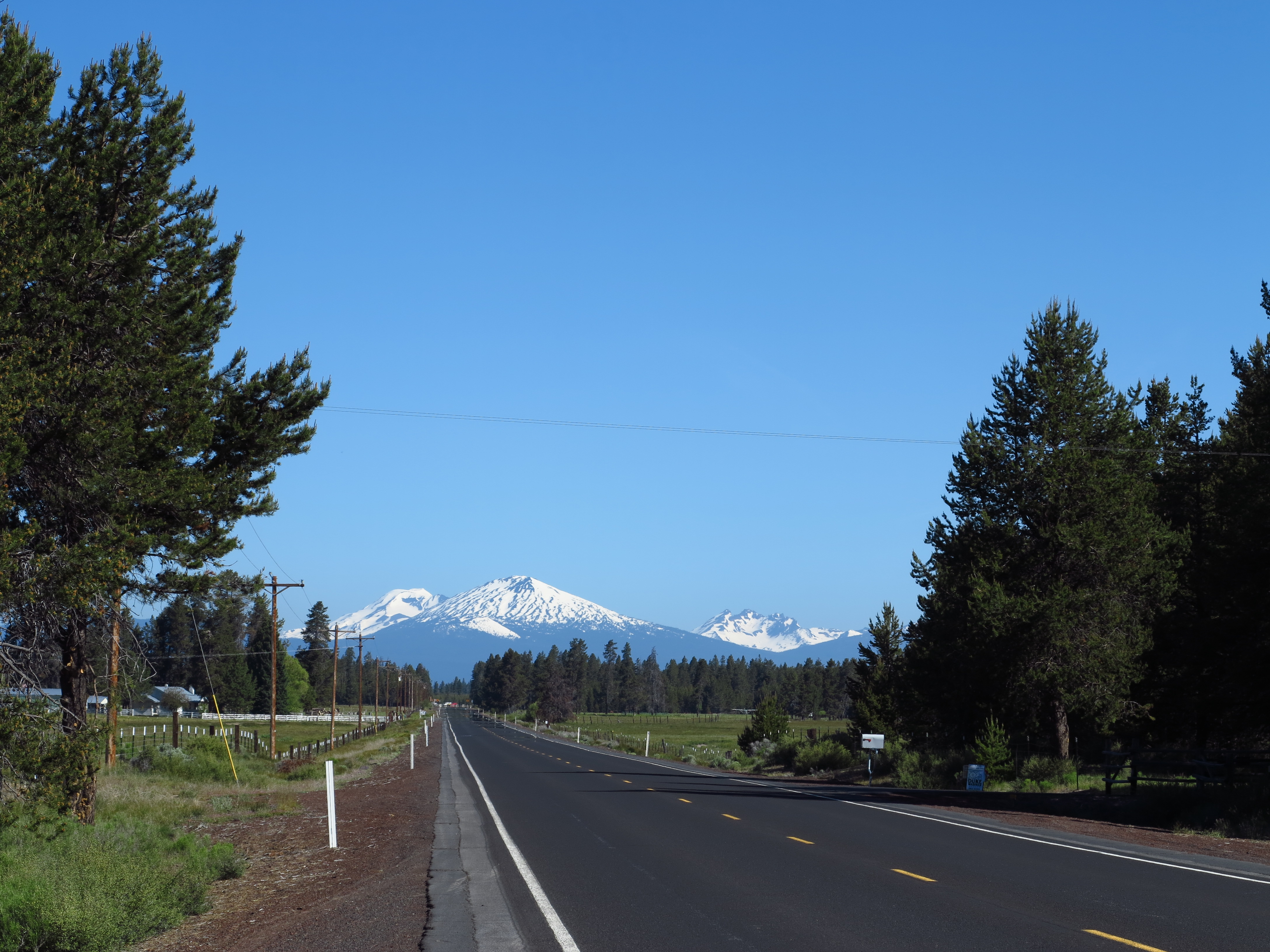


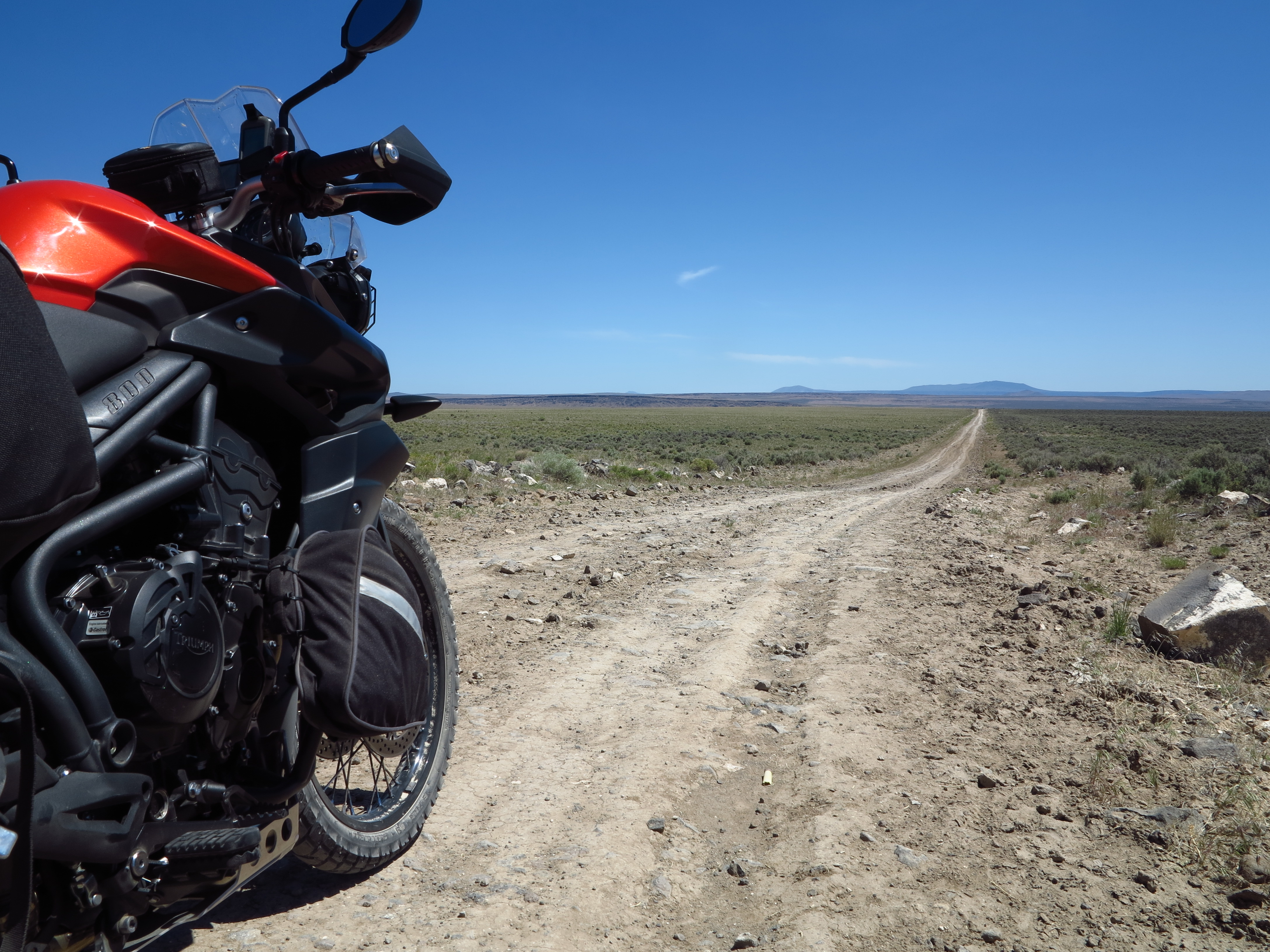


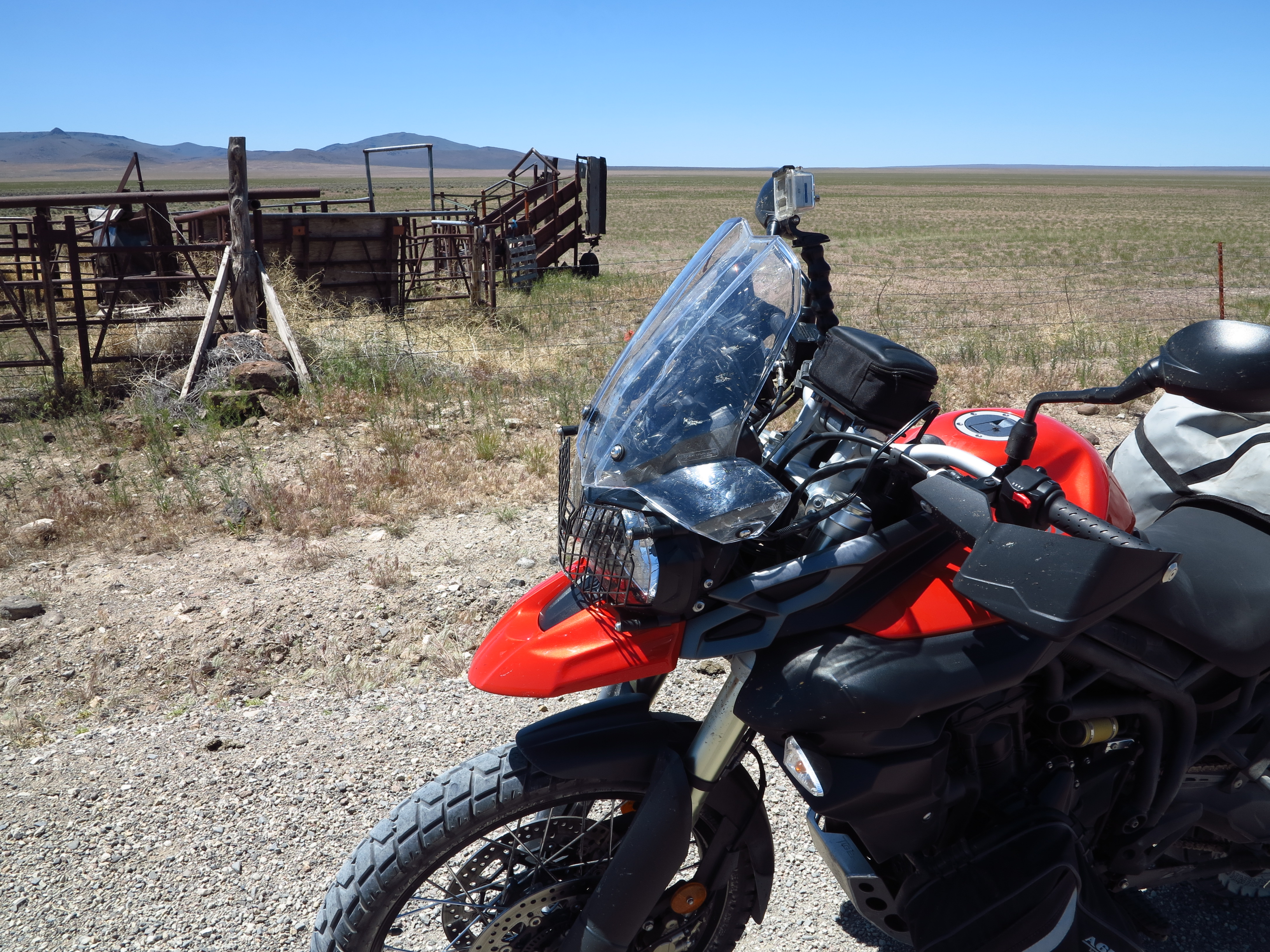
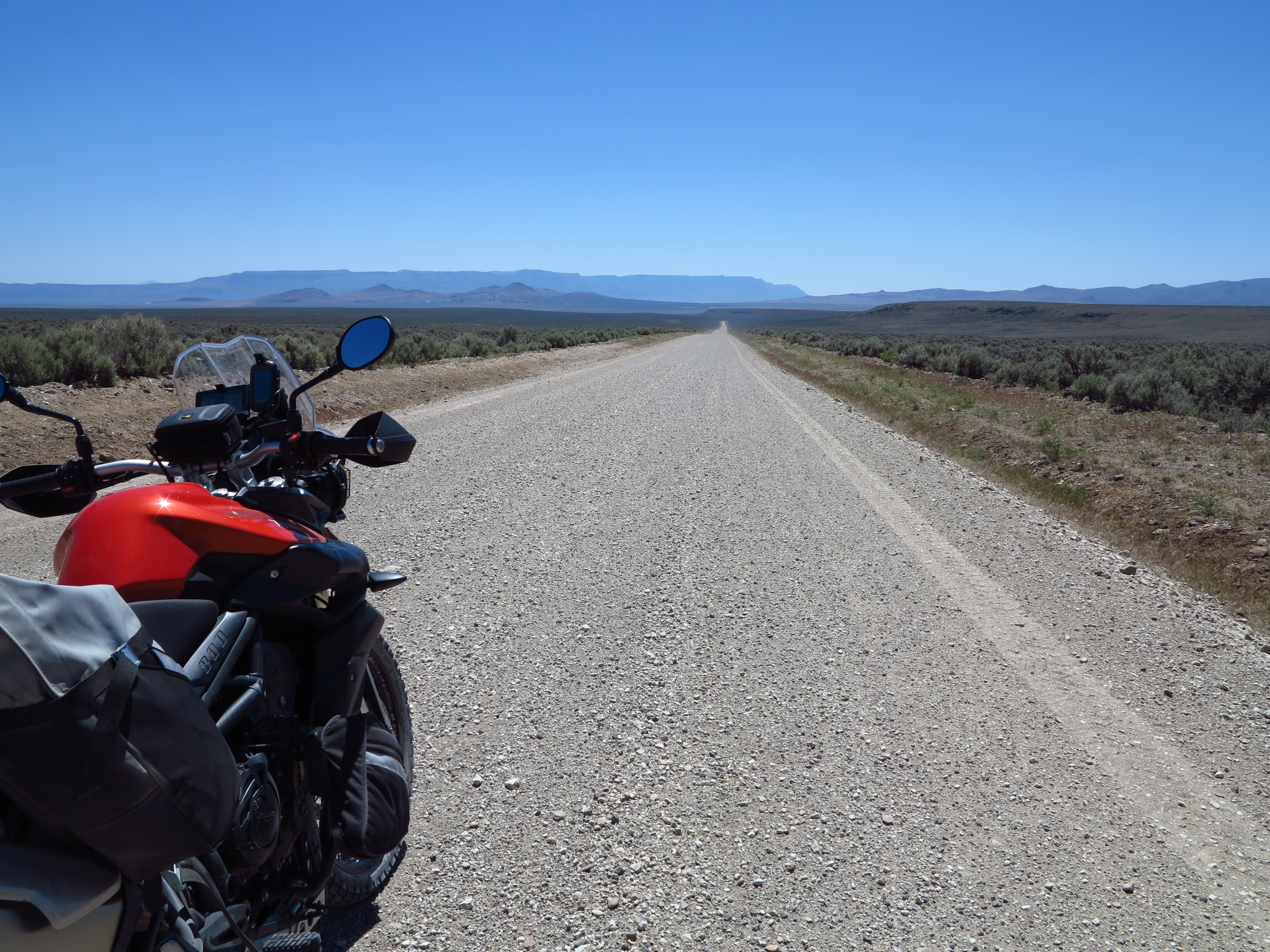


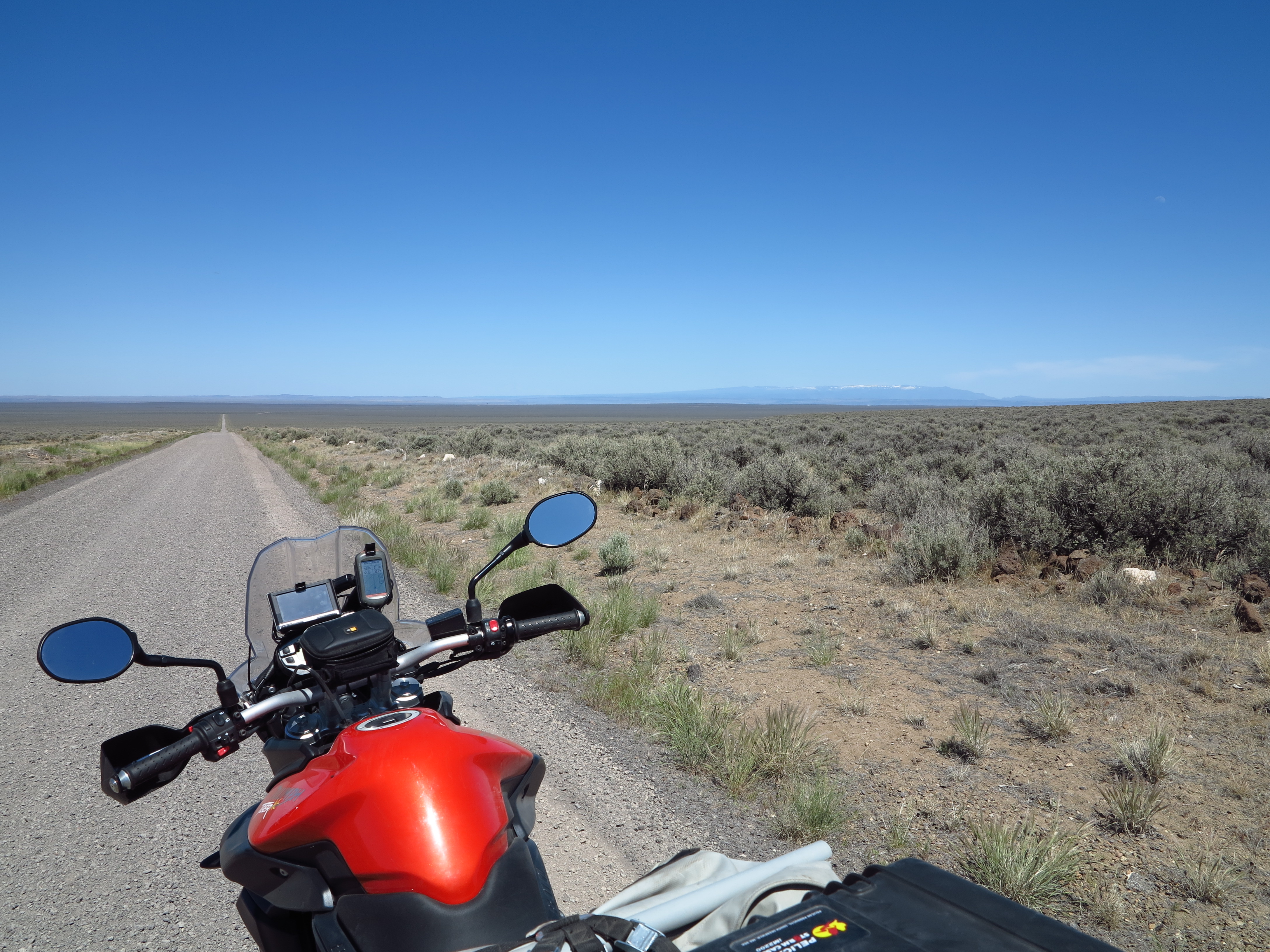
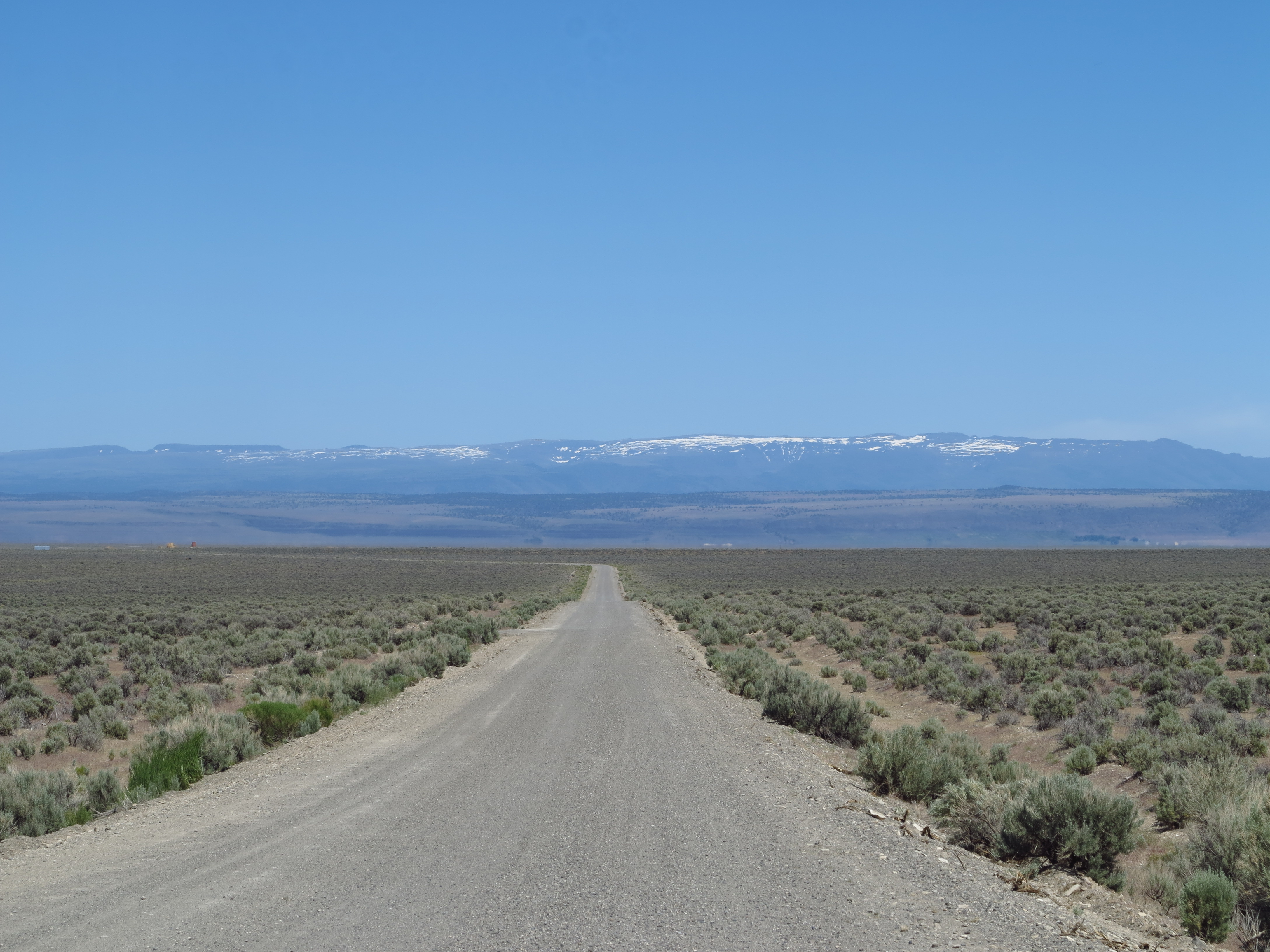
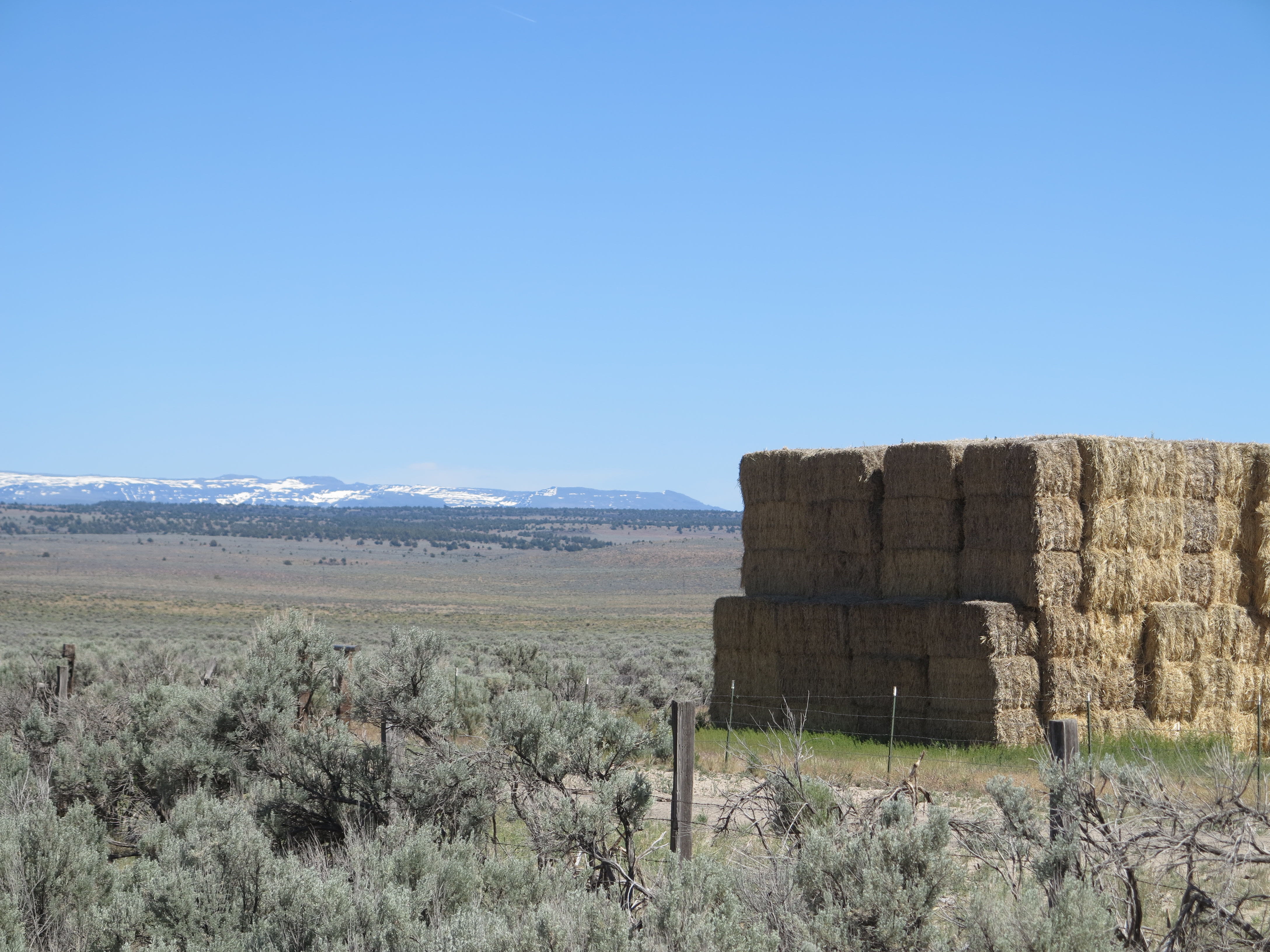
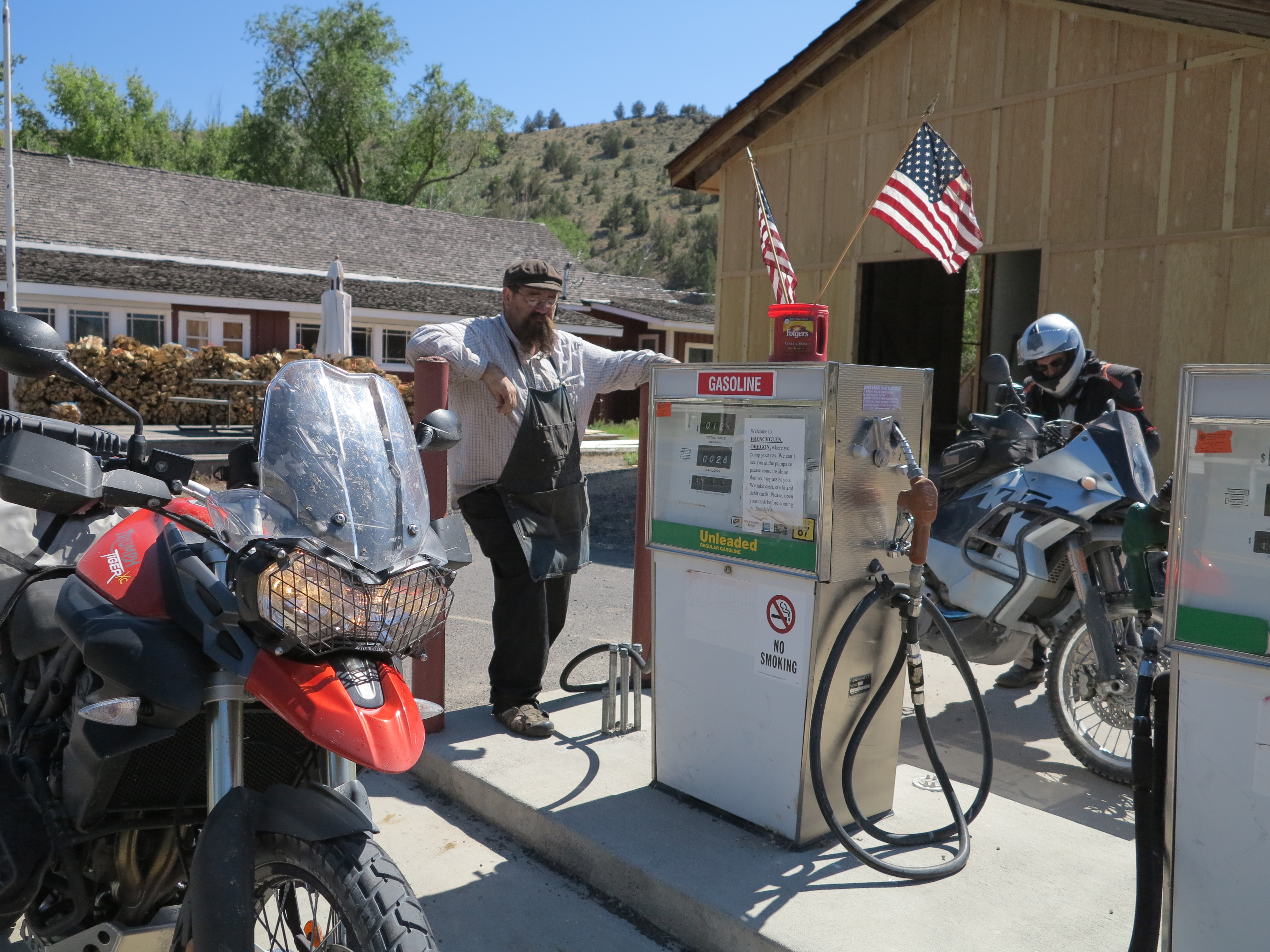


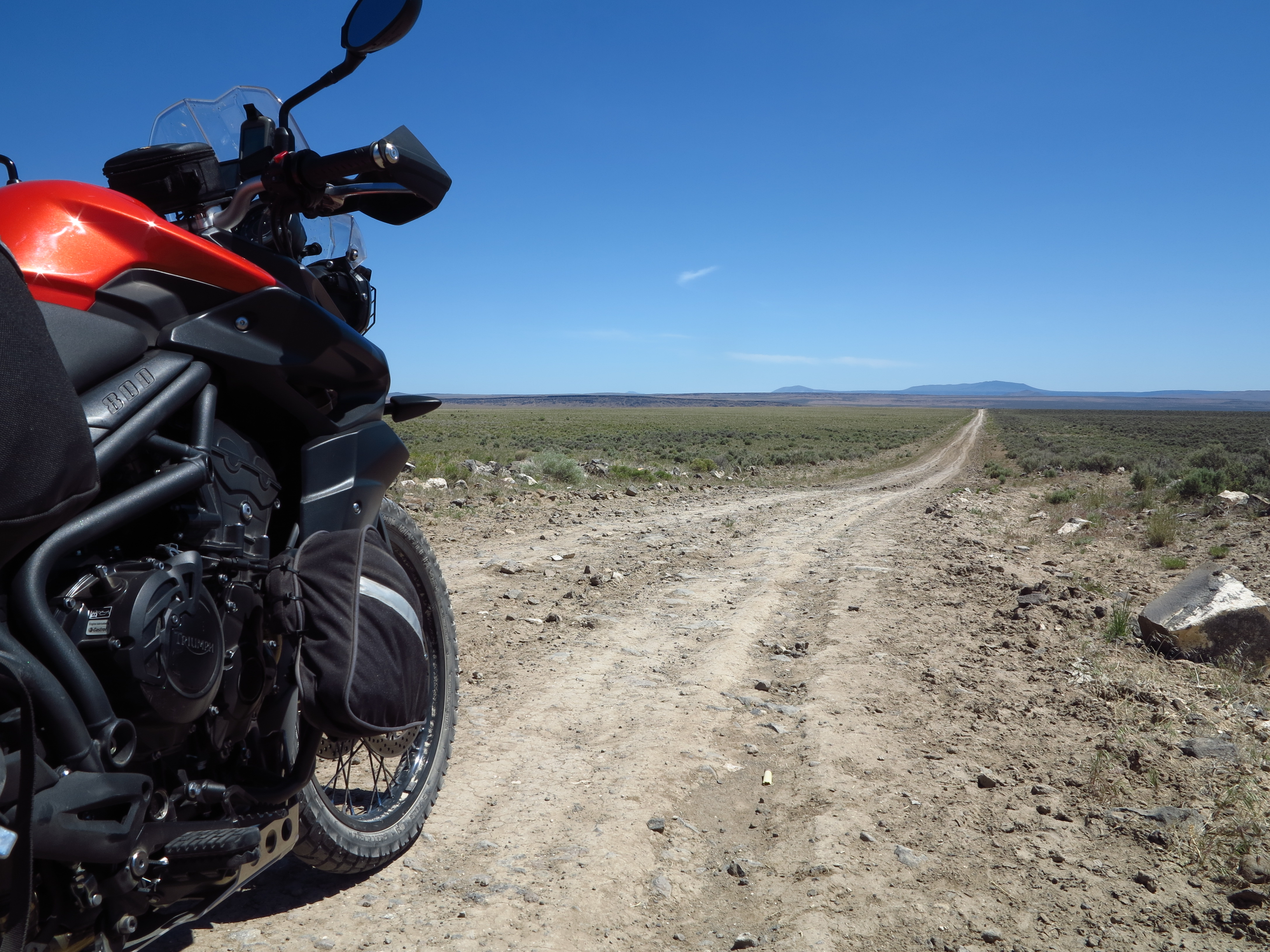




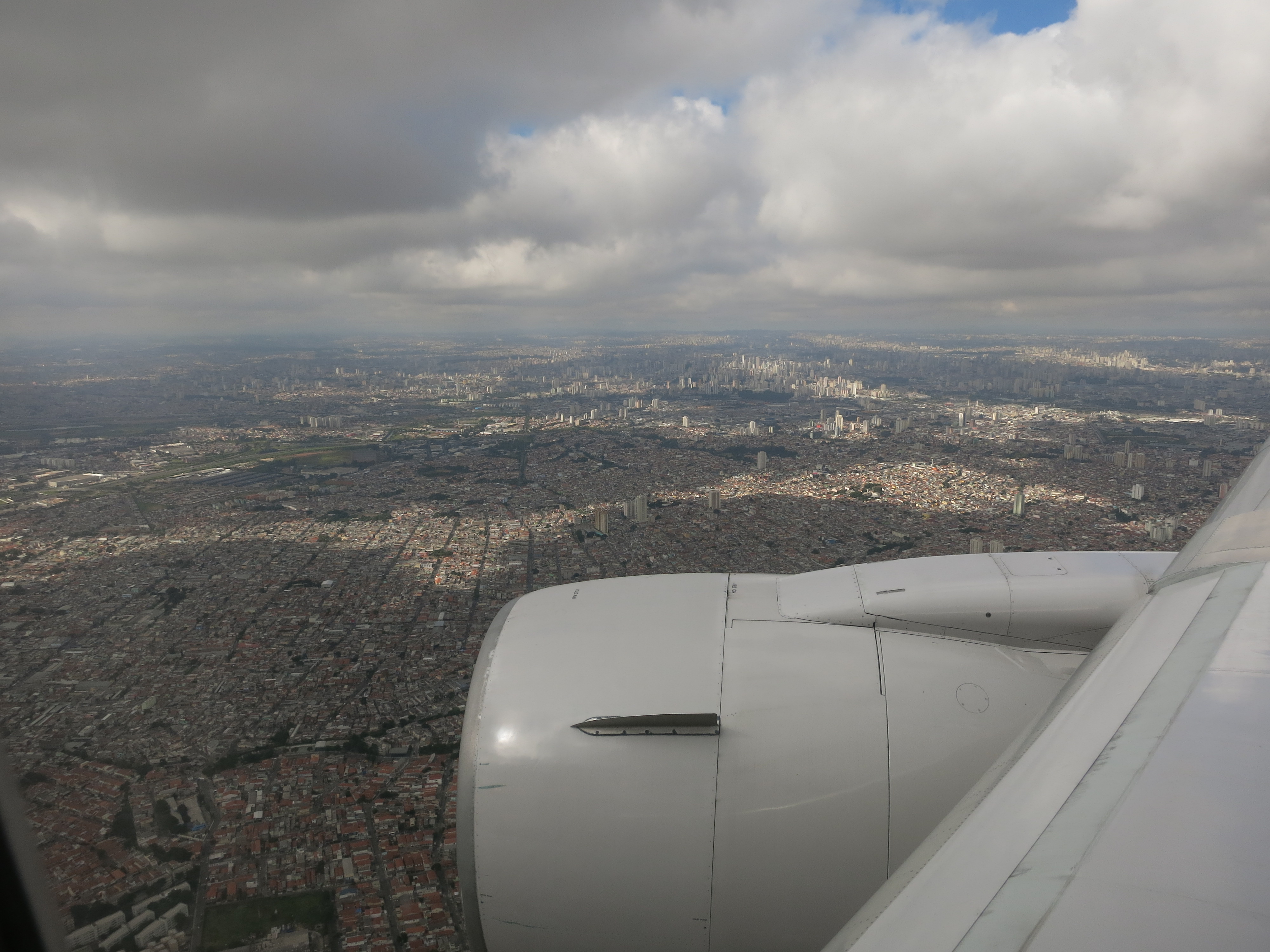


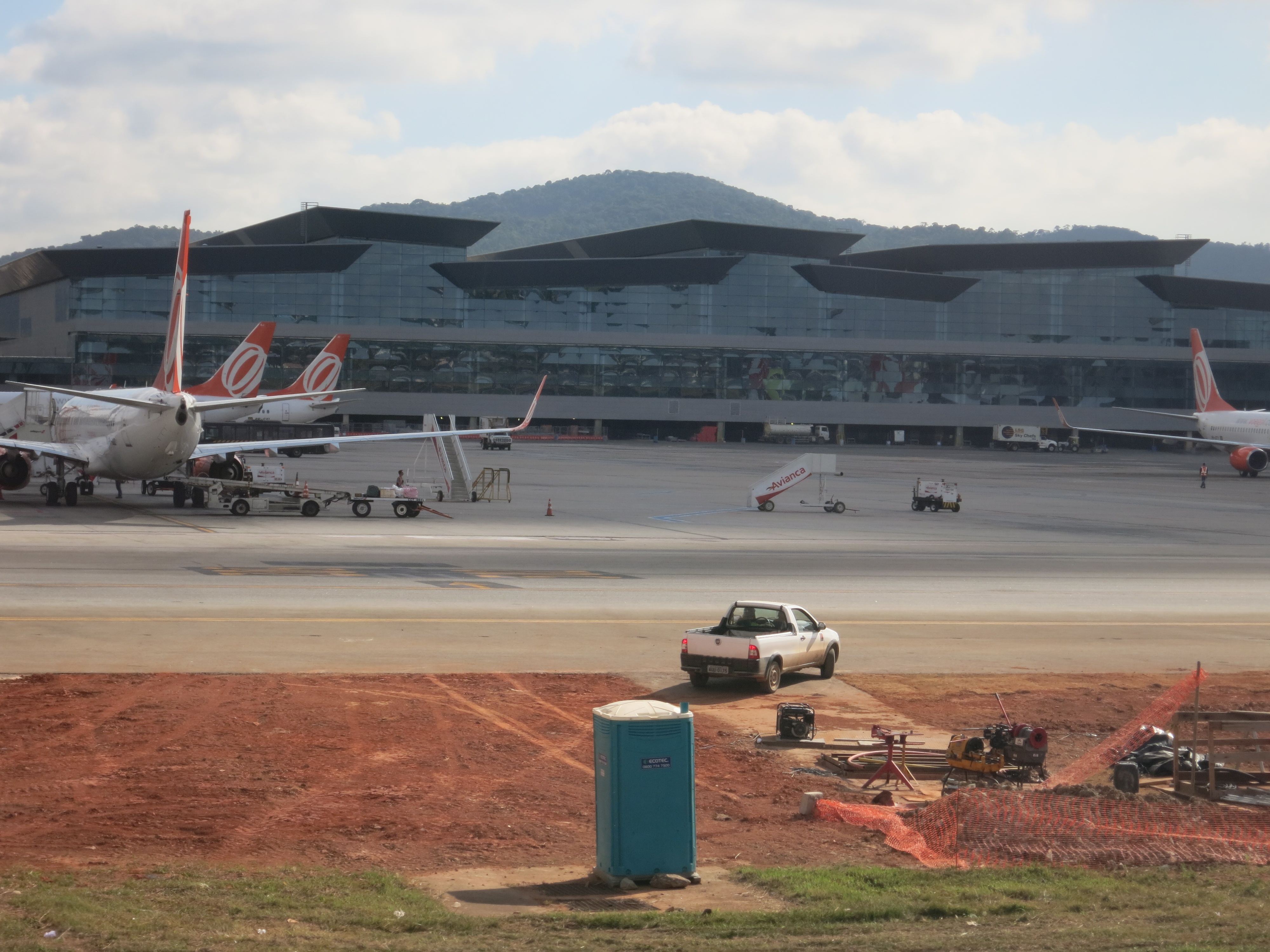


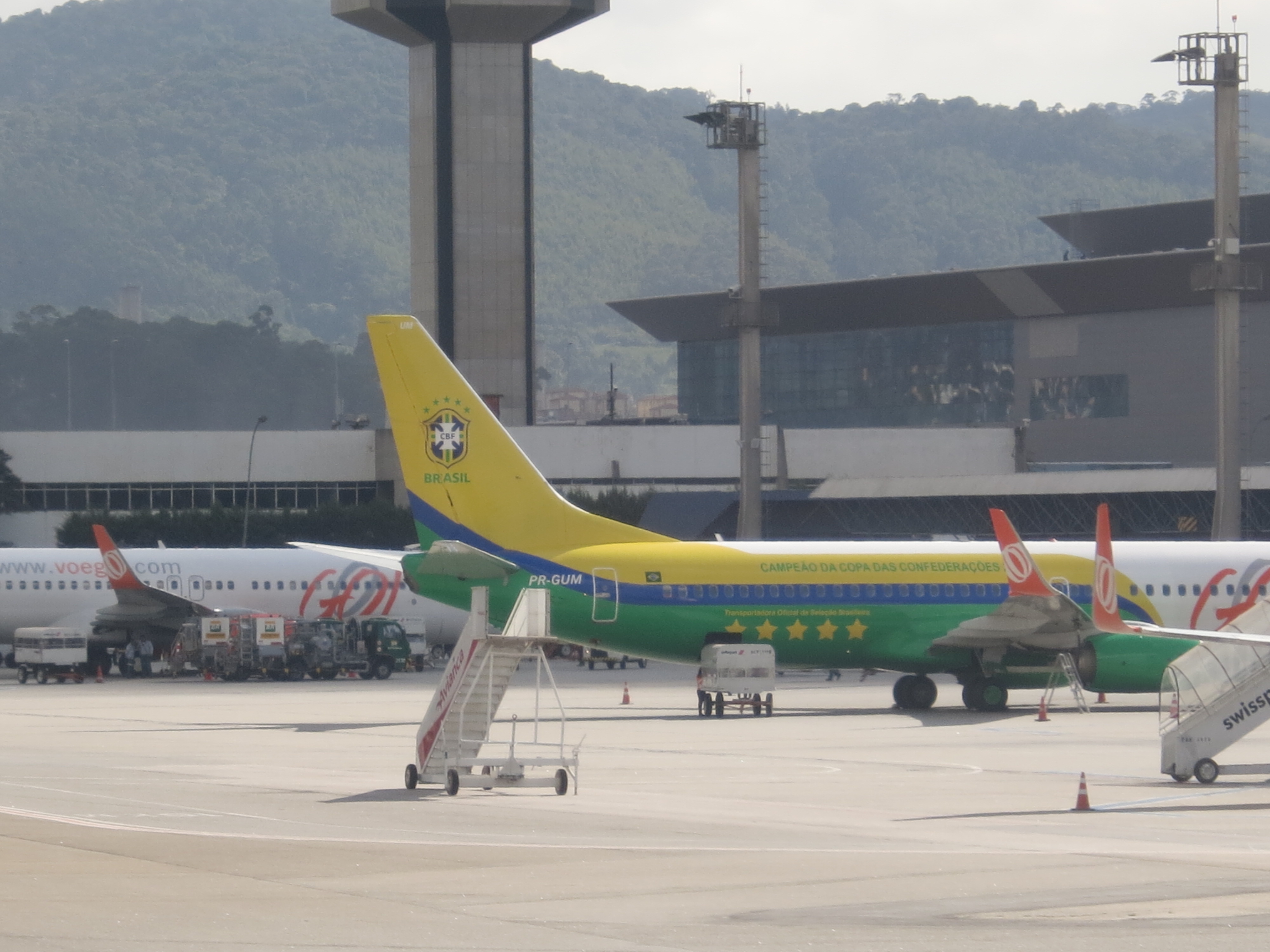

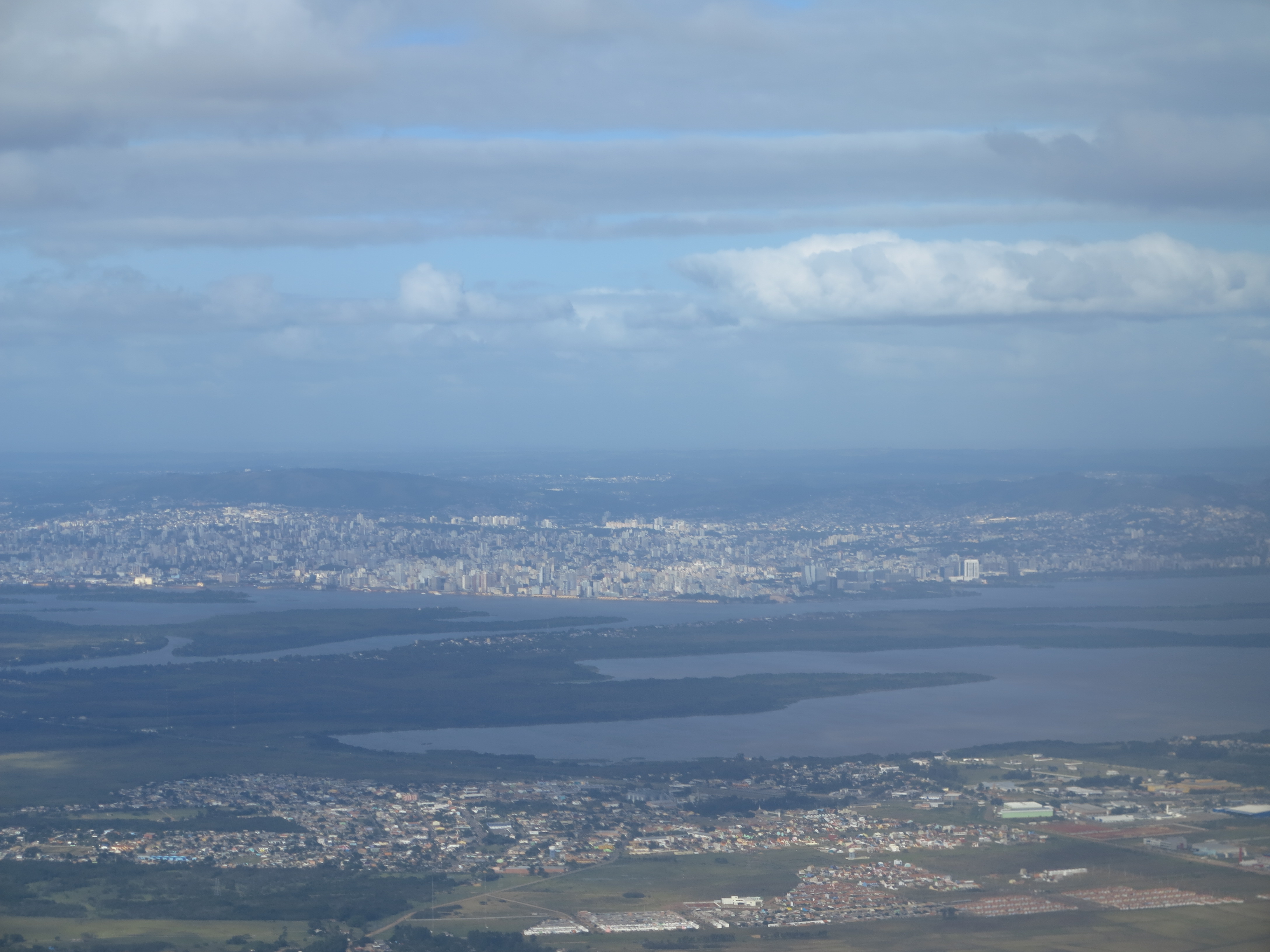


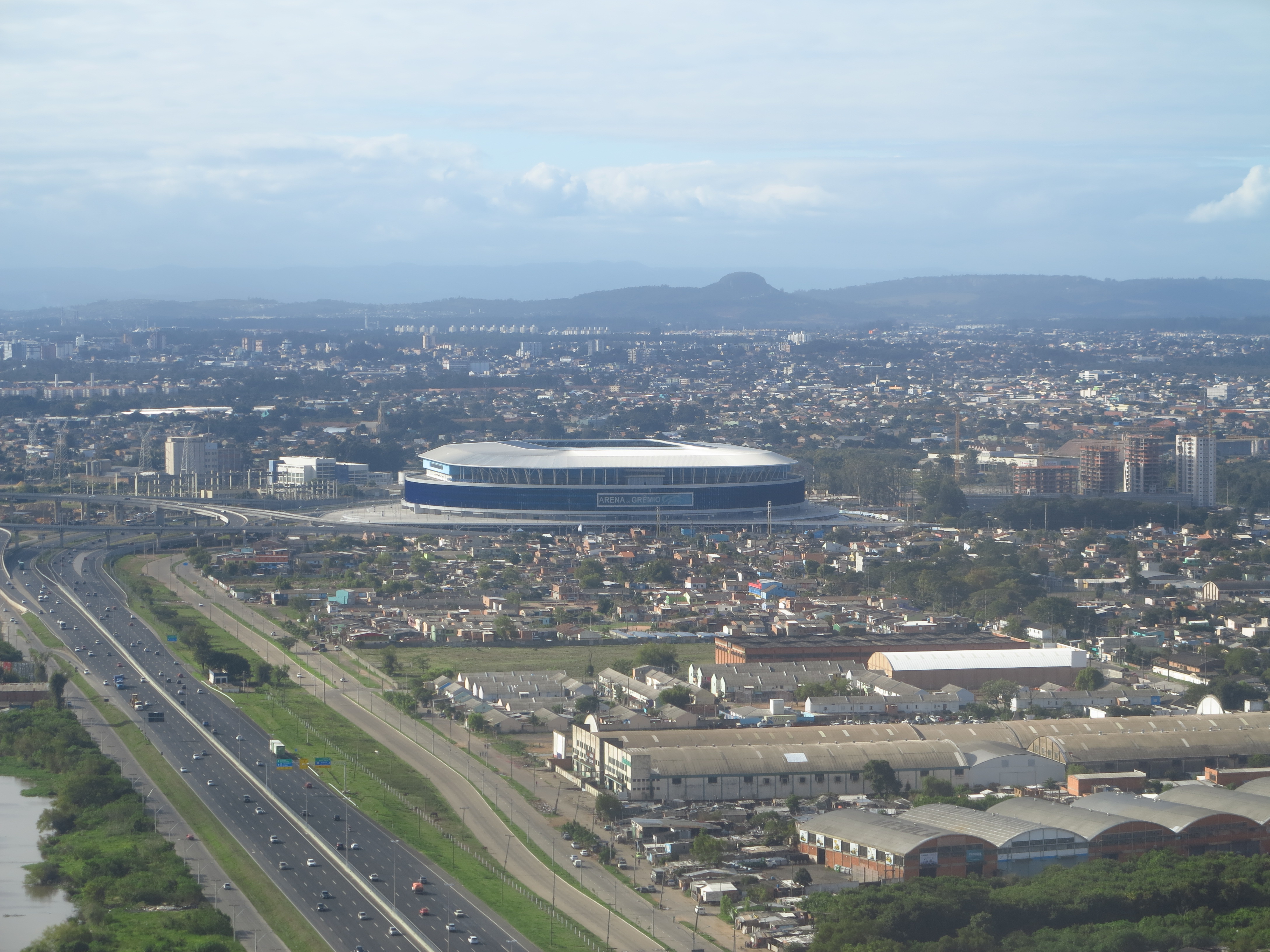


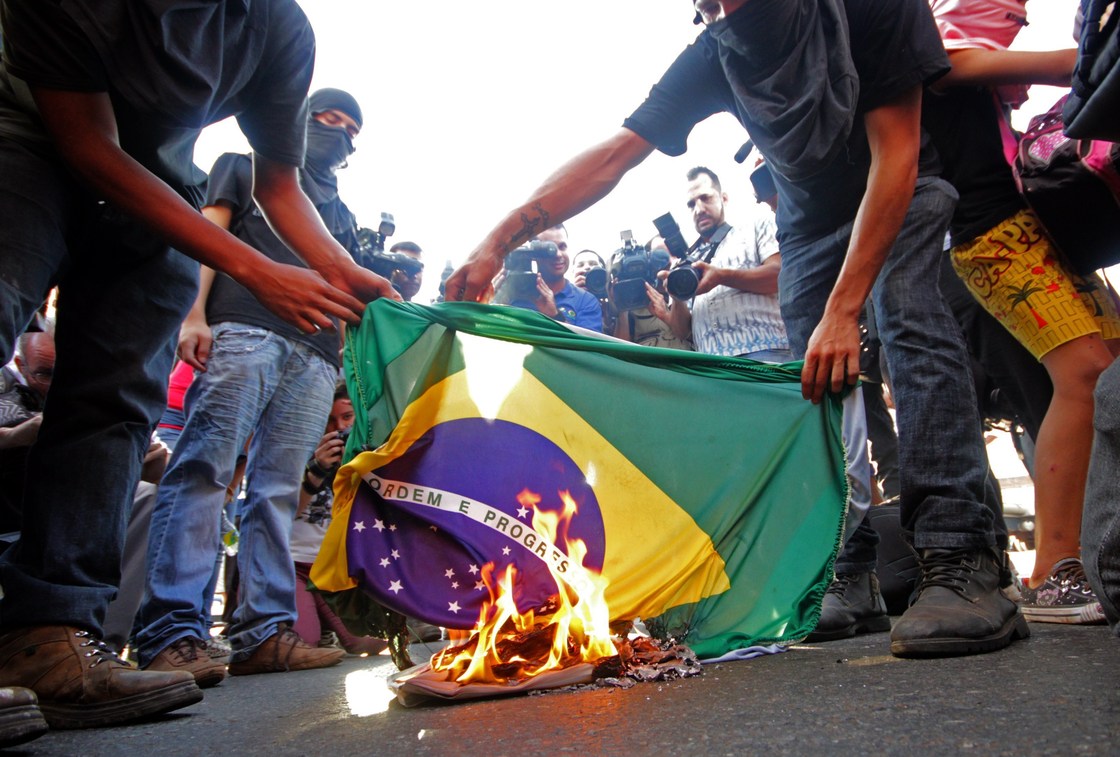
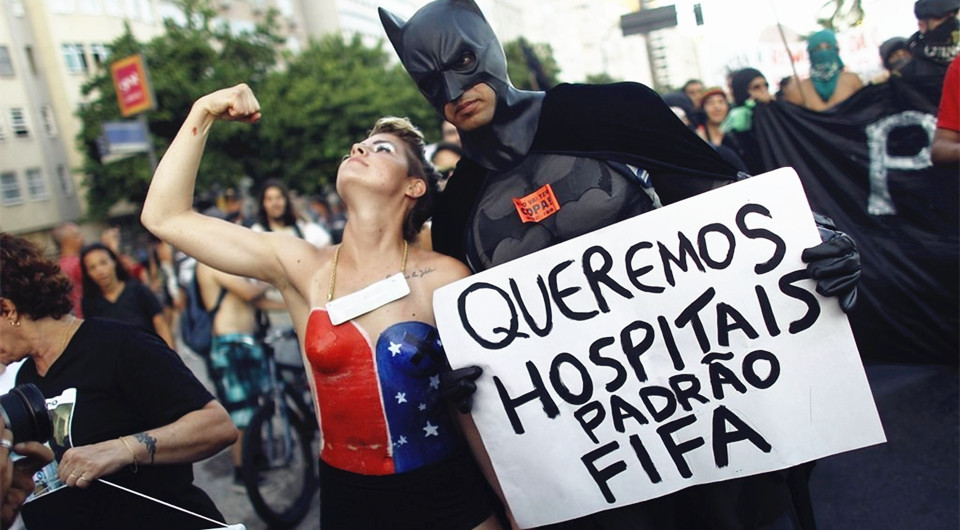
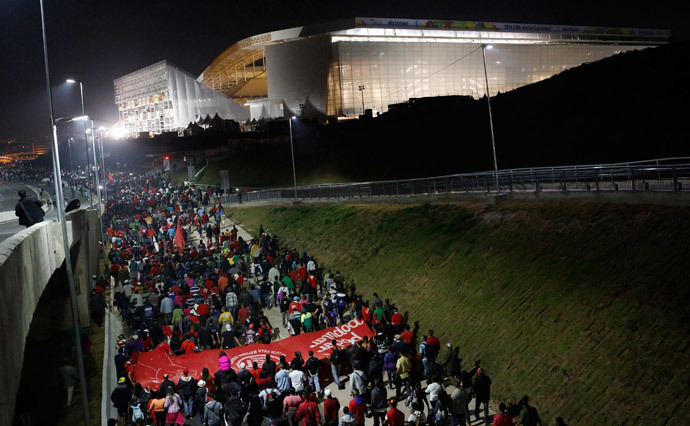




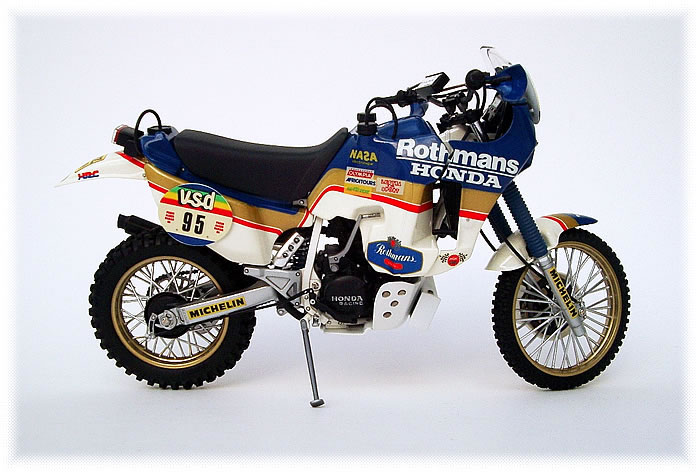


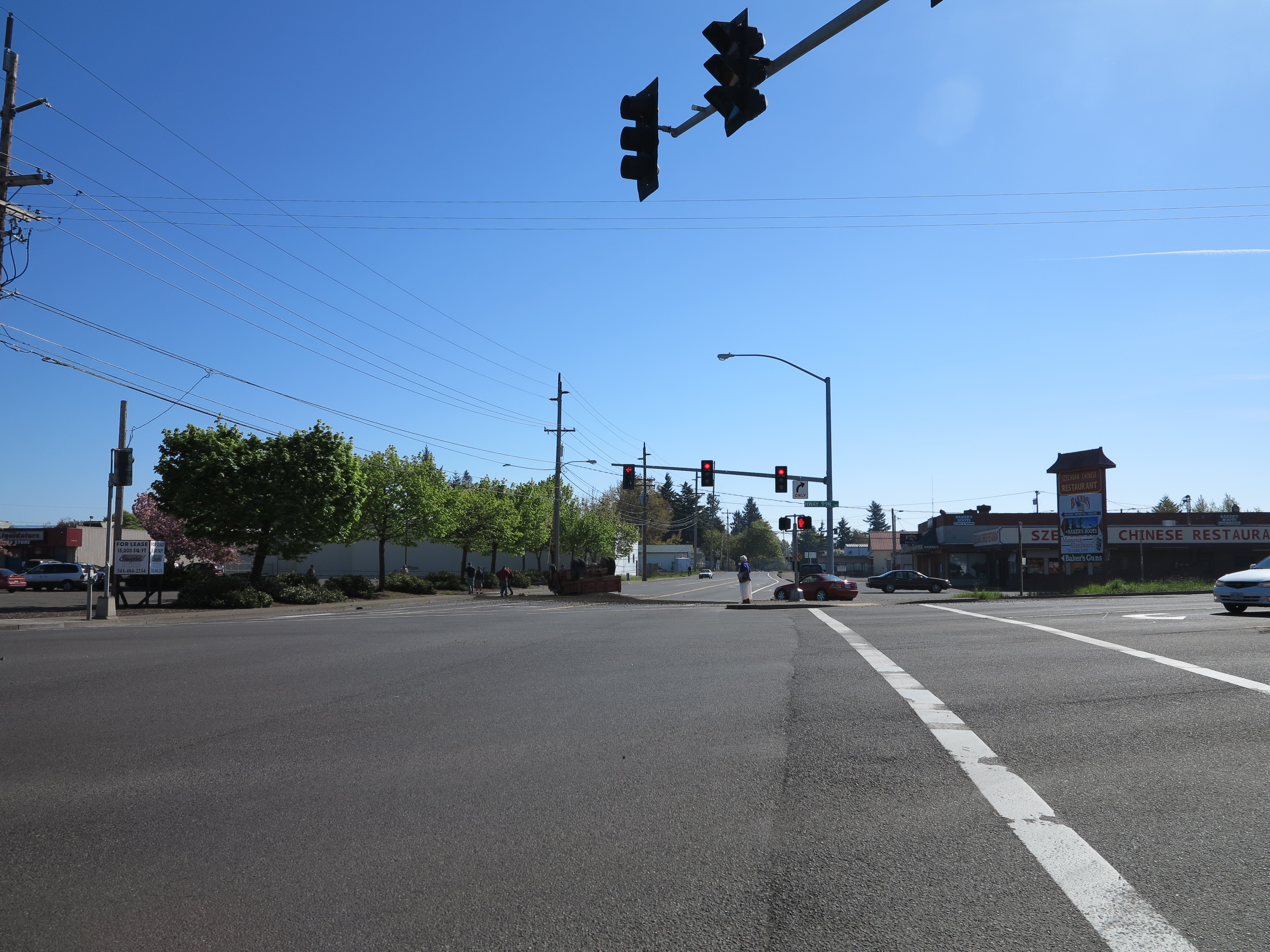

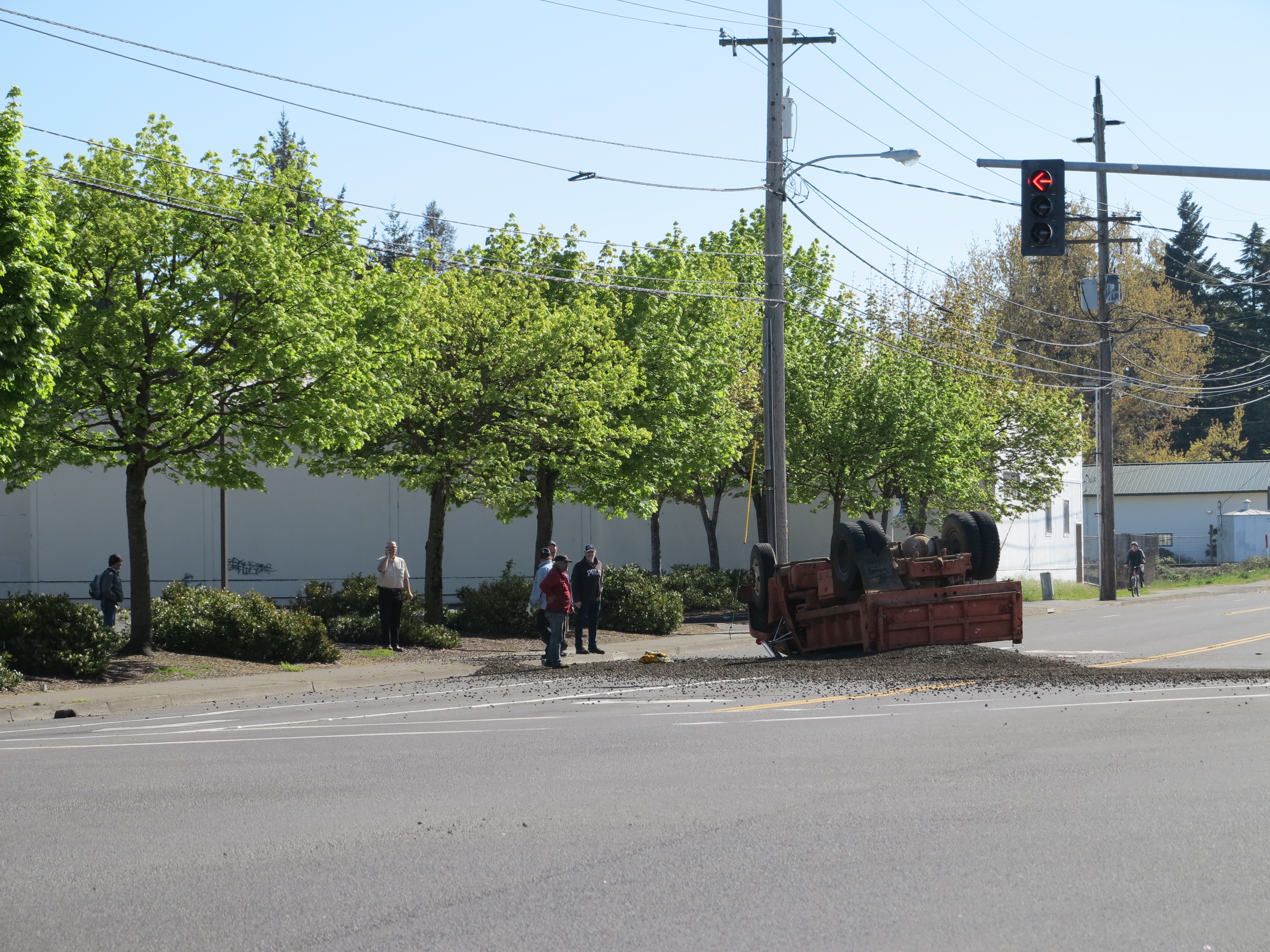


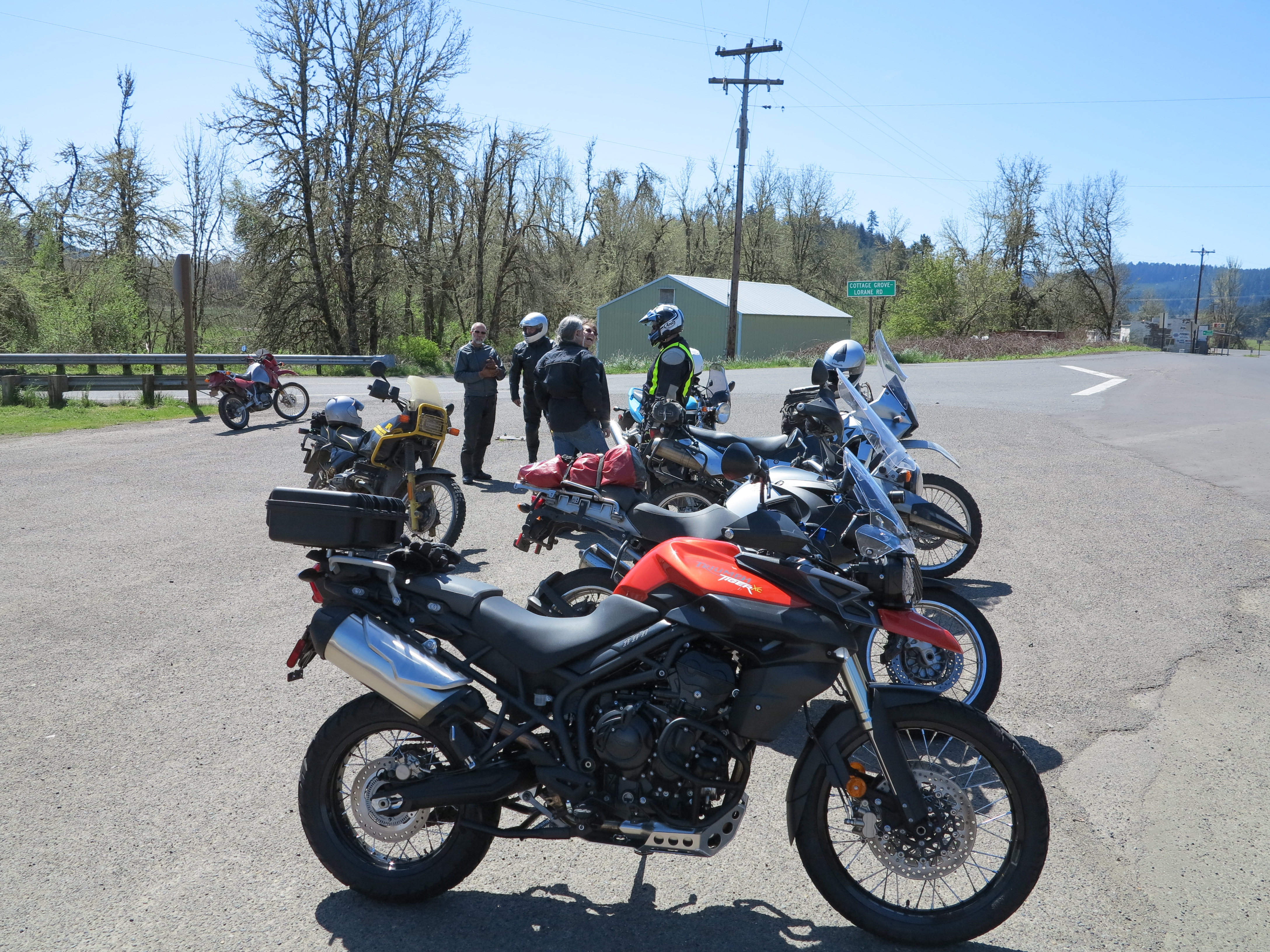
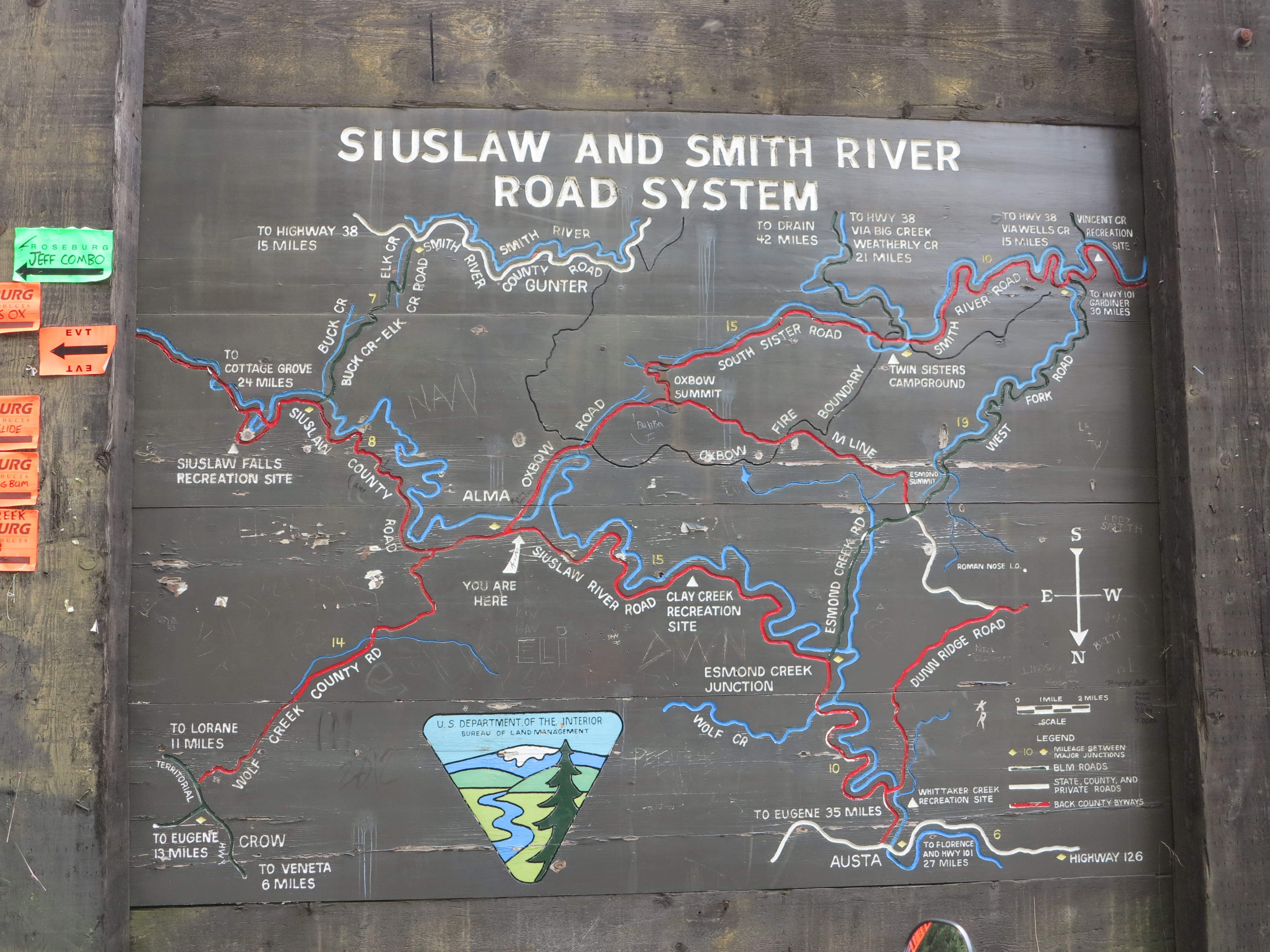

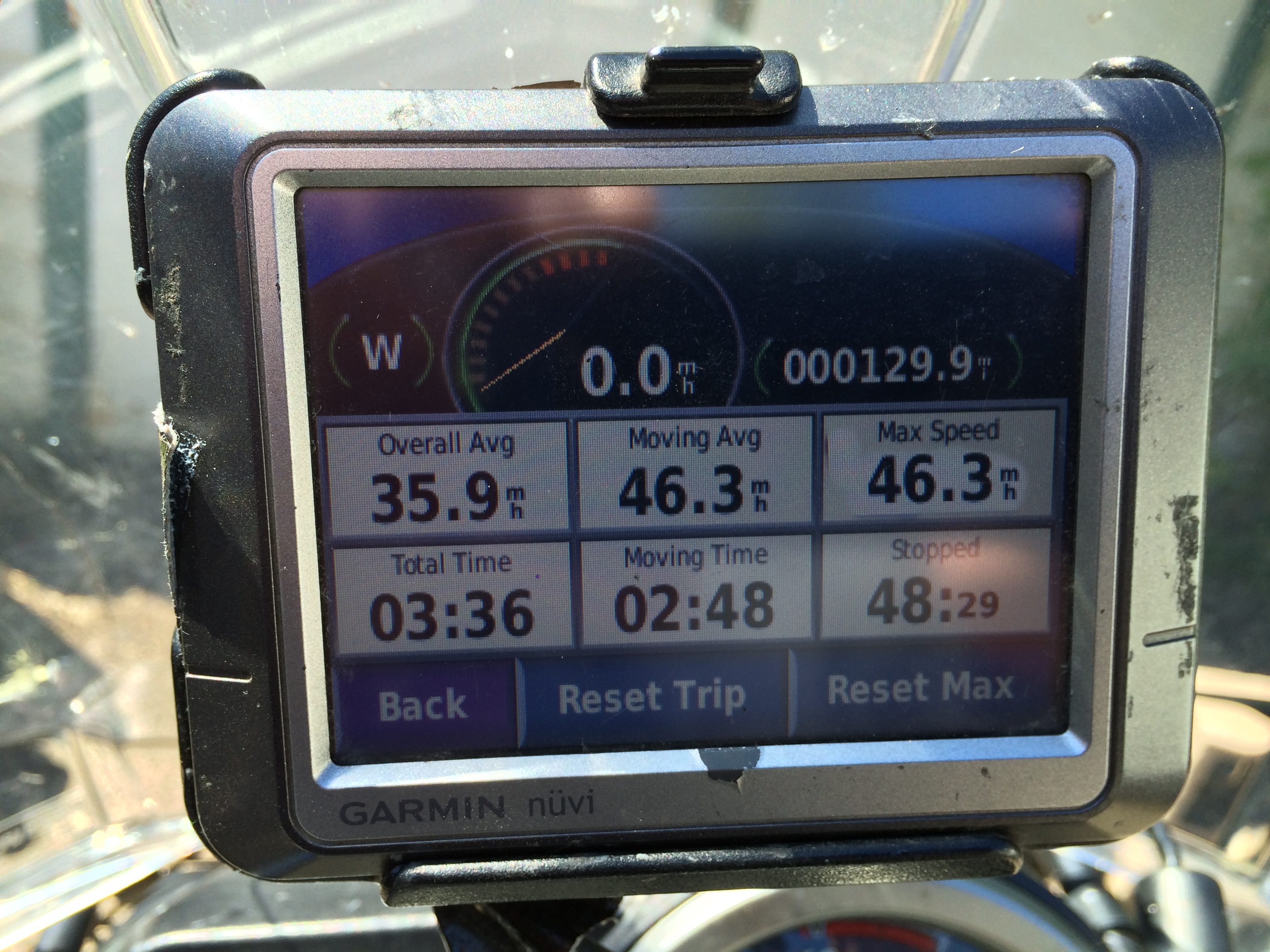




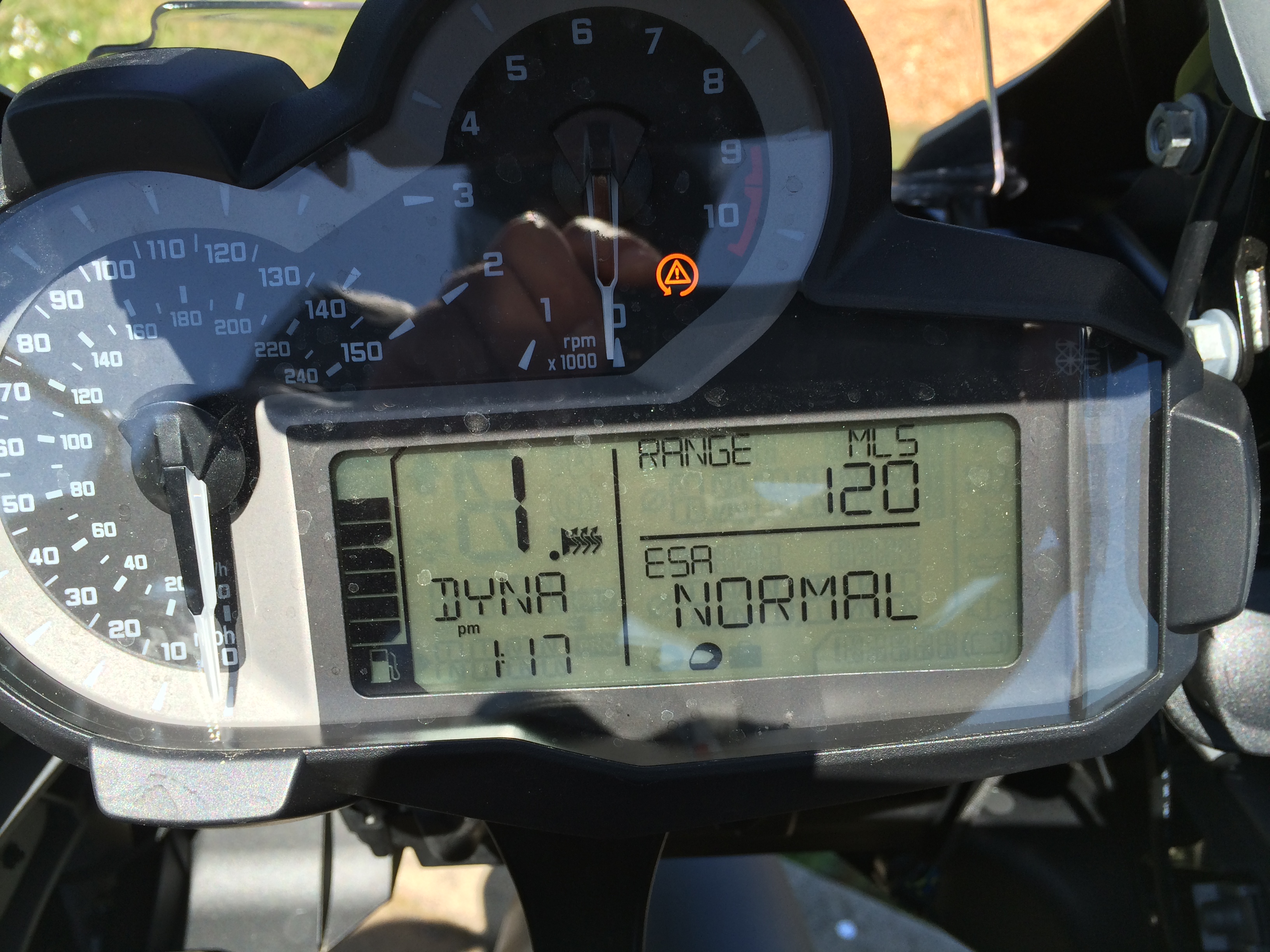


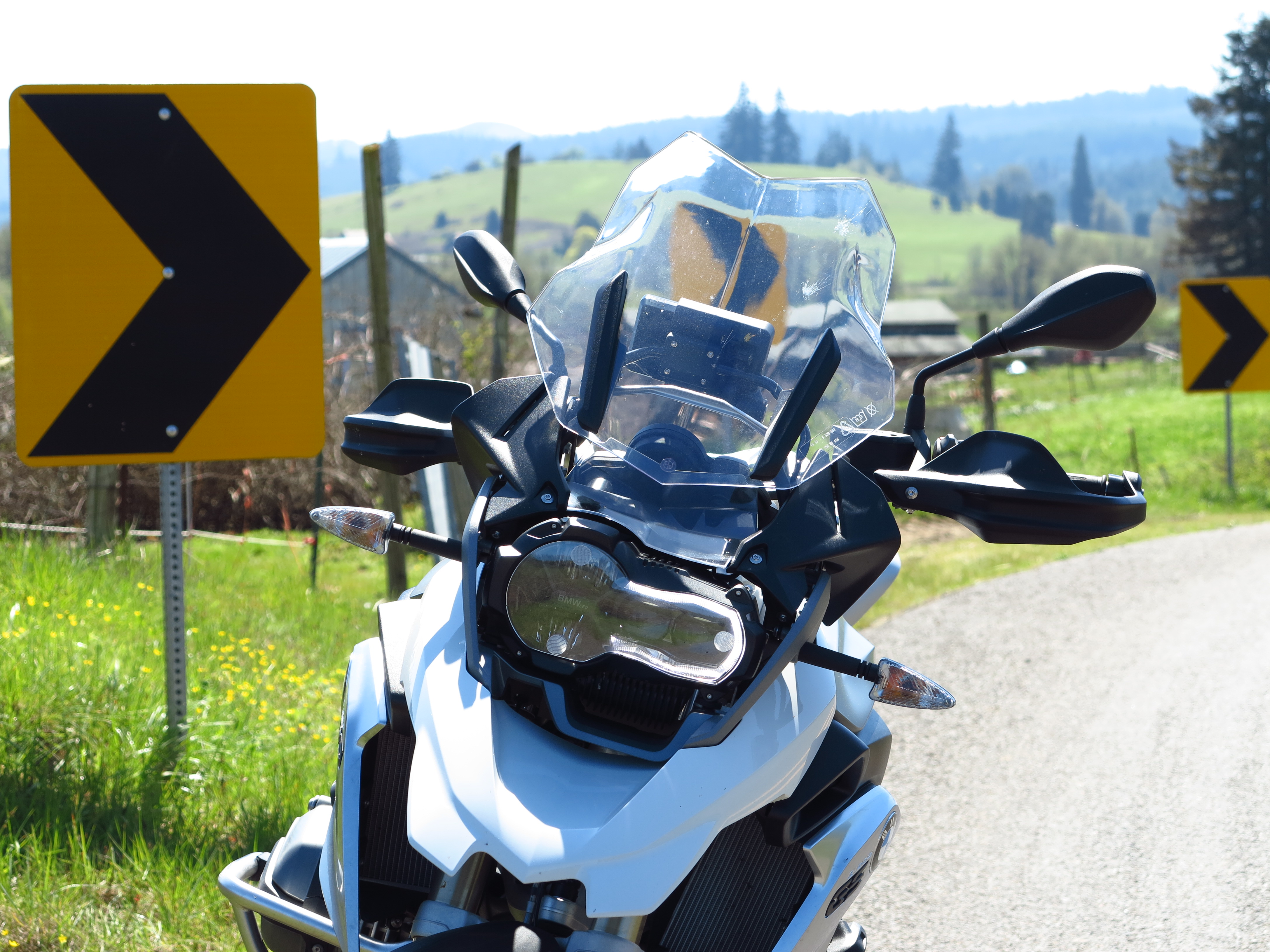

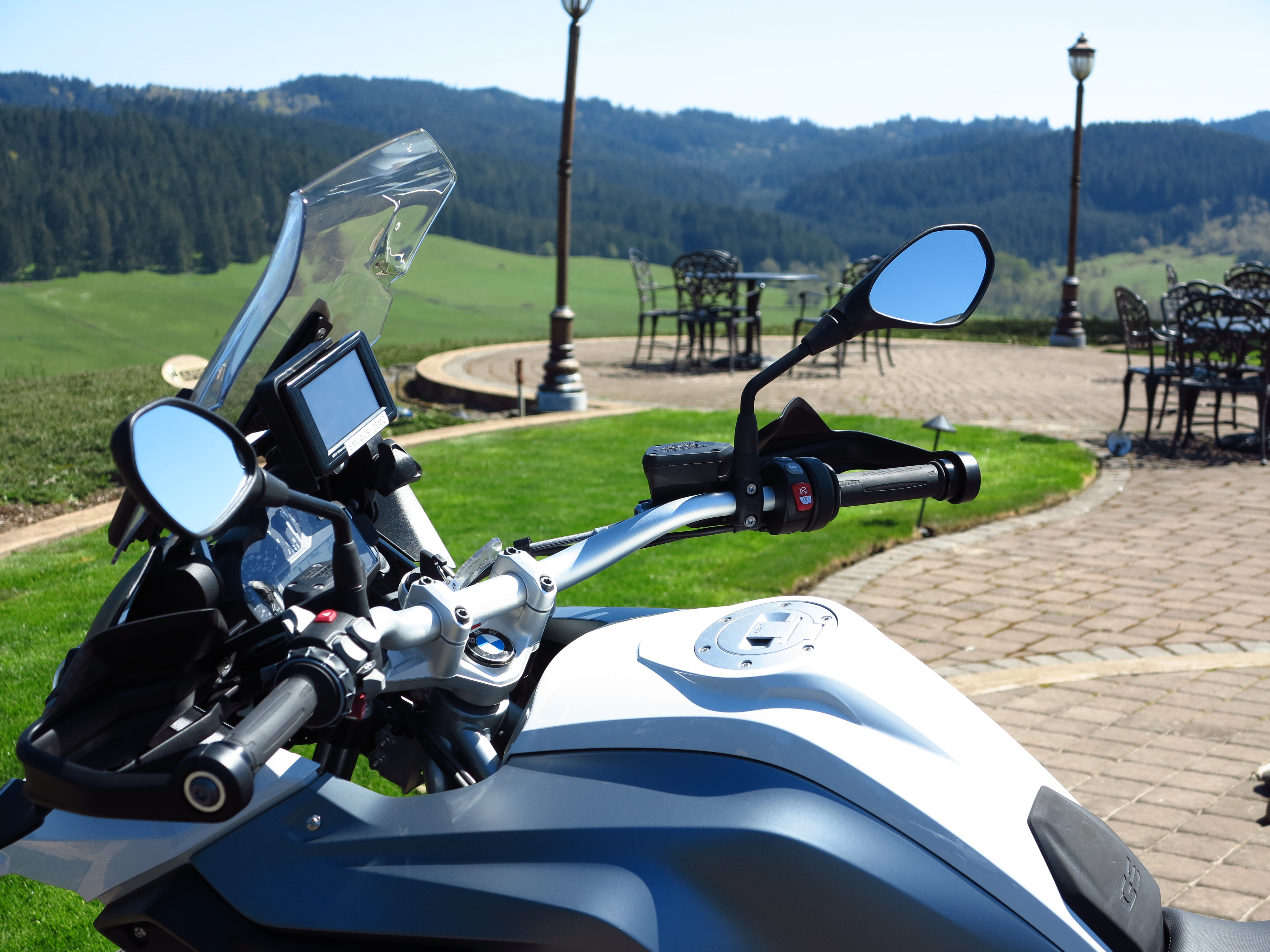


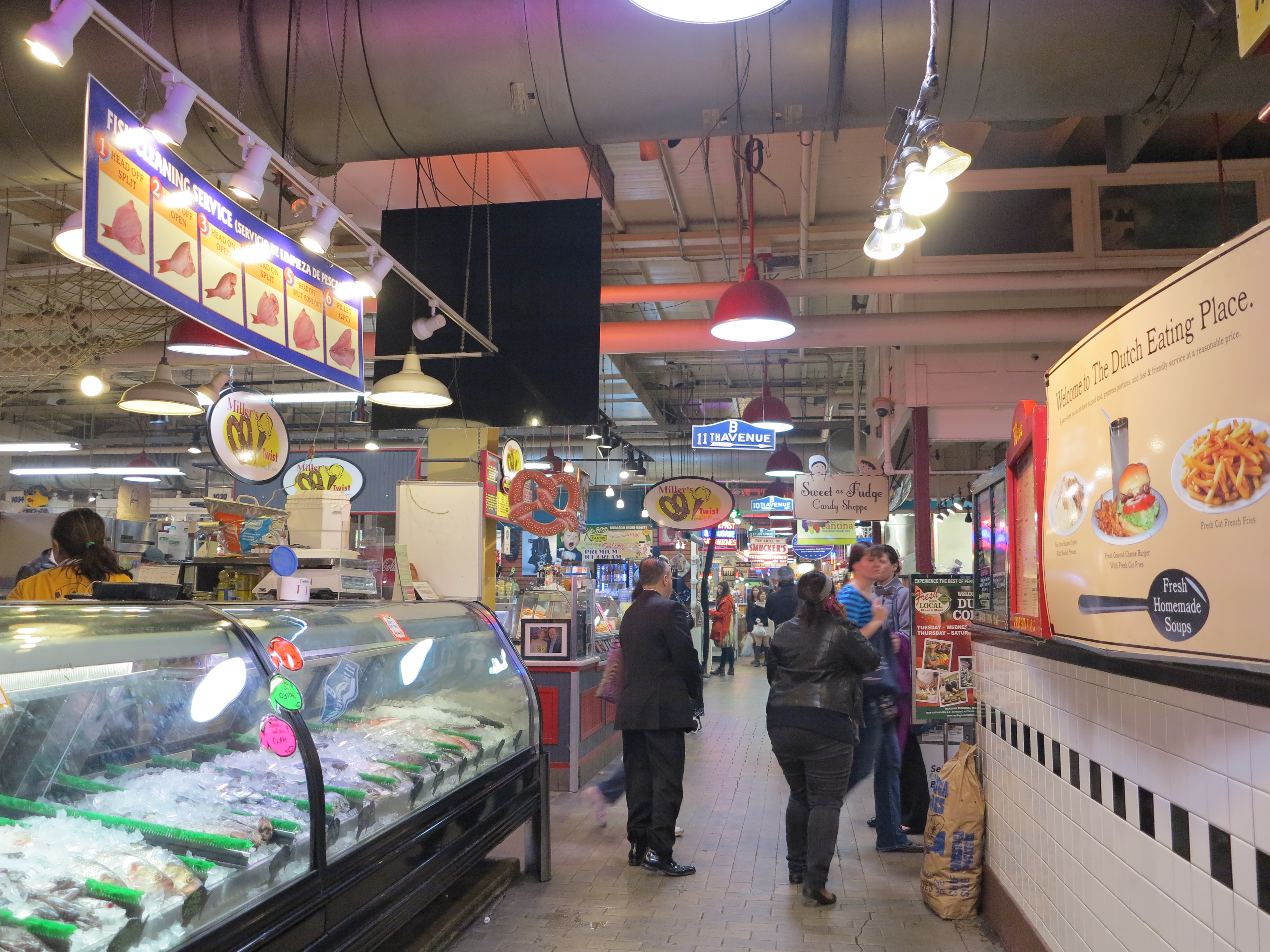




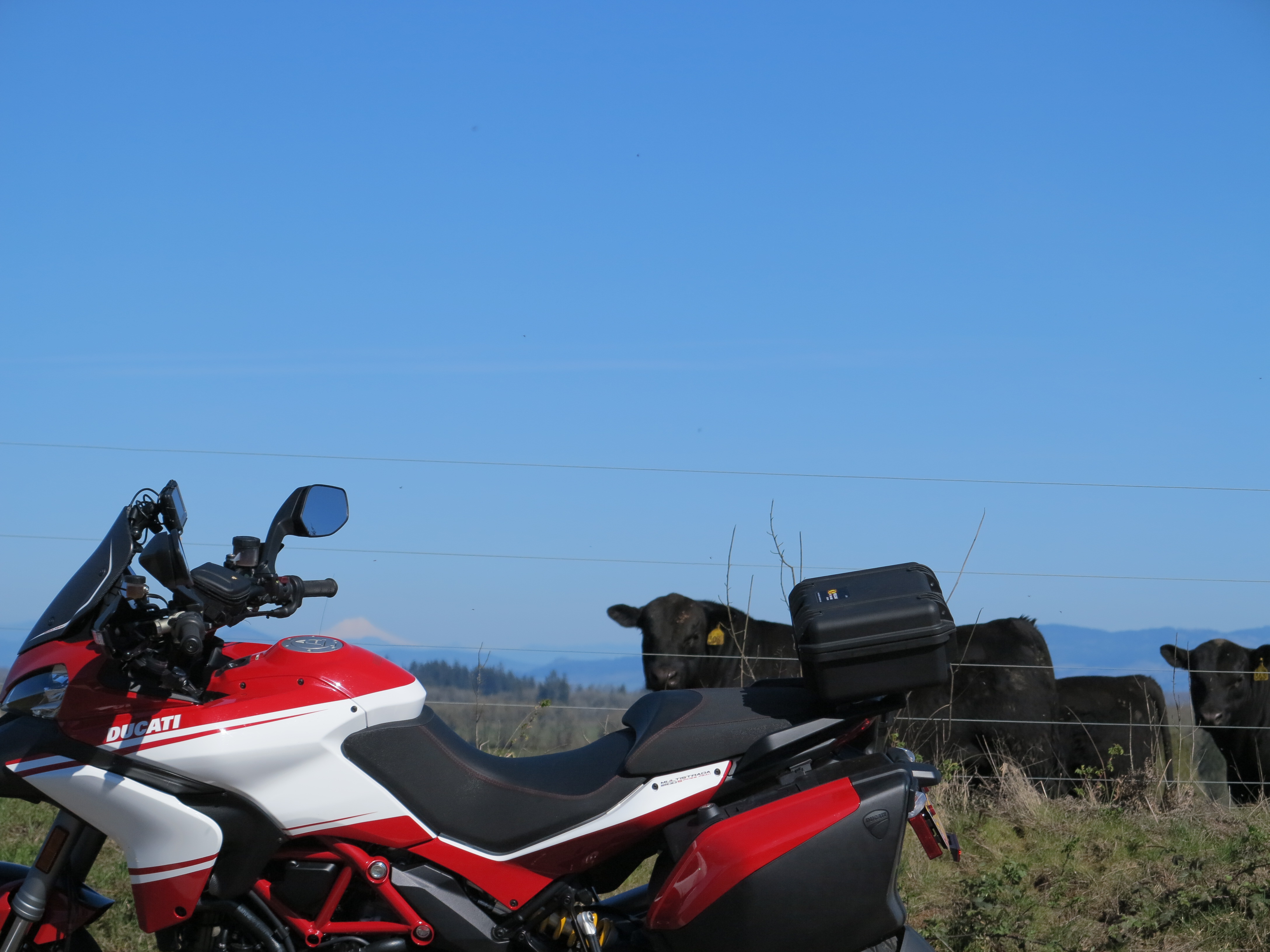

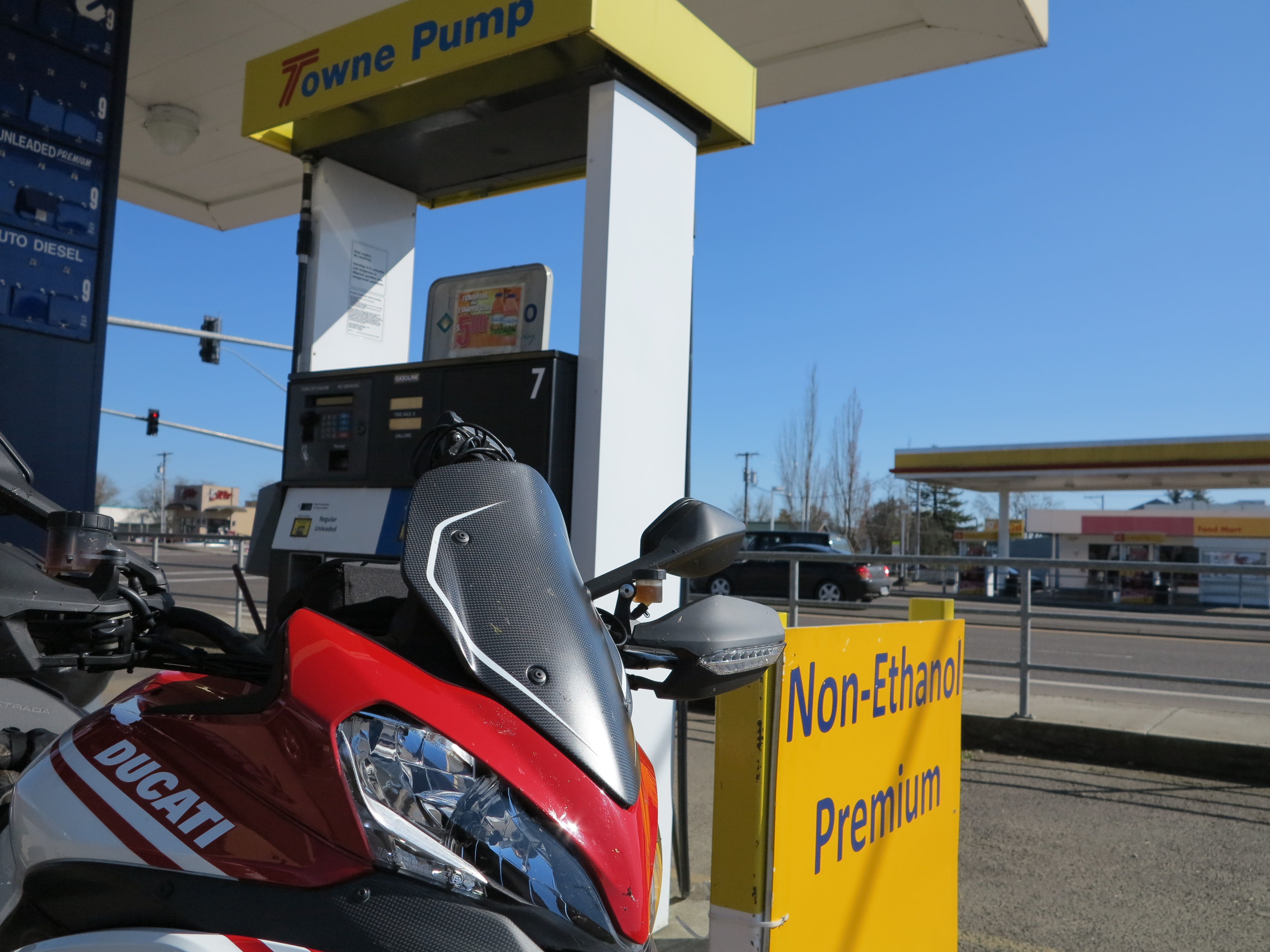





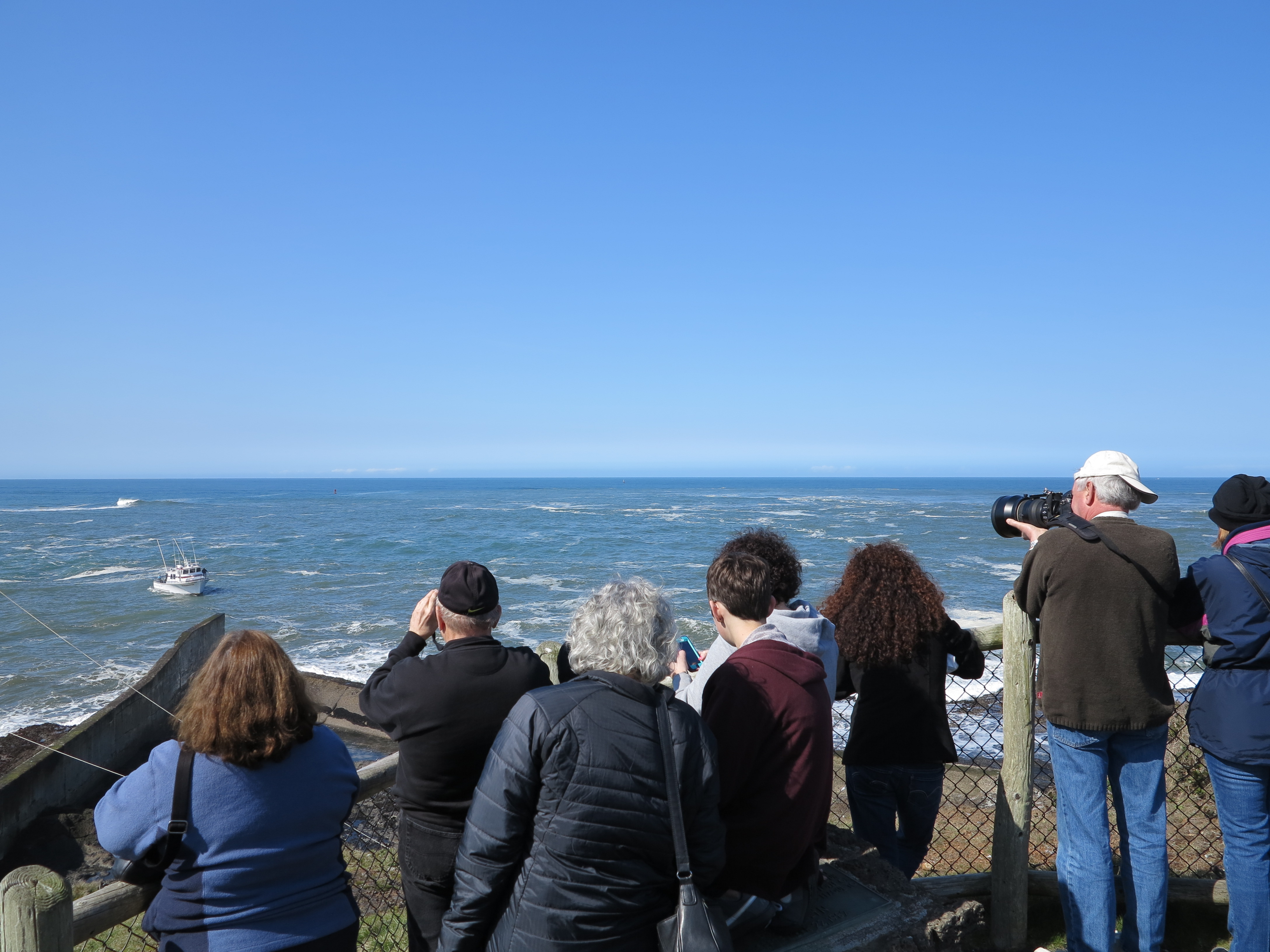


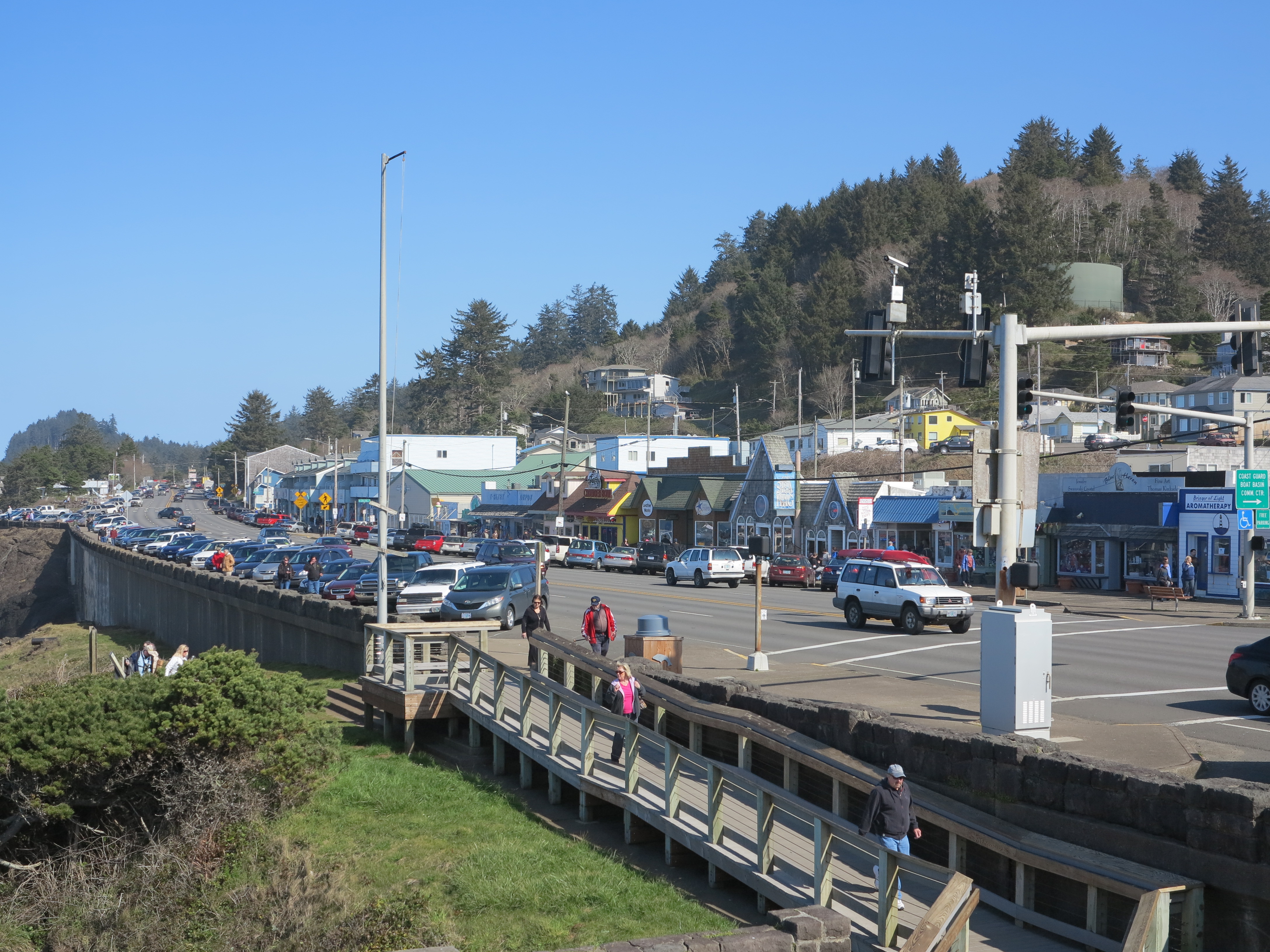

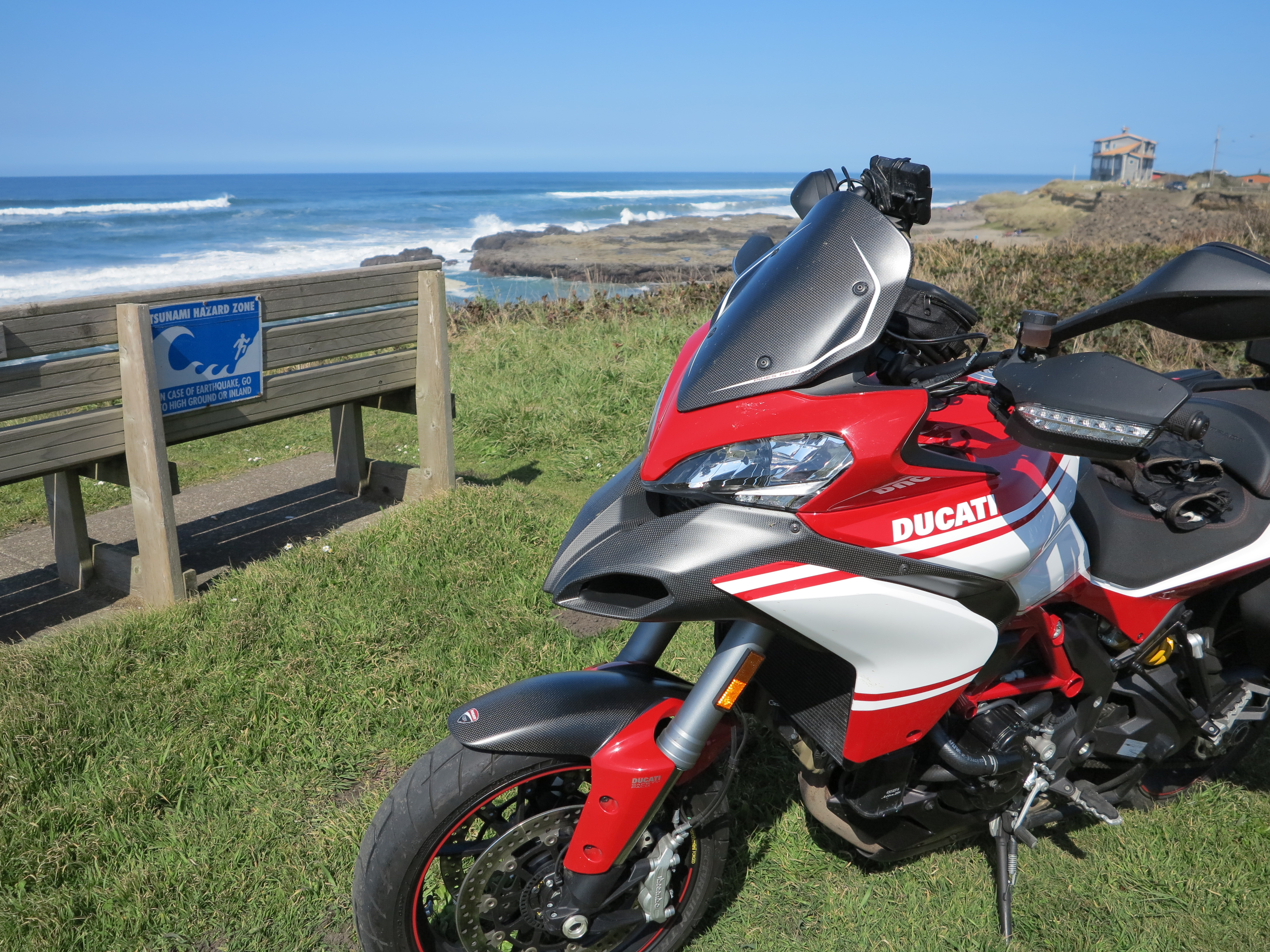
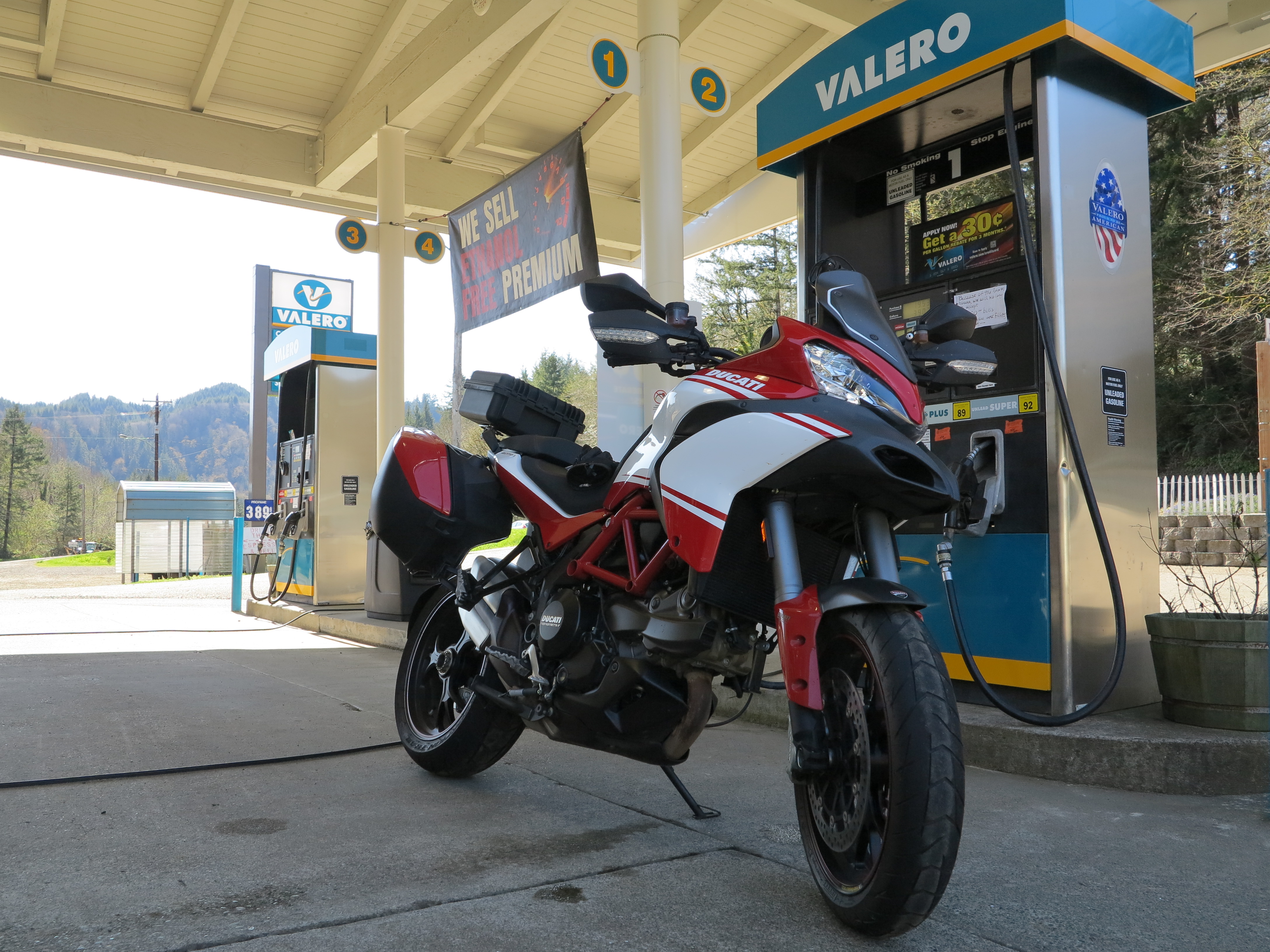




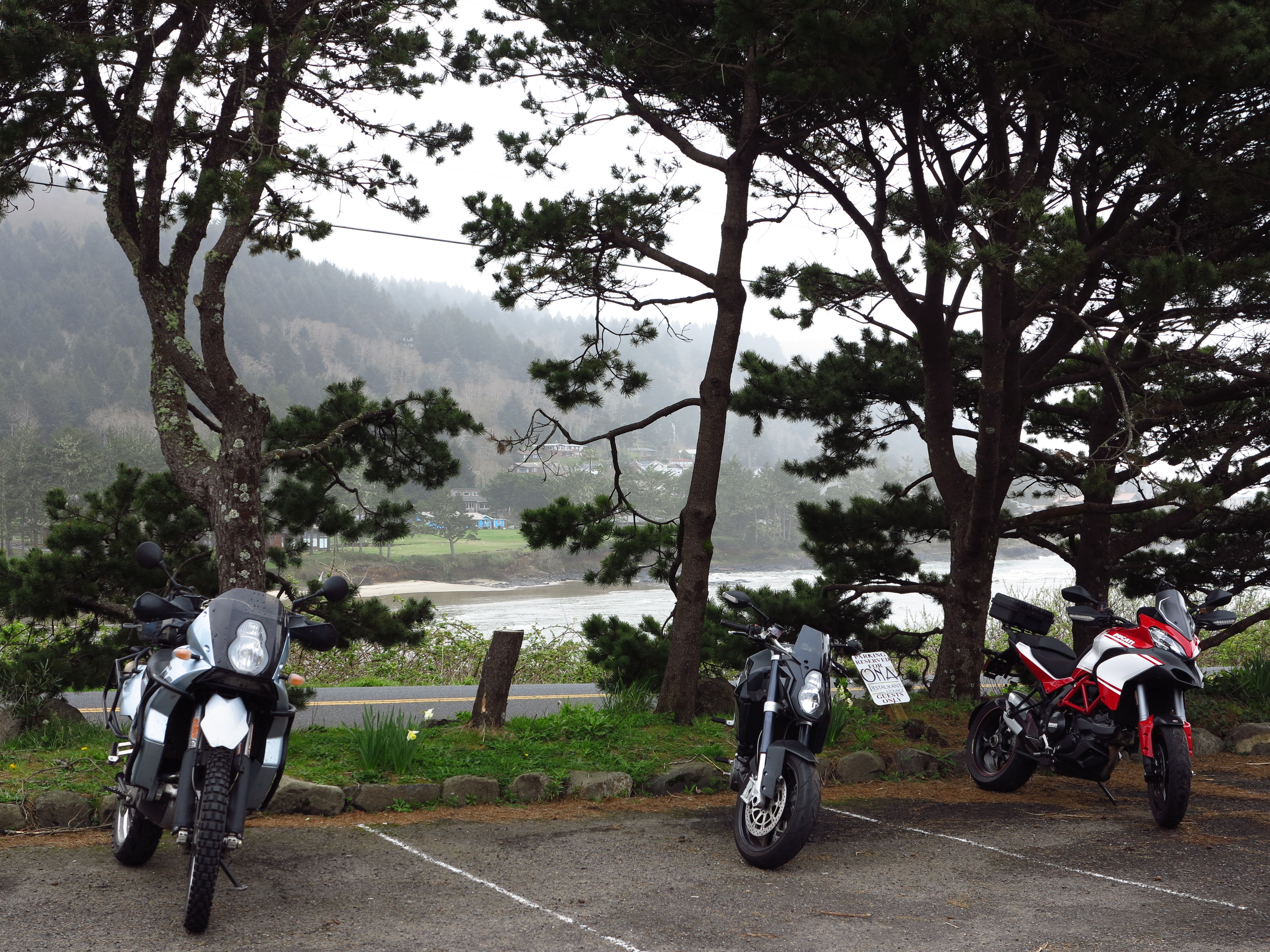

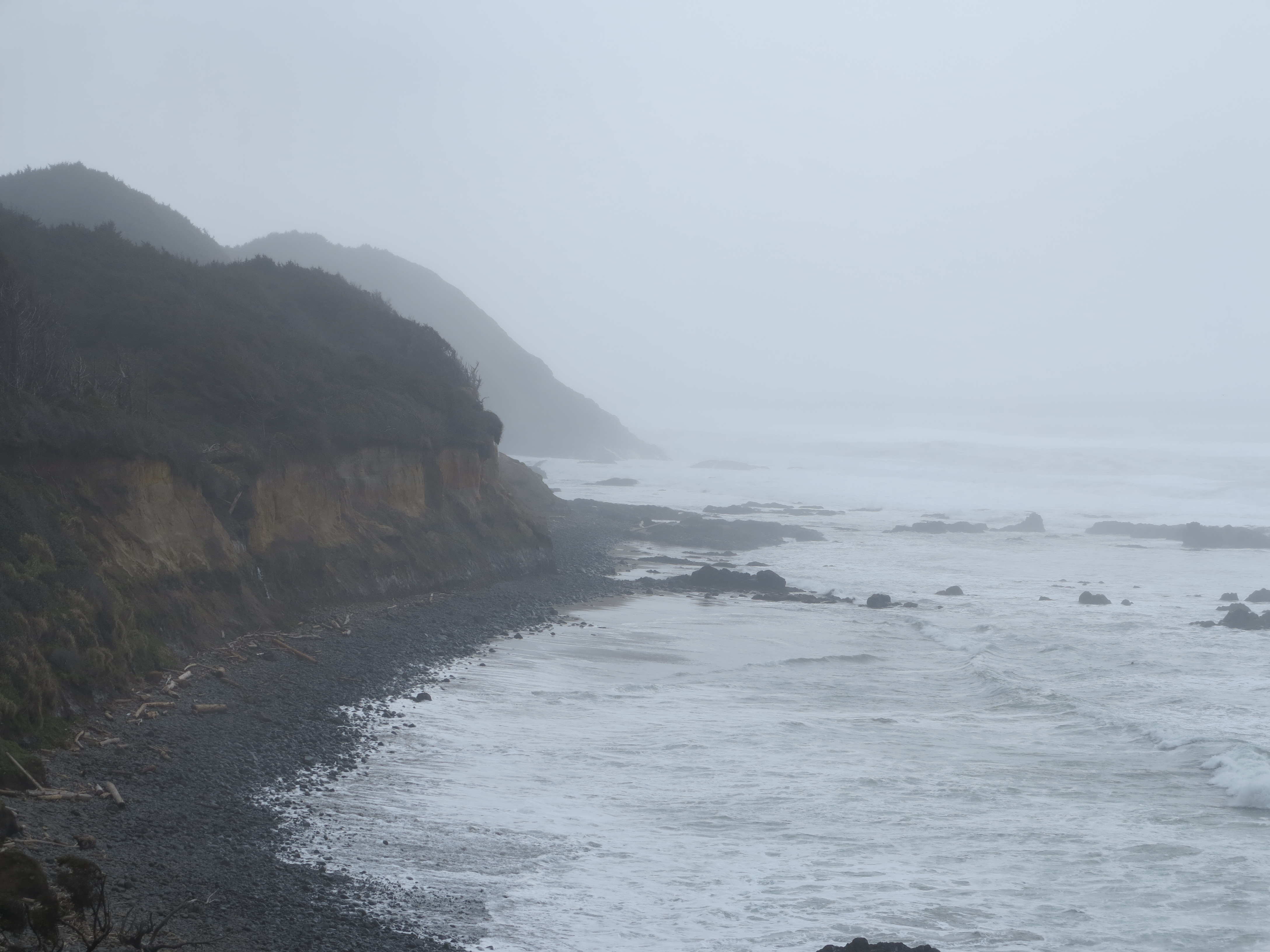
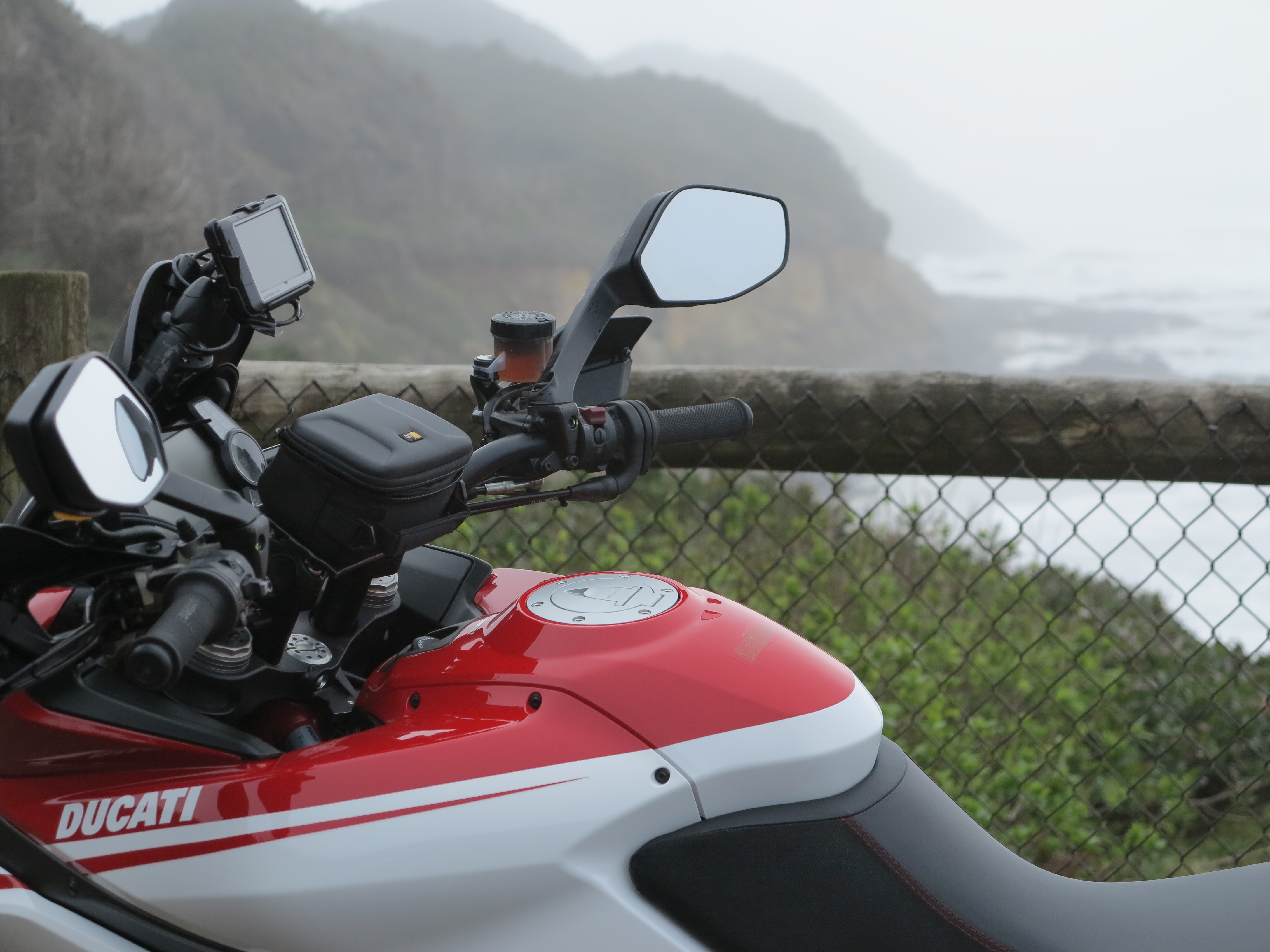
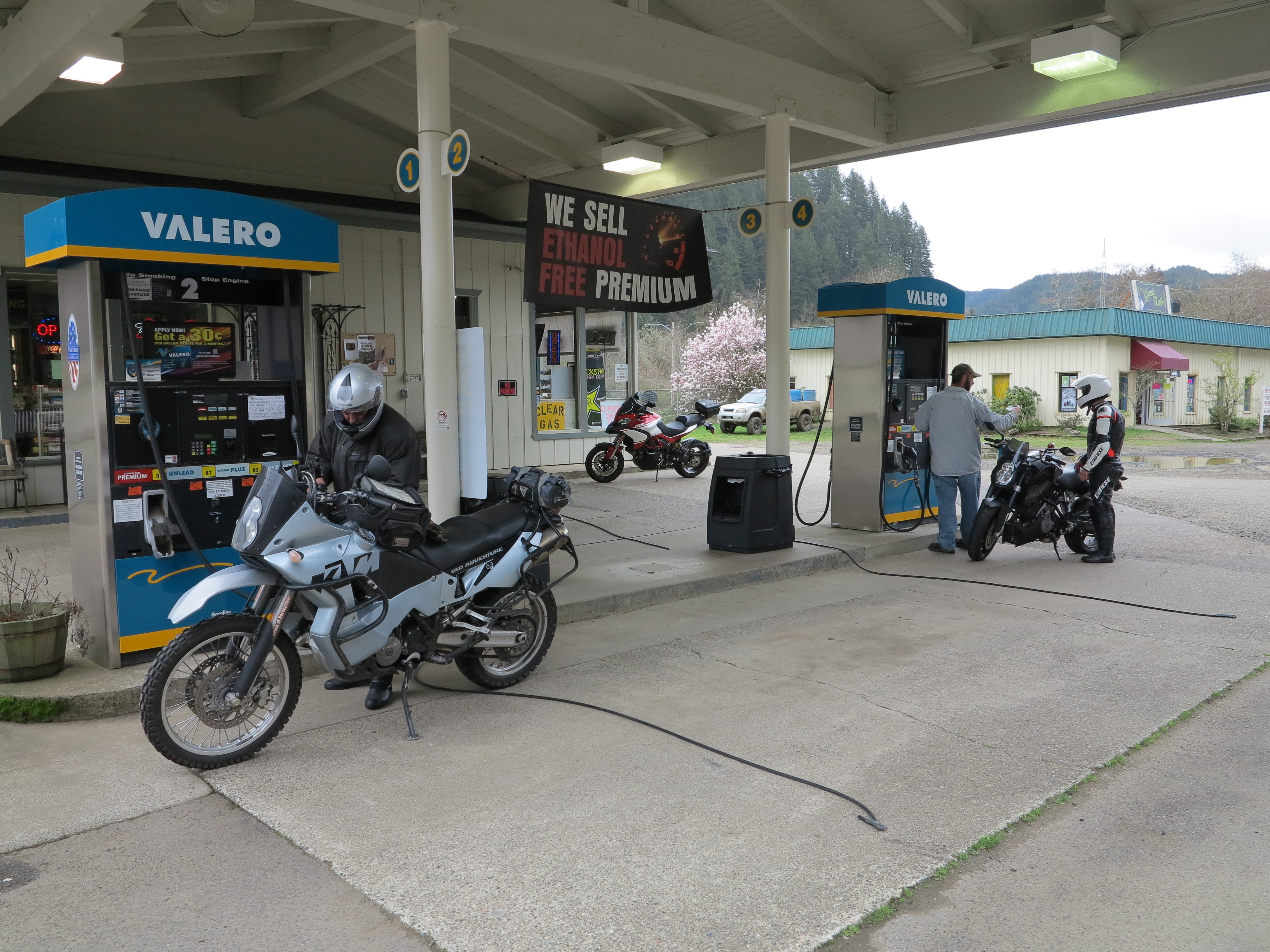


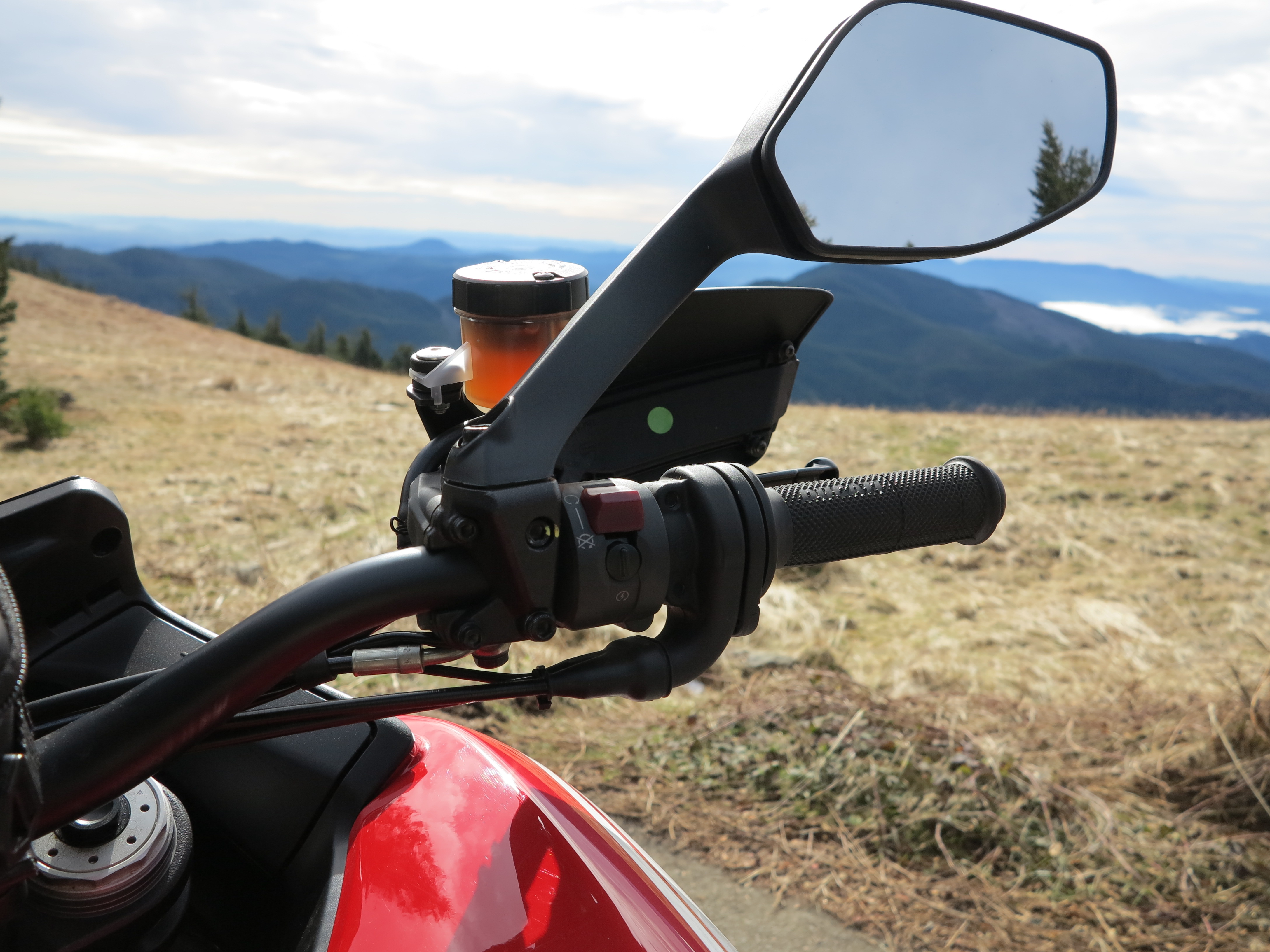

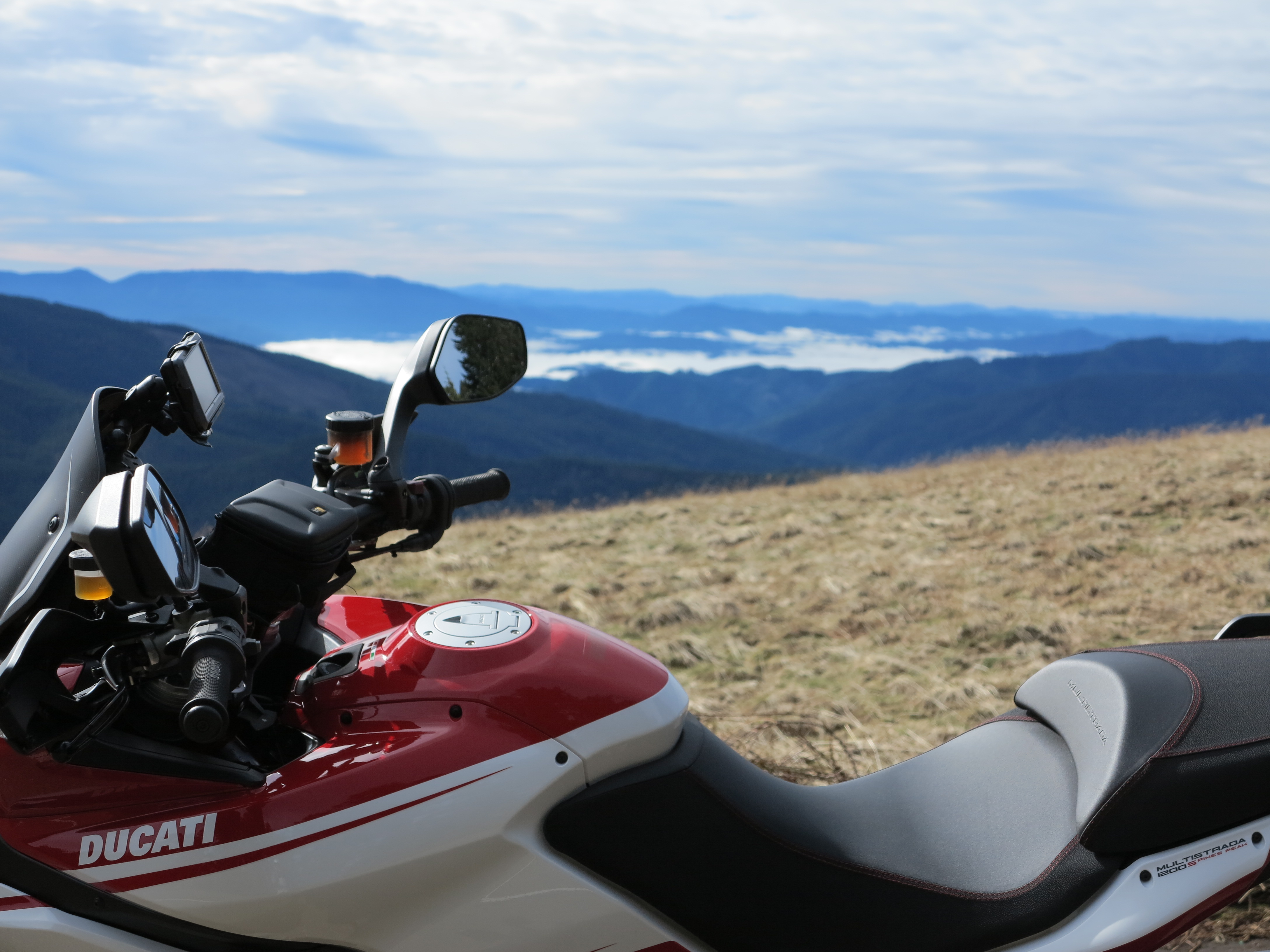
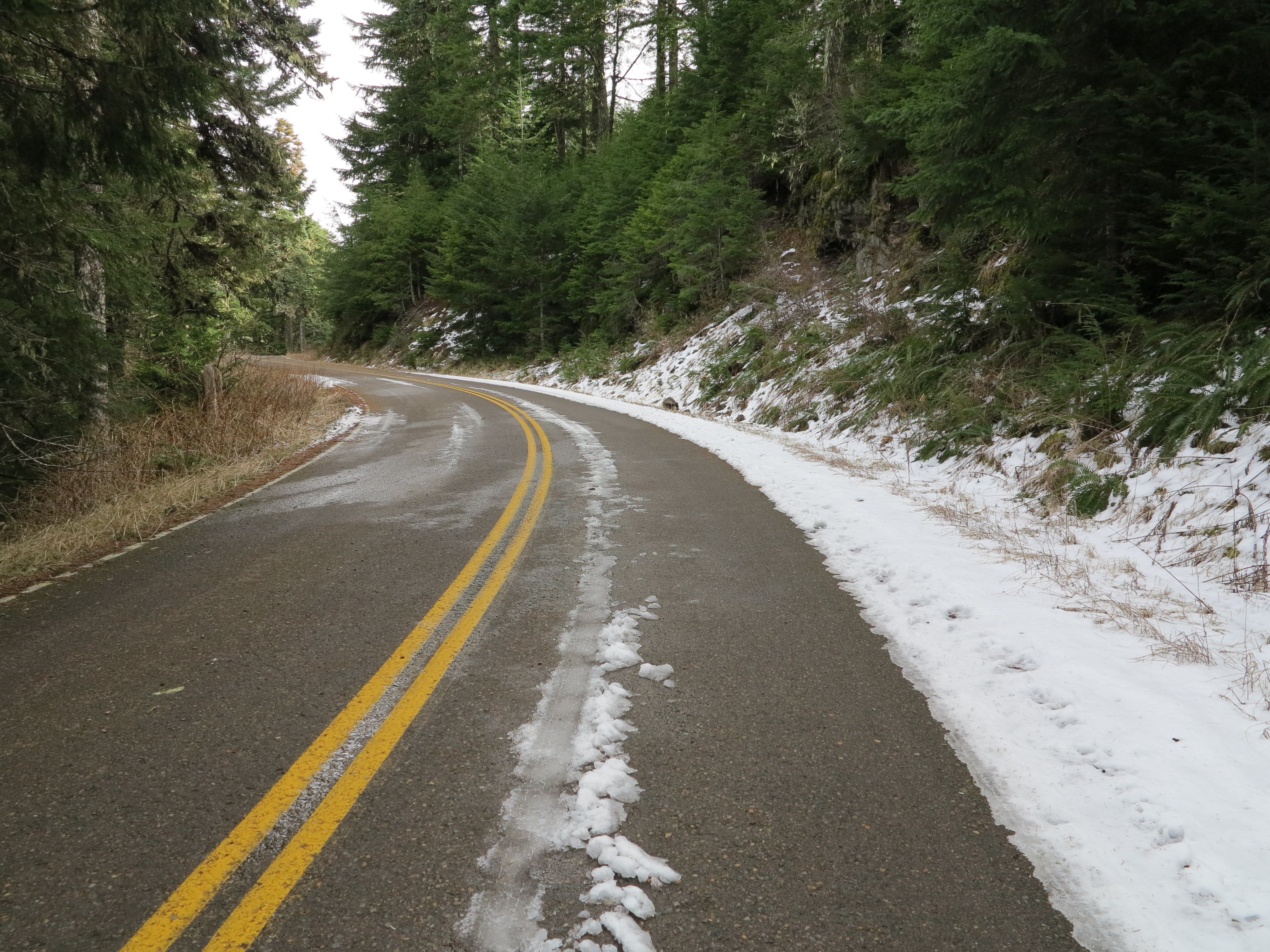




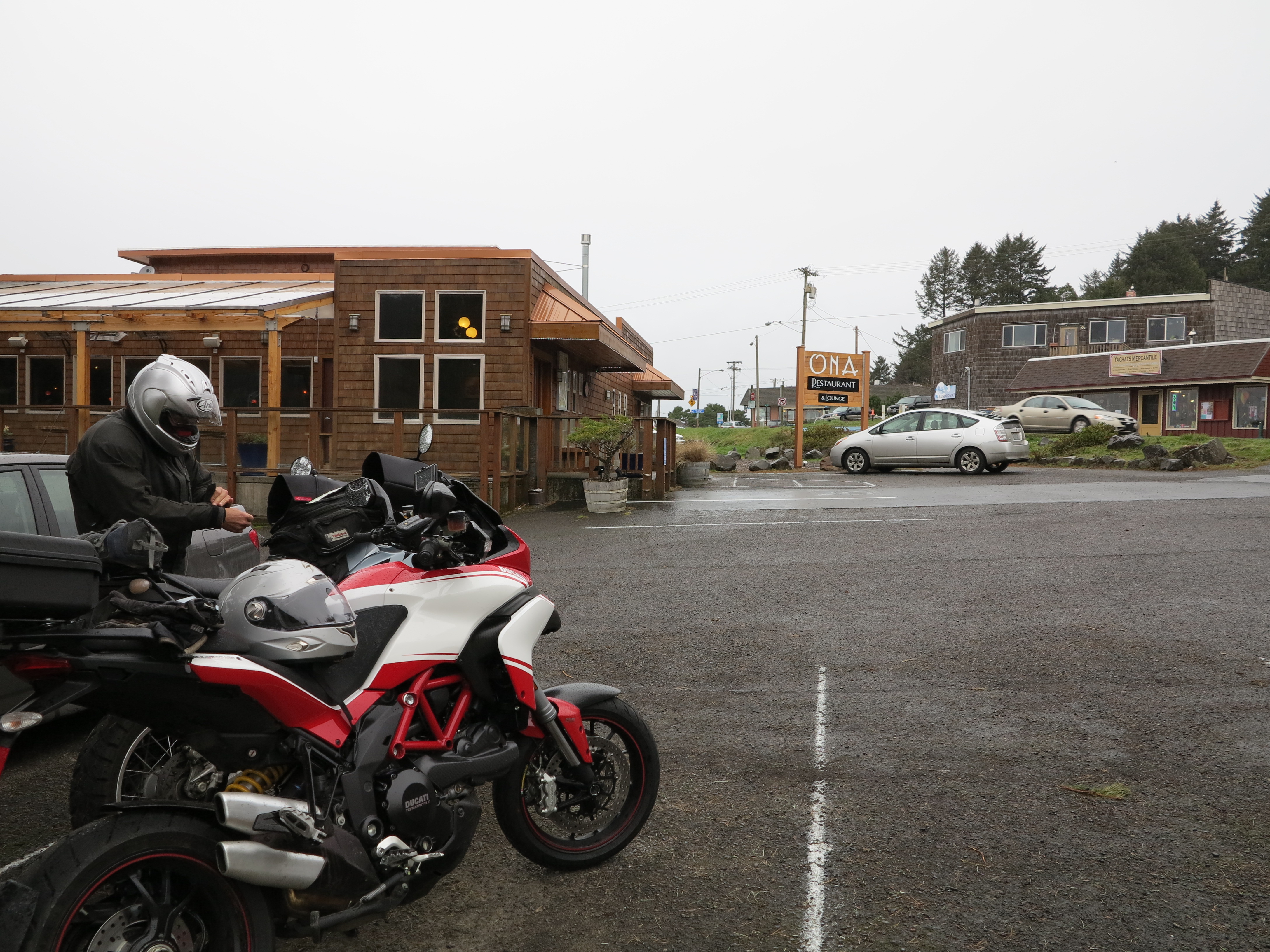
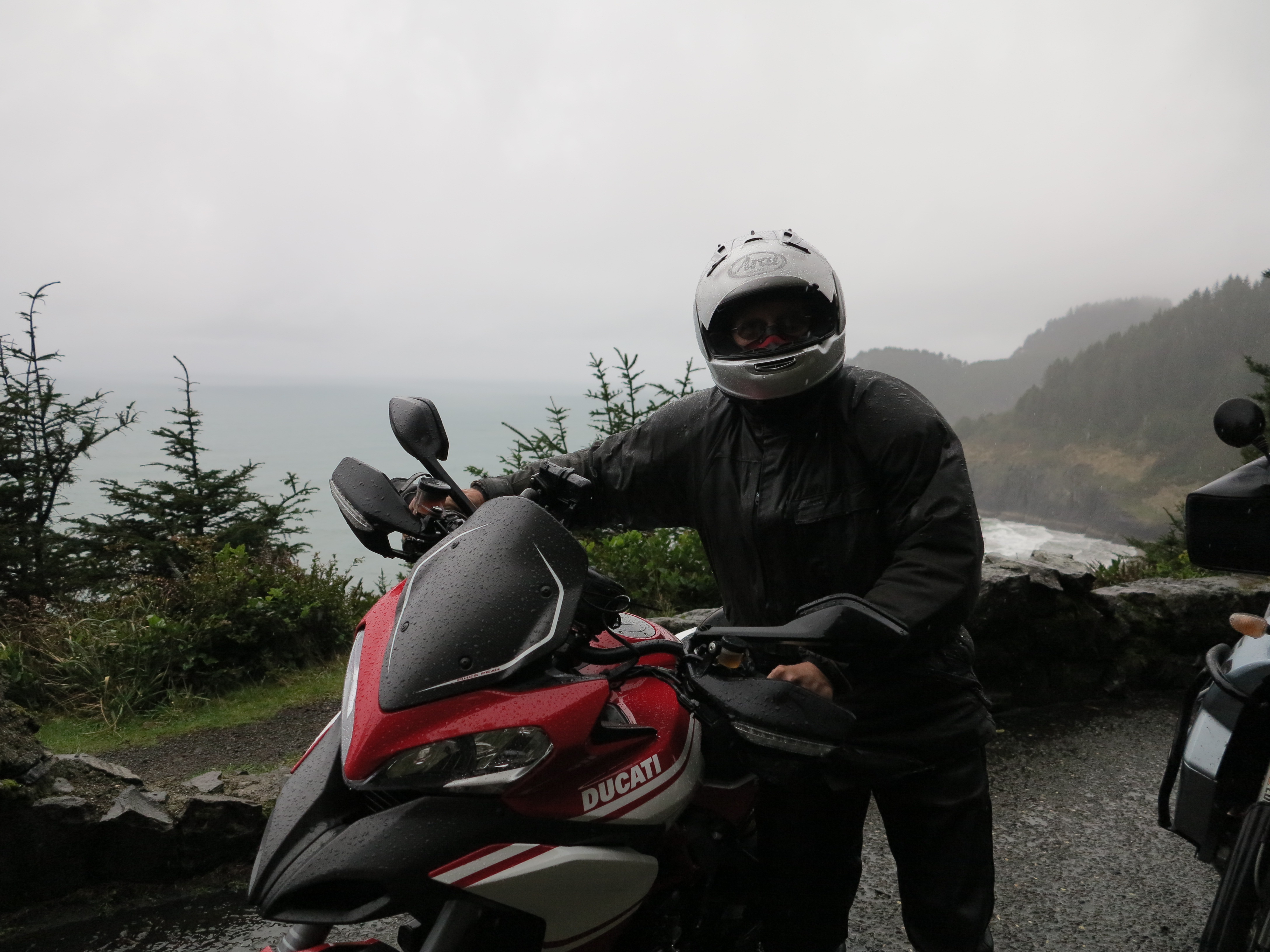
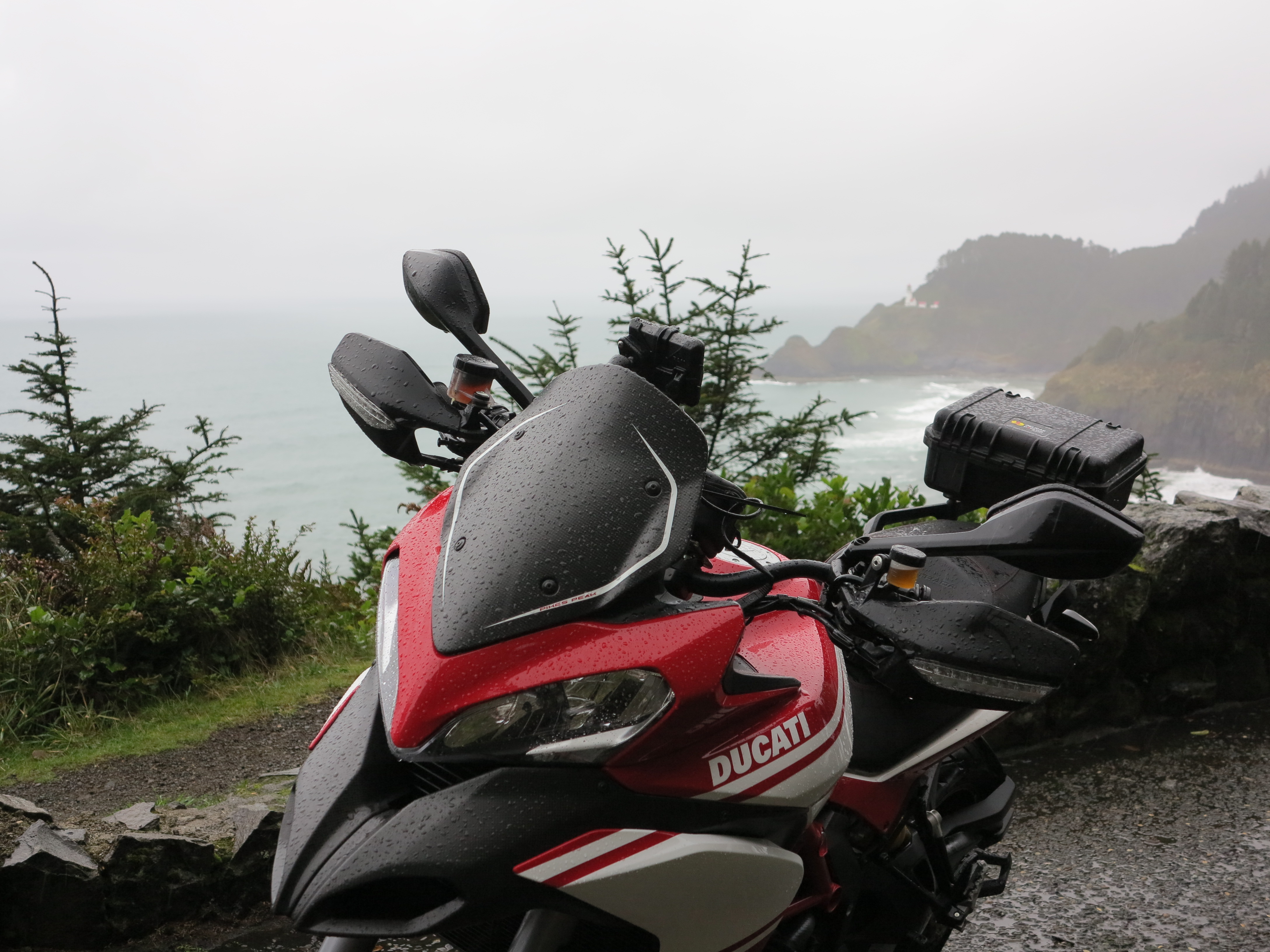
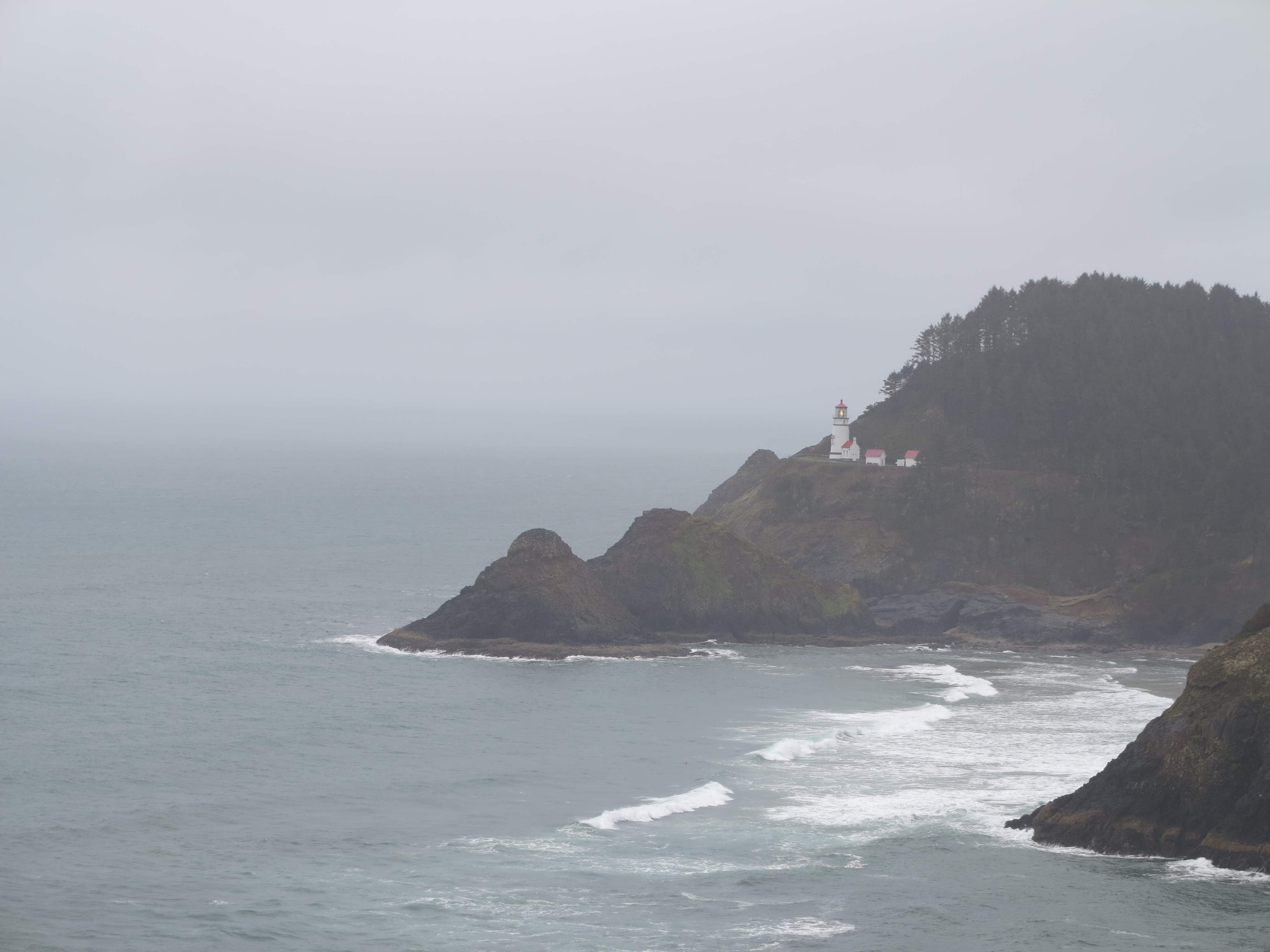
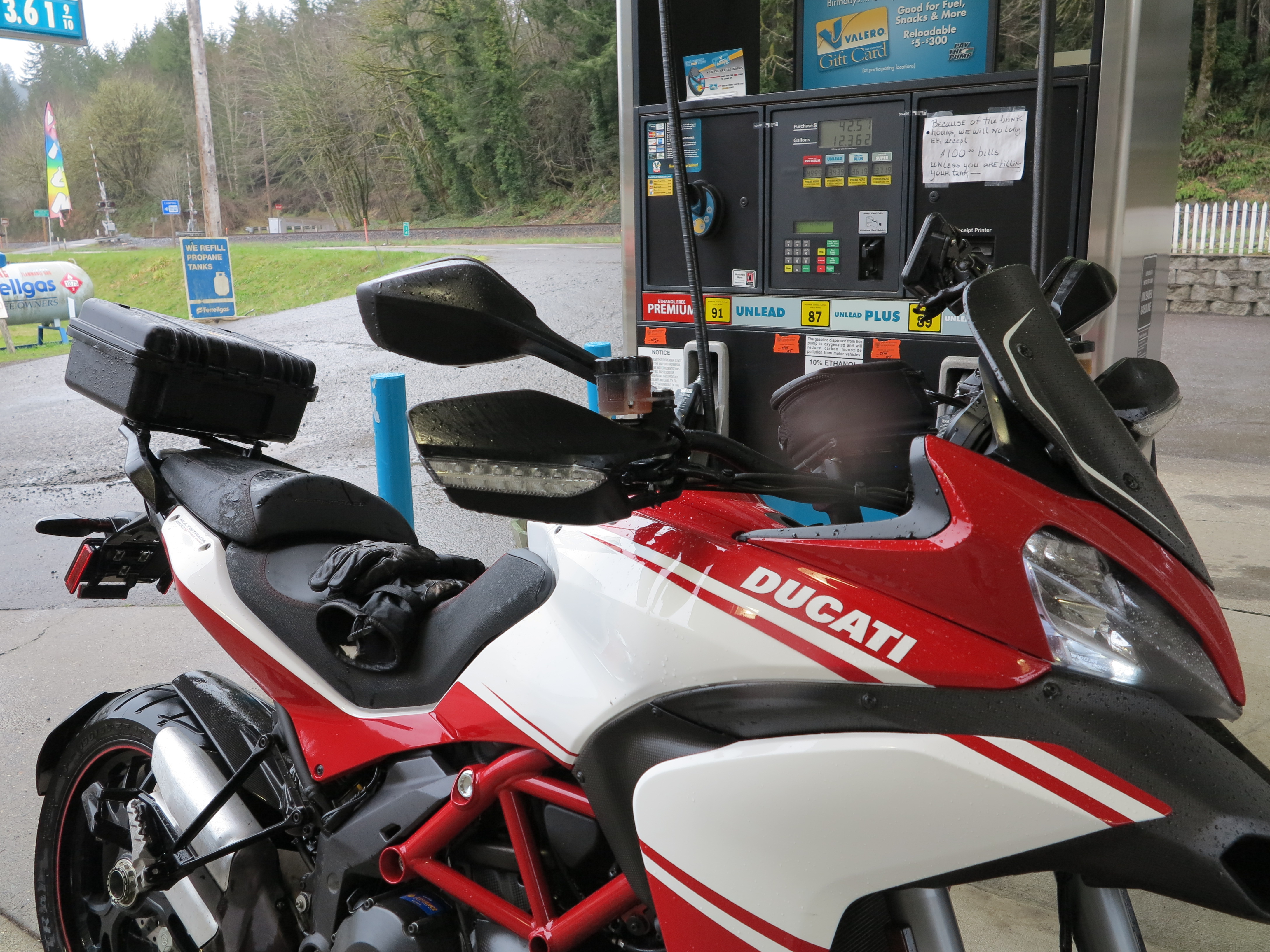

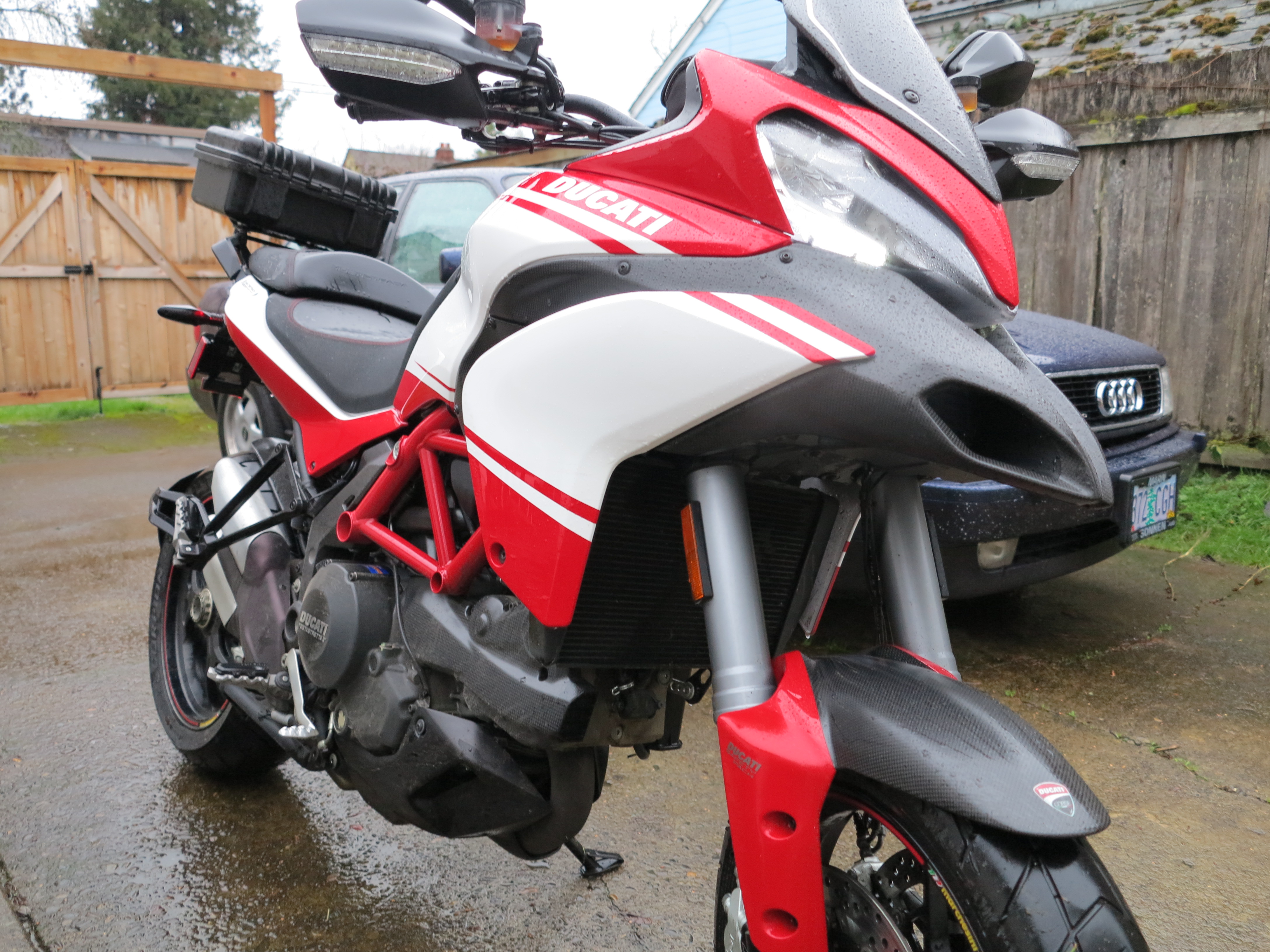
 I'd rather be riding...
